


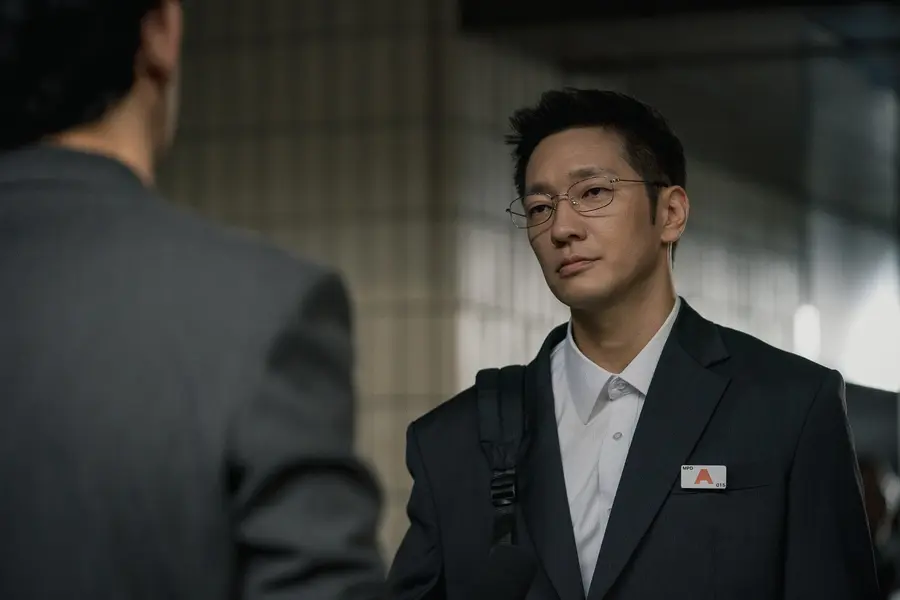
His fifth time playing a detective, his fourth collaboration with director Han Jun-hee. With so many ingredients that could invite a sense of déjà vu, how does he manage to deliver a character this fresh and new? Kim Seok, played by Son Suk-ku, departs both from the Son Suk-ku we know and from the familiar detective archetype in genre dramas. He dials back the animalistic energy of his previous roles, restraining even the movements of his neck and shoulders. With an old-fashioned Seoul accent and meticulously delivered Japanese dialogue, he creates “a human being struggling not to become a monster in order to catch one.”
The Netflix series 〈The Blue Road〉, released Friday, November 20, follows two detectives pursuing corpses with contorted limbs, mysterious messages and a recurring string of horrific murders across national borders. In 〈The Blue Road〉, Son plays Kim Seok, an inspector in the Seoul Metropolitan Police Agency's Mobile Investigation Unit whose cool judgment and drive to act without hesitation on his instincts make him more relentless than anyone in pursuing a series of cross-border murders committed through bizarre methods. Outwardly, Kim Seok works through the case with composure and stubborn determination, but along the way he struggles as he confronts his own limitations and searches for his own way to overcome them.
How did Son Suk-ku portray this multifaceted Kim Seok, who carries society's tragedies beneath a surface held as firm as rock? We met Son on the afternoon of November 25 at a location in Seoul's Jongno District to ask about making 〈The Blue Road〉 and his journey as an actor.

We've heard you look up reactions to your work. 〈The Blue Road〉 has been getting a very positive response overseas, too. Have any reactions to 〈The Blue Road〉 stayed with you?
Honestly, though, I don't really know. I don't know where to look, so I checked a few places and read things the director sent me when he came across an interesting post. This time, actor friends also reached out to me personally. A lot of directors I know called me this time, too. I'm curious about what the public thinks, but what I appreciated most this time was hearing so many kind words from friends I work with in the same industry. They have a different perspective, after all, so sometimes their comments really mean something to me, and there's a lot to learn from them. This time, especially, a lot of people in the same line of work had good things to say. I wondered whether they took the time to reach out because, whatever else you might say about it, our show attempts things you don't often see within the established framework.
We heard Han Jun-hee offered you a role in 〈The Blue Road〉 before there was even a script, and you readily accepted on the spot. What drew you to Han enough to commit without reading a script?
First of all, Han Jun-hee has a very strong sense of responsibility, and he isn't someone who chooses a project lightly. Usually, before I join a project, I need to do some vetting of who is making it and who wrote it. But I consider that vetting done at the director's level, so I get on board. Han is younger than I am, but right now, however you look at it, he's making some of the most varied attempts and working as actively as anyone in South Korea. Watching him, I learn things, too: “Ah, that's the mindset and attitude he's bringing to shouldering this burden.”
〈The Blue Road〉 covers an extraordinarily broad sweep of our modern and contemporary history. It has Han Jun-hee's style woven into it while also trying something new. What was your impression when you first received the script? Did you have any concerns?
It's based on an existing work, but it's also deeply infused with the director's interpretation. His projects are always different, but he persistently digs into one theme. He likes stories about marginalized people throwing eggs at a rock, so that theme was there again this time. I got the impression that, as he gets older and makes more work, he's approaching that theme more profoundly, in greater depth. So nothing threw me off. It was what I'd expected. He didn't let those expectations down, and I thought, “Once again, he's stuck to his guns without worrying about what anyone else thinks.”
Have you read the comic on which 〈The Blue Road〉 is based? How did you feel Han Jun-hee's 〈The Blue Road〉 differed from the original?
Of course. I've liked Kwon Ga-ya's work for a long time. As someone who studied art, I see his drawings as the work of a master. I'd read things like 「A Man's Story」 and 「Namhansanseong」 long ago, but this was a work I hadn't known about. The biggest theme woven into the original was that “the events happening in the present are one enormous event that has continued from the past.” The biggest change in adapting it into our drama was putting all the tragedy passed down through that long history inside one person's body. So I thought portraying that person ultimately meant portraying those histories, and that expressing one person was also expressing the history that came before. I think that may be the biggest change from the original. I hope viewers see Kim Seok as a courageous person who ultimately manages to overcome the fear he carries.
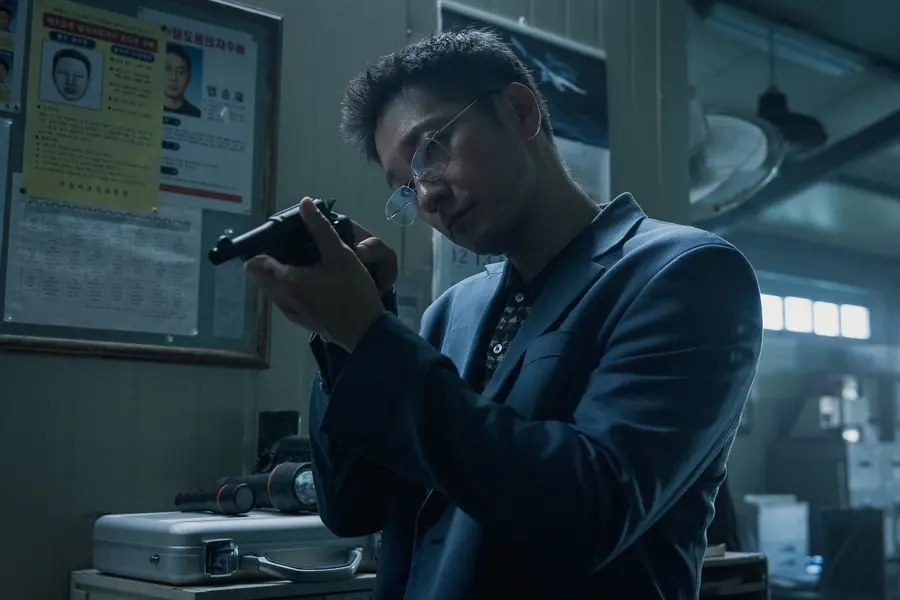
Kim Seok carries the story throughout all eight episodes. He's somewhat at odds with the intense roles you've played before. That must have given you plenty to think about as an actor.
I've never played a role this big. In terms of the usual division between leading and supporting roles, I've often deliberately chosen characters who could spice up a story and show a distinctive appeal. But a character who anchors a story actually has to let go of his ego to that same degree. Still, if you just keep things anchored in a way that's too dry, it won't be interesting. And if you give a more heightened performance, as you might in a role where you appear in one or two scenes out of 10, make an impact and leave, it'll quickly become exhausting. I got to practice finding that balance.
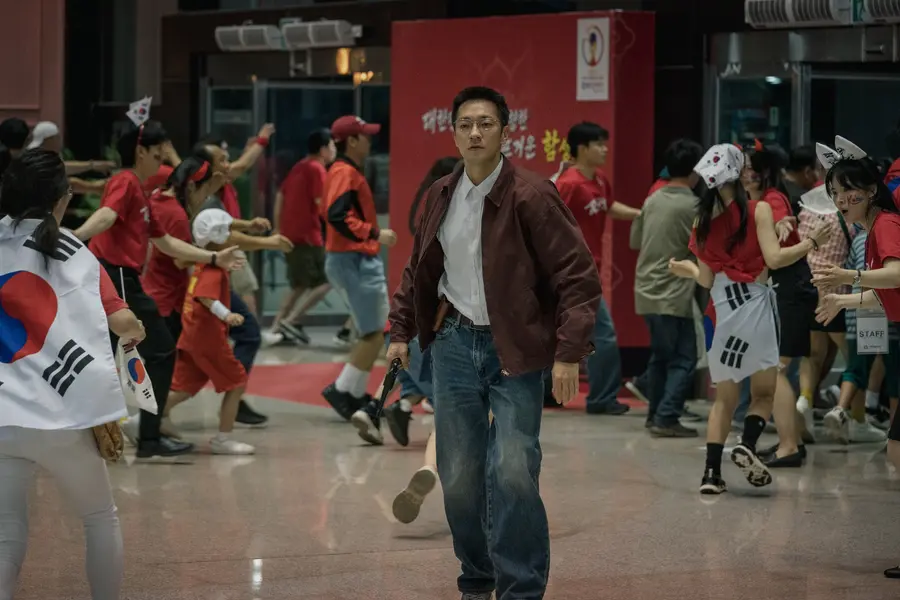
So much detail went into this role, from the character himself to his appearance, that it must have felt fresh to viewers and fans alike. His way of speaking, reminiscent of announcer Kim Dong-gun, also drew attention. Could you explain the detailed choices you made in shaping this character?
It starts with investigating a case that happened in 2002, but this kind of murder also happened in the '80s, and it goes all the way back to the Japanese invasions of Korea. Before that, too, there's a history of tragedy and innocent suffering. You have to be able to express that through one person. He's a character with a lot of room to suggest hints of that through things like changes in his appearance or the way he speaks. So for me, it was incredibly exciting work. Because those aren't details laid out in the script. There really was a lot I could add beyond the script. What's most exciting for an actor receiving a script is that the larger the mass of ice hidden beneath an iceberg floating in the ocean, the more there is to do. Kim Seok was that kind of character. It's not as though I deliberately forced myself to abandon what people commonly call my acting “mannerisms.” Sometimes that leads actors to overreach. I especially believe that, in popular art, you need to change in a way that almost feels unchanged so audiences can take it in comfortably without getting indigestion. With the way he speaks, for example, a lot of people seem to say it was a choice made for historical accuracy, but that wasn't it at all. It wasn't as though there were that many people like that in 2002, either. I think you have to look at this as one individual, not as an era. Ultimately, 〈The Blue Road〉 tells the stories of people who don't belong anywhere. I wondered whether someone with no sense of belonging might be all the more likely to use the most precise language, the language that best expresses “I am Korean,” to assert where he belongs. Whether he might have that determination and compulsion. Even if audiences don't consciously connect the dots and think, “He speaks that way to feel a sense of belonging because he doesn't belong anywhere,” I think it's enough if it sparks curiosity: “What happened to him that makes him talk like that?” That's my job as an actor. But when people say, “He did that for historical accuracy,” I do think, “Ah, I can see how it might come across that way.” But that wasn't my intention. I thought that unbending voice and manner of speaking might express this person best. As you said, he's a character with a broad enough scope to give me as much room as possible to try things I hadn't done before. In a way, these were things I could attempt because I encountered this character. When you get down to it, it wasn't simply a matter of saying, “I want to try something different this time.”




댓글 (0)
댓글 작성
댓글을 작성하려면 로그인이 필요합니다.
로그인하기