



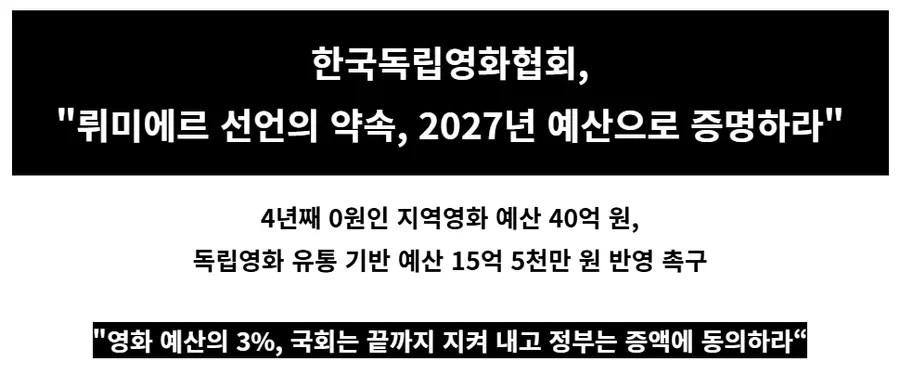
The Association of Korean Independent Film & Video (Chairperson Baek Jae-ho) issued a statement on the 25th calling on the National Assembly and the government to “prove the Lumière Declaration’s promise in the 2027 budget.” With the National Assembly’s Budget and Accounts Committee reviewing the budget, the association called for increases of 4 billion won for regional film programs—which have received no funding for four straight years—and 1.55 billion won to support independent-film distribution. It also called for a dedicated share of Lumière Partnership funding for the overseas distribution of independent films. The association urged the National Assembly to defend the funding through the final stages of budget review and the government to support the increases.
On Sept. 7, the Lumière Declaration on the Future of Film and Audiovisual Media was adopted at the Lumière Summit, co-chaired by the leaders of South Korea and France. President Lee Jae Myung called independent films “the undeniable future of the film industry and a sustained engine of growth” and pledged that South Korea would be a steadfast partner to independent cinema. The Lumière Partnership, in which South Korea and France will each invest 500 million euros, is set to begin in 2027. The association said it welcomed the declaration but that “a promise made before the world must be proven through the budget,” adding that “it is hard to find that promise in the government’s budget proposal.”
The regional film program was a national-government initiative that brought together local film education, screening and festival organizations in networks to sustain film education and screenings for residents and audience groups, while supporting local filmmakers’ development and production work. It began in 2019 in three provinces—Gangwon, Daegu and South Gyeongsang—and by 2023 had expanded to 12 metropolitan regions, with a total of 2.95 billion won invested over five years. By 2022, 44 organizations had carried out 123 projects. In 2022 alone, 21 film education courses for residents were held, and residents made 57 films. There were 91 regional film screenings, attended by 2,295 people. The budget amounted to around 100 million won per metropolitan region annually. The Korean Film Council called the program “the first successful policy model in Korea for a bottom-up regional policy initiative.”
But in 2024, the Yoon Suk Yeol government eliminated the entire 1.23 billion won budget, as allocated in 2023, and funding has remained at zero for four straight years, including in the government’s 2027 proposal. The National Assembly repeatedly called for its restoration during audits of state affairs in 2024, 2025 and 2026, but the requests were not reflected in the budget. At this year’s audit, the Korean Film Council said it “does not have data that it has separately collected or managed” on conditions in regional areas since the program ended.
The effects are already being felt on the ground. Gwangju Film School, effectively the only film school in Jeonnam and Gwangju, where there are no film departments, has operated since 2018. After national funding ended, its budget fell from 38.5 million won to 12 million won, enrollment dropped from 92 to 26, and classes were cut from 77 to 41. Courses in acting, documentary, feature screenwriting, film criticism, import and distribution, and youth filmmaking workshops all closed, leaving only a basic short-film production course. It is now scraping by with some of the budget for the independent-film theater supported by Gwangju City.
Daegu is facing a similar situation. From 2019 to 2024, Daegu Film School graduated 72 students. Of them, 57% work in film and video, and 52.7% are active in Daegu and North Gyeongsang. But after national funding ended, local-government funding for regional film in Daegu fell to zero. Daegu Film School’s budget was cut from 45 million won to 20 million won, and support for film-culture communities fell from 12 groups to four. Daejeon’s city-funding match became precarious, Incheon effectively abolished practical film training, and feature-film development support in Daegu and North Jeolla disappeared. Regional arts and culture programs exclude film on the grounds that it falls under the Korean Film Council’s jurisdiction, but the council’s regional film budget is zero. Regional film has been left in a funding blind spot, supported nowhere.
Distribution for independent films also remains stuck at the level set by the 2024 cuts. In the government’s 2027 proposal, production support for independent and art films rises 45.7% from 2024 to 10.196 billion won. But operating support for dedicated theaters (3.03 billion won) and release support (1.482 billion won) are frozen. The budget for the Independent Film Distribution Support Center fell 18.4%, from 1.241 billion won in 2023 to 1.013 billion won. At a National Assembly audit, the Korean Film Council acknowledged that “priority was given to expanding production support, so the relative share for distribution, screening and audience support fell.” It identified “at least 10%, or around 10 billion won” as an appropriate level. But the 2027 government proposal provides 7.98 billion won, just 4.9% of the Film Development Fund. The association said, “Even if production increases, if the foundations for screenings and audience development stay the same, more films will simply have to compete for the same narrow door.”
Existing distribution infrastructure is delivering results, but its budget is frozen. Of the 101 independent films participating in the Distribution Support Center’s distribution-matching program, 74 signed distribution contracts and 49 were released in theaters. This year, support for community screenings reached its limit early, after 159 screenings. The public online theater had 63,756 members by the first half of this year, up 29.2% in a year, while visits increased 79.3%. But with operating costs frozen, server outages recur every year. A library-content call for submissions drew 1,070 films, but only 90 were selected. The integrated ticketing service for dedicated theaters ended in 2023. The Korean Film Council designed an integrated distribution platform through two research projects, but its construction budget is zero.
Theaters face the same difficulties. Dedicated theaters for independent and art films have no separate facility-improvement budget, so every won spent repairing an aging projector means less operating support. The number of theaters receiving facility-improvement support fell from six in 2024 to four in 2025 and three in 2026. The Korean Film Council’s review committee also said in 2024 that it could not select some theaters because “the limited scale of support from the Film Development Fund alone is insufficient to achieve the intended goals.” Of the 68 dedicated independent and art-film theaters nationwide, 32 are in Seoul; Ulsan, Sejong, South Jeolla and Jeju have none.
In areas without dedicated theaters, small screening venues are filling the gap. Cinema MM, a cooperative in Mokpo, is a 30-seat independent cinema, the first established to screen independent films regularly in Jeonnam and Gwangju. It holds post-screening discussions, offers film education for residents and screens regional films, with free admission for young people and people with disabilities. But it is excluded from most support because it is classified as a “non-permanent” screening venue, operating fewer than 120 days a year. At a September meeting with young independent filmmakers hosted by the Democratic Party of Korea, Cinema MM said it faced “the contradiction of having to close the theater and go work elsewhere in order to keep the independent cinema open.”
The path overseas is even narrower. The 2027 government proposal allocates 4.499 billion won for overseas promotion, focused on international sales, showcases, overseas screenings hosted by the Korean Film Council and screenings at overseas diplomatic missions. It includes no programs to support international exchanges among independent screening organizations or local theatrical releases overseas. Through exchanges between the Korean Association of Art Theaters and the Japan Community Cinema Center, among others, at least 13 Korean independent films have opened or are scheduled to open in Japan this year, but the private sector has borne all the costs. France has around 1,300 art-house theaters, and Unifrance serves as a public-sector hub supporting the overseas promotion and distribution of French films. The association said independent films, too, should have a place on the “strong stepping stone for local content to reach the global stage” envisioned by the president. For that to happen, the Lumière Partnership must go beyond co-investment and co-production to support screening exchanges between South Korea and France and local releases in both countries.
The association stressed that “independent films are both recipients of public support and creators of public value.” Independent films have documented the lives of workers and young people, women and minorities, people with disabilities and immigrants, and people in regional communities—voices not chosen by box-office criteria. In doing so, they have broadened public discourse in a democratic society and sustained cultural diversity, while discovering new creators and cinematic languages and nurturing the next generation of Korean cinema, the association said. “Support for independent films is not preferential treatment but public investment. Making films funded by taxpayers available to people wherever they live—that is what distribution funding is for,” it said.
The association is seeking 4 billion won for regional film programs: 2 billion won to support regional film culture and 2 billion won for development and production by regional filmmakers. It also said the bottom-up structure, in which multiple regional film organizations plan initiatives together, should be restored. The 1.55 billion won requested for independent-film distribution infrastructure is divided among five items: 500 million won for operations at the Distribution Support Center; 100 million won for an English-language information page on independent films for international festivals and distributors; 200 million won to stabilize the public online theater; 150 million won for an information strategy plan (ISP) for an integrated distribution platform; and 600 million won for facility improvements at dedicated theaters.
The association said of the National Assembly, “The combined 5.55 billion won for the two budgets is just 3% of the 172.6 billion won allocated to film in 2027, but it is funding essential to the survival of regional and independent film.” It added: “The National Assembly must do more than call for an increase; it must ensure all the way through that the funding makes it into the final budget and leads to actual programs.” Of the government, it noted that “the culture minister has said the government has a public responsibility to support distribution infrastructure, and the Korean Film Council has also recognized the need to restore regional film funding and expand distribution support.” It called on the Ministry of Economy and Finance and the Ministry of Culture, Sports and Tourism to “responsibly support the increases sought by the National Assembly.”
Baek Jae-ho, chairperson of the Association of Korean Independent Film & Video, said, “The president promised before the world that he would be a steadfast partner to independent cinema, and the first test of that promise is the 2027 budget.” He added, “Fifty-five billion won is just 3% of the total film budget, but for young people learning filmmaking in regional communities, small neighborhood theaters and audiences waiting for those films, it is practically everything. I hope the National Assembly will protect this modest budget through the end.”
[Attachment]
Prove the Lumière Declaration’s Promise in the 2027 Budget
We urge the inclusion of funding for regional film and independent-film distribution
On Sept. 7, the Lumière Declaration on the Future of Film and Audiovisual Media was adopted at the Lumière Summit, co-chaired by the leaders of South Korea and France. The declaration established the diversity of works and creative freedom as principles for the future of film. President Lee Jae Myung called independent films “the undeniable future of the film industry and a sustained engine of growth” and pledged that South Korea would be a steadfast partner to independent cinema.
We welcome this declaration. But a promise made before the world must be proven through the budget. The first year’s budget is now under review in the National Assembly, as the Lumière Partnership—in which South Korea and France will each invest 500 million euros—is set to begin in 2027. Yet it is hard to find that promise in the government’s budget proposal. The distribution infrastructure that brings independent films to audiences remains stuck at the level set by the 2024 cuts, while regional film funding, eliminated in full by the Yoon Suk Yeol government that same year, has been at zero for four straight years.
Regional film refers to all the activities outside Seoul-centered film industry structures through which local creators and organizations learn about and make films, and watch them with residents. Regional film funding was national funding that enabled networks of local film organizations to sustain film education and screenings for residents, build audience groups, and support development and production by regional filmmakers. From 2019 through 2022, 44 organizations across 12 metropolitan regions carried out 123 projects. The budget was less than 100 million won per metropolitan region annually. The Korean Film Council called the program “the first successful policy model in Korea for a bottom-up regional policy initiative.”
When this funding disappeared without a review of its results, the regional infrastructure began to crumble. Matching funds from local governments were cut or put at risk, and film schools where residents could learn filmmaking in areas without film departments were sharply scaled back. Regional arts and culture programs excluded film on the grounds that it falls under the Korean Film Council’s jurisdiction, but the council’s regional film budget is zero. A government that speaks of balanced development must first protect regional culture.
Independent-film distribution faces the same problem. Support for releases and the operation of dedicated theaters has been frozen, while the Distribution Support Center’s budget is down 18.4% from 2023. The Korean Film Council identified “at least 10%, or around 10 billion won” as the appropriate level for distribution, screenings and audience support, but the 2027 government proposal provides just 7.98 billion won, or 4.9% of the Film Development Fund.
The path overseas is even narrower. There are virtually no public programs to support local theatrical releases and screening exchanges for independent films overseas. Independent films, too, should have a place on the “strong stepping stone for local content to reach the global stage” envisioned by the president.
Independent films are both recipients of public support and creators of public value. They have documented the lives of workers and young people, women and minorities, people with disabilities and immigrants, and people in regional communities—voices not chosen by box-office criteria. They have brought disasters and tragedies, discrimination and inequality before audiences, broadening public discourse in a democratic society and sustaining cultural diversity. They have also drawn citizens into cultural production through film education and community screenings, discovered new creators and cinematic languages, and nurtured the next generation of Korean cinema.
Support for independent films is not preferential treatment; it is public investment that protects values essential to society but unrewarded by the market. That investment is complete only when it reaches the public. Making films funded by taxpayers available to people wherever they live—that is what distribution funding is for.
We therefore urge the National Assembly and the government:
First. Include 4 billion won for regional film programs, which have received no funding for four straight years. This consists of 2 billion won to support regional film culture and 2 billion won for development and production by regional filmmakers. The bottom-up structure, in which multiple regional film organizations plan initiatives together, must also be restored.
First. Increase funding for independent-film distribution infrastructure by 1.55 billion won. Existing infrastructure—including the Distribution Support Center, community screenings, the public online theater, an integrated distribution platform and facility improvements at dedicated theaters—must be made to work properly.
First. Clearly earmark a share of Lumière Partnership funding for overseas distribution of independent films and screening exchanges.
First. The National Assembly must defend this funding through budget review. The combined 5.55 billion won for the two budgets is just 3% of the 172.6 billion won allocated to film in 2027, but it is funding essential to the survival of regional and independent film. The National Assembly must do more than call for an increase; it must ensure all the way through that the funding makes it into the final budget and leads to actual programs.
First. The government must support the increase. The culture minister has said the government has a public responsibility to support distribution infrastructure, and the Korean Film Council has also recognized the need to restore regional film funding and expand distribution support. The Ministry of Economy and Finance and the Ministry of Culture, Sports and Tourism must responsibly support the increases sought by the National Assembly.
The Lumière Declaration is a promise made before the world. Reviving regional film, whose funding was eliminated by the Yoon Suk Yeol government, and ensuring independent films reach audiences across the country and around the world are ways to keep that promise. Film diversity cannot be protected by words in a declaration alone. The National Assembly and the government must prove the Lumière Declaration’s promise in the 2027 budget.
November 25, 2026
The Association of Korean Independent Film & Video




댓글 (0)
댓글 작성
댓글을 작성하려면 로그인이 필요합니다.
로그인하기