


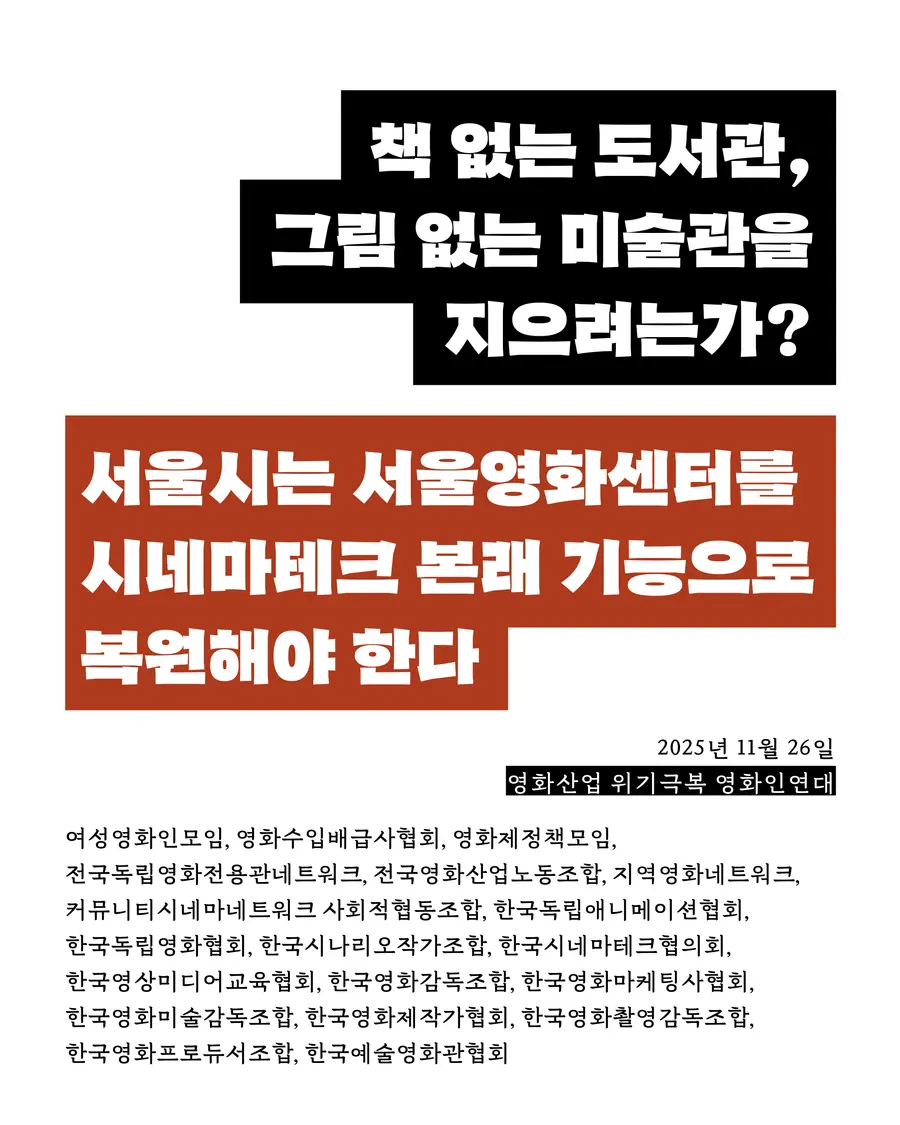
The Film Alliance for Overcoming the Crisis in the Film Industry (hereinafter referred to as the Film Alliance) expresses deep concern over the Seoul City government's push to open the Seoul Film Center (formerly the Seoul Cinematheque) in a way that undermines the core functions of the cinematheque and shakes its identity. This act goes beyond simply breaking promises with the film community; it seriously infringes upon the high-quality cultural rights that Seoul citizens should enjoy.
The recent controversy surrounding the Seoul Film Center is not merely an issue of a single facility. The essence of the matter is that a public cultural facility, into which hundreds of billions of won of taxpayer money has been invested, is on the verge of falling into a state of 'functional deficiency' where it cannot perform its intended role.
As a result of unilaterally changing the consensus structure that Seoul City has built over the past 15 years, the world-class cinematheque that Seoul citizens should enjoy is now in a situation where it will open with only a shell remaining. Currently, Seoul City is attempting to present a 'half-baked cinematheque' to citizens, lacking essential functions such as storage, masking, and research, much like building a library without books or an art museum without paintings.
The Seoul Cinematheque project was a long-standing cultural aspiration for citizens that had been raised long before its officialization in 2010. The cinematheque, independent film theaters, and video media centers have expanded the base of film culture through the screening and archiving of classic art films from both domestic and international sources, as well as independent film screenings and education. However, due to an unstable rental structure, there have always been limitations in providing citizens with a continuous and stable viewing environment. Therefore, the construction of the Seoul Cinematheque was not a demand for space from specific filmmakers, but an essential social investment to ensure that citizens can enjoy the best film culture in a stable public space that is not swayed by gentrification.
However, Seoul City has not respected this historical background and the public nature for citizens. It unilaterally disbanded the construction preparation committee, changed the project name from 'Seoul Cinematheque' to 'Seoul Film Center', and is hastily opening the facility without properly equipping it with core functions such as storage, viewing spaces, dedicated screening rooms, and research capabilities. This is a hasty promotion of a public infrastructure built with taxpayer money, ultimately reducing and distorting the cultural benefits that should return to citizens.
Seoul City claims that "film screenings are possible," but this reveals a lack of understanding of the functions of a cinematheque. Even the basic 'masking' facilities of a cinema are excluded, forcing audiences to watch films amidst light pollution from the screen margins. In this state, it is impossible to properly implement vertical subtitles, which are essential for screening art films. This is a 'poor screening environment' that falls far short of international cinematheque standards and reflects an irresponsible attitude towards providing incomplete services to citizens.
Moreover, a cinematheque is not merely a facility for screening films. Collecting and preserving film heritage to pass it on to future generations is the very reason for the existence of a cinematheque and its essential duty. However, the Seoul Film Center does not even have a storage facility, which is the heart of archiving. A facility that cannot preserve the history of film and leave behind a legacy is not a cinematheque. By pushing ahead with the opening without storage, Seoul City is fundamentally abandoning its function as a public record institution and is throwing away the opportunity to have a unique film heritage archive that Seoul citizens can take pride in.
Furthermore, under the guise of 'efficiency', Seoul City is forcibly closing grassroots hubs such as 'Chungmuro Video Media Center Oh! Jaemidong', which has been beloved by citizens. This is akin to cutting off the capillaries of the existing ecosystem to build the large facility known as the Seoul Film Center. Attempting to replace the function of local media centers, which are vital for accessibility, with a single facility in Chungmuro is a typical example of administrative convenience. Seoul City claims that existing projects are redundant, but the two institutions have completely different roles and structures, and the Seoul Film Center has not even presented a concrete plan to replace them.
The crux of the problem is that Seoul City has pursued these policy changes without consulting the opinions of citizens and the film community. The establishment of an operational advisory committee cannot replace the process of public discourse and does not signify the restoration of democratic procedures. Public infrastructure like a cinematheque should be built not for short-term openings but within a long-term public plan and transparent consultation structure.
The Film Alliance for Overcoming the Crisis in the Film Industry demands the following.
First, Seoul City must restore the original purpose of the cinematheque—preservation, viewing, research, and accurate screening environments for domestic and international film heritage. To avoid providing citizens with a mere shell of a facility, it must fully equip itself with basic infrastructure that meets international standards, including storage, viewing spaces, research and educational functions, and dedicated screening rooms.
Second, a public-private consultative body involving the film community and civil society must be immediately restored, and information regarding the entire process of changing the project name and adjusting functions must be transparently disclosed.
Third, policies that justify the reduction or termination of existing public film culture projects under the pretext of the Seoul Film Center must be halted. New facilities should complement and expand the existing ecosystem rather than replace it.
Fourth, the operation of the Seoul Film Center should be reorganized not as a short-term performance-based consignment method but as a long-term public plan based on expertise.
This statement is not intended to limit the choices of organizations or individuals but is a minimal demand to ensure that citizens' precious taxes are used correctly and that citizens' cultural rights are fully protected. The Film Alliance will continue discussions and actions for the normalization of the cinematheque in collaboration with the film community and civil society.











댓글 (0)
댓글 작성
댓글을 작성하려면 로그인이 필요합니다.
로그인하기