



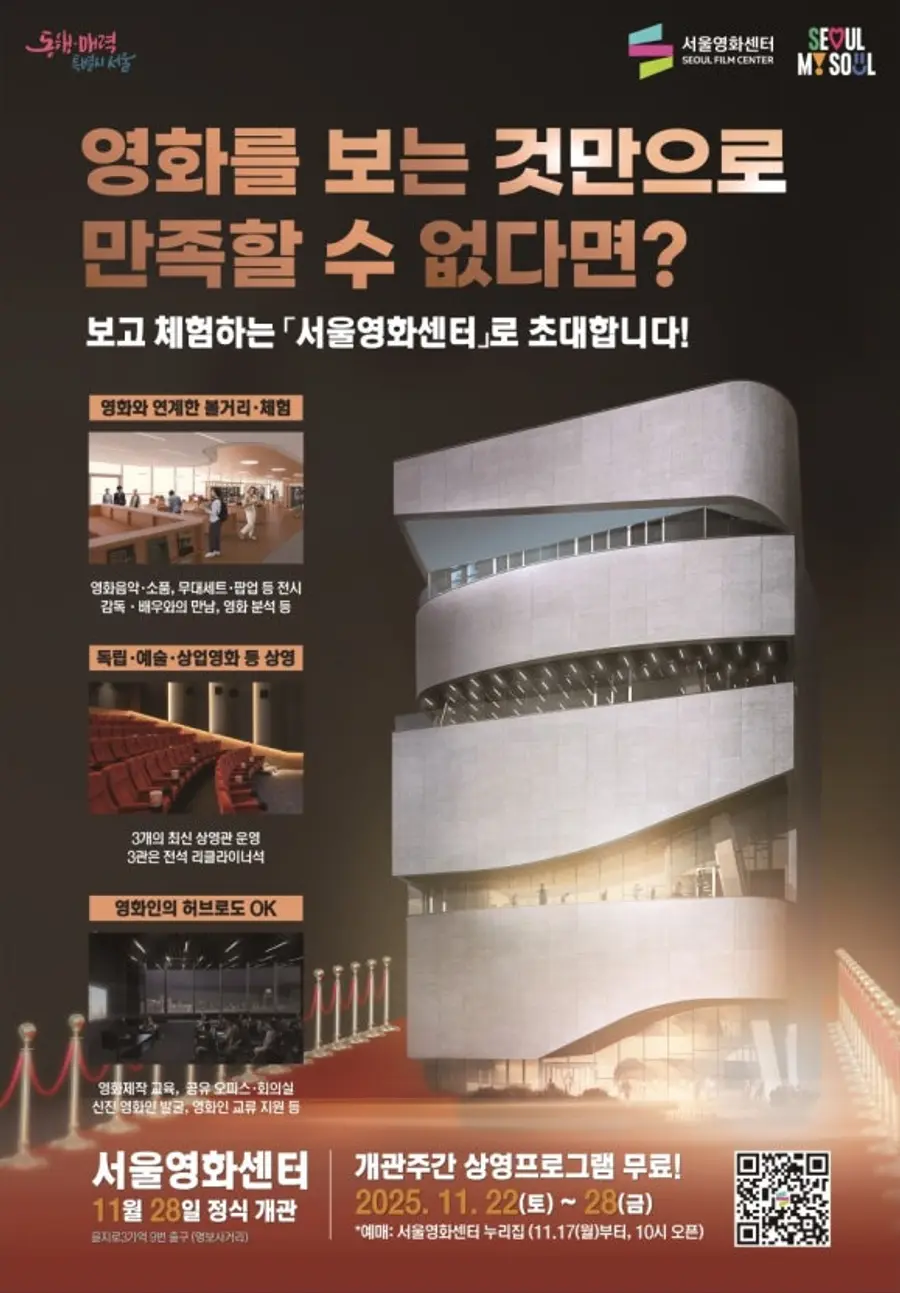
 The Film Alliance (co-representatives Baek Jae-ho and Lee Dong-ha) issued a statement on the 5th, declaring a full boycott of any cooperation with the current operation system of 'Seoul Film Center' and strongly urging the return to the original plan of 'Seoul Cinematheque' and the immediate establishment of a public forum. This action is a response to the unilateral cancellation of the public-private agreement built with the film industry and civil society by the Seoul city government since 2010.
The Film Alliance emphasized that above all, "restoration of the original plan for the Cinematheque" is the top priority. They criticized that in 2023, the Seoul city government unilaterally changed the project name to 'Seoul Film Center' without prior consultation, weakening or eliminating core functions of the Cinematheque such as film archives, public reading rooms, and research and educational spaces. As a result, despite hundreds of billions of won in taxpayer money being invested, it has fallen into a state of "functional deficiency" where it does not serve its purpose as a public cultural facility.
They also pointed out that while the Seoul city government promotes 'average ticket sales rate of 90%' and 'full house' daily, the actual number of viewers and on-site occupancy rates are not transparently disclosed. Furthermore, they criticized that filling the center's empty schedule with free rental events under the pretext of supporting aspiring filmmakers is merely "performance building" rather than actual support.
Revelations about the overall regression of Seoul's film policy followed. The budget for supporting independent film theaters and art film theaters has been continuously cut, and even the citizen-participatory community media projects have been abolished. In particular, after drastically cutting the budgets of film festivals supported by the Seoul city government by nearly 30%, they criticized that it is deceptive administration to transfer the support project to the small-scale Seoul Film Center, which can hardly accommodate even the opening ceremony. This ultimately leads to the collapse of both the foundation for film creation and enjoyment.
In this regard, the Film Alliance clarified that this situation is not about the interests of a specific group of filmmakers but is directly related to the cultural rights of the citizens of Seoul, urging the city government to address three core demands.
- First, immediately present a concrete plan to fully restore the core functions of 'Seoul Cinematheque' (film archives, public reading rooms, dedicated screening rooms, research and educational spaces) that were agreed upon through 15 years of social discussion.
- Second, transparently disclose the current operational structure, budget execution status, and mid- to long-term plans of the Seoul Film Center to the citizens, and clearly outline the decision-making process leading to policy changes.
- Third, immediately fulfill the promise to hold the canceled public forum and establish a structure for open discussions involving filmmakers and citizens. This is not a matter for negotiation but a promise already made by the city government.
The statement included the signatures of 19 major film organizations, including the Korean Film Producers Association, the Korean Film Producers Guild, the Korean Independent Film Association, the Board of the Korean Film Directors Guild, the Korean Cinematheque Association, the Women Filmmakers Association, and the National Film Industry Labor Union. (End)
 [Attachment] Full text of the statement urging the return to the original plan of 'Seoul Cinematheque' and the immediate establishment of a public forum. |
[Statement] The Seoul City Must Fulfill Its Promise to Citizens: Urging the Return to the Original Plan of 'Seoul Cinematheque' and the Immediate Establishment of a Public Forum
The Seoul city government unilaterally broke the public-private agreement built with the film industry and civil society over 15 years, and as of March 2026, has not fulfilled the promised public forum nor the name and function of 'Seoul Cinematheque'. The Film Alliance clearly states that this issue is not about the interests of a specific group of filmmakers, but is directly related to the cultural rights of the citizens of Seoul.
15 Years of Promises and Unilateral Cancellation The project to establish the Seoul Cinematheque has been a public cultural policy pursued in collaboration with the film industry and civil society since 2010. Through a multi-layered public-private consultation structure, including policy discussion meetings, working TFs, international design competitions, and establishment preparation committees, it was promised to create a 'film library for the citizens of Seoul' that preserves classic, heritage, independent, and art films and allows anyone to access and screen them.
However, in 2023, the Seoul city government unilaterally overturned all these agreements with the film industry without prior consultation. The project name was changed from 'Seoul Cinematheque' to 'Seoul Film Center', and the establishment preparation committee was disbanded without prior explanation. Core functions of the Cinematheque, such as film archives, public reading rooms, and research and educational spaces, were weakened or eliminated. The agreements built over 15 years by filmmakers and citizens have disappeared without any public discussion.
The Cinematheque is Not a 'Niche Space' The Cinematheque is not just a screening room; it is a public archive of the city that collects, preserves, restores film materials, enables research and viewing, and carries cultural memory across generations. Major cities around the world, such as the Cinémathèque Française in Paris, the Cineteca di Bologna in Bologna, and the Filmoteca de Catalunya in Barcelona, have developed their cinematheques into public cultural facilities with long-term support from local governments, starting from voluntary film culture movements. Reducing this to a 'niche space' or changing its identity based on commercial standards is an act of diminishing citizens' cultural rights.
Seoul Film Center Fails to Keep Its Own Promises The Seoul city government claimed during the process of changing to the Seoul Film Center that 'archives are not needed in the OTT era' and cited functional overlap with the Korean Film Archive as a reason. However, the current screening program of the Seoul Film Center is filled with films that anyone can watch on OTT and YouTube, and no substantial differentiation from the programs of the Film Archive has been explained. Above all, the roles of the national institution, the Film Archive, and the municipal Cinematheque are different. Just as the National Library does not negate the need for the Seoul City Library, the municipal Cinematheque, which directly engages with citizens in the unique cultural context of Seoul, is a unique public infrastructure in itself. The logic of the Seoul city government is negating its own operation.
Let’s reflect on other promises made by the Seoul city government. What specifically has been done to 'strengthen industrial functions'? Is 'citizen openness' sufficient merely by allowing free access to films? If 'support for aspiring filmmakers' is limited to filling empty schedules with free rental events, that is not support but merely performance building. The Seoul city government must clearly disclose to citizens whether the alternatives it proposed while abandoning the Cinematheque are being properly realized.
The Seoul city government promotes 'average ticket sales rate of 90%' and 'full house productions', but there has been no transparent disclosure of the actual number of viewers and on-site occupancy rates. A public cultural facility funded by hundreds of billions of won in taxpayer money is in a state of 'functional deficiency' where it does not serve its purpose.
Ironically, the 'industrial functions' emphasized by the Seoul city government could have been much better performed by the original plan for the Cinematheque. An archive that allows access to rare films, unreleased materials, and classic originals is a practical creative infrastructure that cannot be replaced by OTT for aspiring filmmakers and current creators. The unique industrial functions of the Cinematheque, such as screening exchanges of rare films from abroad through connections with the global Cinematheque network and international filmmaker exchanges, can only be performed by the Cinematheque. Furthermore, the Seoul Cinematheque could have become a hub of an organic ecosystem that connects archive viewing to creative education in collaboration with nearby film and media education infrastructures like O!Jaimidong and Indie Seoul. The original dedicated screening function for independent and art films of the Cinematheque played a key role in directly supporting the public independent film ecosystem in Seoul, and the culture of screening where works and audiences breathe together is also the foundation of film criticism and discourse. A public space where community cinemas and various film groups can gather to watch and discuss films is another unique role that the Cinematheque plays in the city. While the Seoul city government abandoned the Cinematheque under the pretext of industry, it has actually created a space that has regressed in terms of industry, education, and the independent film ecosystem, as well as in terms of criticism and community culture.
Looking more broadly, there is a concerning trend across the entire film policy of the Seoul city government. The budget for supporting independent film theaters and art film theaters has been continuously cut, and the community media projects that were the foundation of citizen participation in media culture have been abolished. There have been instances where the budgets for O!Jaimidong, Indie Seoul, and Independent Film Showcase were completely cut, and only after fierce protests from citizens and filmmakers were they barely restored. Additionally, the budgets for film festivals supported by the Seoul city government have been drastically cut by nearly 30%, and they announced that they would transfer the support project to the Seoul Film Center. The statement from the person in charge that they would utilize the Seoul Film Center cheaply because the overall budget has been cut is deceptive. The Seoul Film Center was originally designed as a Cinematheque, and it is too small to accommodate even the main events of film festivals, let alone the opening ceremony. Both the foundation for film creation and enjoyment are collapsing simultaneously.
The Essence of the Problem is 'Lack of Procedure' The Seoul city government unilaterally changed the name and function of the project without prior explanation or consultation with the film industry and civil society, which have been discussed together for 15 years. The minimum principles of public policy, such as transparency, consistency, and accountability, have been seriously undermined.
As the June local elections approach, while the Seoul city government focuses on extending free access, citizens have yet to hear answers about how the city government will take responsibility for Seoul's film culture in the long term. The Seoul city government must answer this question. That is the minimum responsibility of a public institution operated with citizens' taxes.
In this regard, the Film Alliance urges the Seoul city government to do the following.
First, immediately present a concrete plan to fully restore the core functions of 'Seoul Cinematheque'—film archives, public reading rooms, dedicated screening rooms, research and educational spaces—agreed upon through 15 years of social discussion.
Second, transparently disclose the current operational structure, budget execution status, and mid- to long-term plans of the Seoul Film Center to the citizens, and clearly outline the decision-making process leading to policy changes.
Third, immediately fulfill the promise to hold the canceled public forum and establish a structure for open discussions involving filmmakers and citizens. This is not a matter for negotiation but a promise already made by the city government.
The Cinematheque is not just a matter of 'one space'. It is a question of what kind of city Seoul will become, and the citizens of Seoul have the right to choose that answer.
The Film Alliance does not cooperate with the current operational system of the Seoul Film Center and will continue discussions and actions in solidarity with civil society until the Seoul city government resolves this issue through social consensus. |
March 5, 2026 Film Alliance Korean Art Film Association, Korean Film Producers Guild, Korean Film Directors Guild, Korean Film Producers Association, Korean Film Art Directors Guild, Korean Film Marketing Association, Korean Film Directors Guild Board, Korean Video Media Education Association, Korean Cinematheque Association, Korean Screenwriters Guild, Korean Independent Film Association, Korean Independent Animation Association, Community Cinema Network Cooperative, Local Film Network, National Film Industry Labor Union, Film Festival Policy Group, Film Import and Distribution Association, Women Filmmakers Association, Busan Film Alliance (in reverse alphabetical order) |




![[Photo&] Seoul Film Center Opening Soon…Emergency Forum](https://cdn.www.cineplay.co.kr/w160/q75/article-images/2025-11-27/6a965d14-644c-42d9-b9c2-e309cc5cea7c.jpg)
![[Photo&] 'National Actor' Ahn Sung-ki's Eternal Smile from 'Our Joyful Young Days', May We Remember Him for a Long Time!](https://cdn.www.cineplay.co.kr/w160/q75/article-images/2026-01-05/3c7350fa-be45-4d1d-87f0-d050408da63e.jpg)
댓글 (0)
댓글 작성
댓글을 작성하려면 로그인이 필요합니다.
로그인하기