


※ This interview with actor Lee Joon-hyuk about 〈Lotto Winner Still Goes to Work〉 continues from Part 1.

As winning the lottery can sometimes mark the start of misfortune, great luck can also turn into unhappiness. I think Gong Eun-tae made good use of that luck in the drama. Over your 20-year acting career, have you ever experienced a major stroke of luck?
As in life generally, most strokes of luck seem to come with pain. Sometimes I get cast in a role before I’m ready; other times I get cast in something and someone else may not be at the same level, so there’s always a share to carry on set. Each set always has its share of responsibilities to bear. It isn’t always purely good, so I can’t call it pure luck. If anything, luck means being able to keep playing the game. Faker has been hugely successful, but he keeps playing that game. That’s all he plays. Isn’t it similar? We, too, are in this game; there are dozens of variables and sometimes other team members might not perform. Still, we take responsibility, and I also receive help at times. That’s how I think we keep going.
Gong Eun-tae comes to appreciate the value of a repetitive routine and the colleagues around him after winning the lottery. Over your long acting career, what have you come to value?
My career has, physically, become a very long stretch, and when I go home I mostly watch films—thousands of them—so looking back after 20 years there’s almost nothing else. My life is literally that. I even shot three weekend dramas. If you add up the time, it’s almost 100%—20 years of working and watching films—that’s all. So when someone on set is more passionate or more knowledgeable than I am, I feel jealous—not out of malice, but because I want to know more. That keeps driving me. That’s why I want to try producing. It’s like watching a magic show and being curious about the trick. But once you try it, you realize how hard the magician had to work. When I watch a movie or a drama now, I see how much pain the actors endure in a scene and how much difficulty producing it must involve. Knowing that lets me admire a film even more.

Gong Eun-tae enjoys small pleasures like drinking a beer at home after work. You said earlier you find dieting difficult—when you get home from work, do you enjoy small comforts like Eun-tae does?
It’s a bit sad, but I watch films. (laughs) Recently I was very moved by 〈Digeo〉. A few days ago I pulled an all-nighter and was so exhausted I thought I couldn’t shoot the next day. But watching 〈Digeo〉, I saw Tom Cruise, 64, doing that. He pulls off a technically flawless 10-minute long take and the film tackles our industry and the world. You wonder why someone with billions would do that. 'Does he love work more than I do? Even if I’m tired, wouldn’t someone 20 or 30 years older than me be even more exhausted?' I draw strength from thoughts like that.
You pull all-nighters and return to set, and even after work you keep going by watching films—almost a monk-like existence. Do you keep doing it because you enjoy it?
Ask Faker too why he does it. (laughs) Someone who’s reached the top—why are they still in such a fierce game? I also want to perform this acting game better than anyone and I don’t want to be a burden to my teammates running alongside me. I want to know more deeply. Someday I might inspire someone else; wouldn’t that be even better? Tom Cruise, 64, is still challenging himself with 〈Digeo〉. 'Why would someone with billions do that?' I think it’s similar to 〈Lotto Winner Still Goes to Work〉. He loves film so much, and I’m influenced by that. I think, 'I love this too; I should at least match that,' which allows me to take bold challenges. On set, including the director, people like Seo Hyun-woo—how do they not get exhausted and still maintain that energy to the end? I’m moved by that and it lets me keep working. People like Seo Hyun-woo do far more than just act. They are true professionals: they manage the set, the lead actor’s condition and rhythm, and ensure everything runs smoothly. They’re not only doing their main job. Among us, we recognize those people—they fill so many gaps. When you work, you notice such people; they’re necessary. That’s where I get energy, and it encourages me to challenge myself and move forward. I think that’s possible because so many people genuinely love the work.
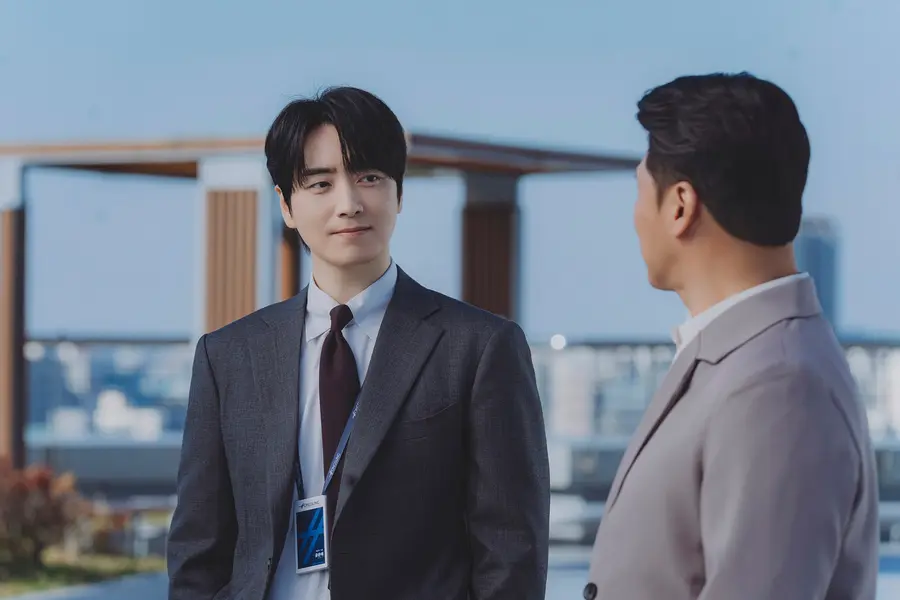
Then would you say you are a work-focused actor like Gong Eun-tae? On set, are you closer to Gong Eun-tae, to Yang Jun-ho, or to other team members?
Are you asking me to praise myself? (laughs) I don’t think I’m the type to cause problems at work, and I tend to try to do more than what’s strictly required of me when possible. I also think the whole production is very similar to our work. We have bosses above us, investors, and the head of the production company. I heard this project was hard to get into production, but like an executive backing it, TVING said 'go ahead' and I came in as the lead. That was actually a difficult thing. For a lead not to shoulder every episode and to give other actors chances can be hard from the production or platform side, but it was possible because of mutual trust. So inside and outside the project felt very similar. My favorite line is what I say to Jeong Seon-hyeok (Oh Dae-hwan) in the final episode: "We know. We know what we did, how we did it, how hard we worked." I think that’s something people who give their all can say. From the perspective of those making the show, we can’t tell viewers 'we suffered like this,' but when you meet the director or our cast, you can tell from just a look how hard we worked.
This series seems to resonate more with ordinary workers like me, including reporters. Watching Gong Eun-tae hold 1.3 billion won in his hand yet still go to work every day was comforting. What would you like to say to the countless office workers packed into crowded subway cars every morning?
In films and dramas, we often portray very specialized professions and make them look cool. What I really liked about this show is that it talks about how admirable ordinary office life can be. Remember when the drama 〈On Air〉 aired and suddenly many wanted to become managers? Acting is also a very difficult profession, yet many come into it simply because it looks glamorous. So I want to tell office workers that they are very admirable. That’s how admirable their working lives are. This drama portrays office workers in a flattering light, which makes their work look impressive. Aren’t we all playing a very respectable game?

As a joke, many viewers say your life is as lucky as winning the lottery. What do you think?
Isn’t life something everyone envies in some ways? We all have those moments and moments of suffering. If everything were only good, no one would go to the movies. Isn’t that what comforts us? For today, however, since reporters like you are talking about our work seriously, I feel like we’ve hit the lottery. Many reporters willingly give their time to our work like this. That’s not an easy thing. So in that respect, I think we really did hit the lottery.


댓글 (0)
댓글 작성
댓글을 작성하려면 로그인이 필요합니다.
로그인하기