



A truly outrageous movie has arrived. It’s 〈Boomerang〉 (original title: Outcome), in which Keanu Reeves appears as a famous Hollywood actor—almost as if it were Keanu Reeves himself. Is it a documentary? No. In this film, Keanu Reeves plays a former child actor who shot to fame and maintained his stardom for 40 years: Reef Hock. Reef! That’s a name that means “reef,” like a breaking rock. Even the name feels ominous.
After winning two Oscars and living as a star for a lifetime, Reef is now stranded—wrecked on a reef and nearly shipwrecked. Just as he’s trying to regain his footing while undergoing treatment for alcohol addiction, he receives a mysterious video threat. The trouble is, Reef doesn’t know either what the threat says or who’s behind it. That’s why the movie feels even stranger. As he looks back on more than 40 years of his life, Reef revisits the “mistake” he made—almost like self-examination.

From the first manager who once looked after him to his ex-wife and his mother—nearly every relationship that ever brushed past his life becomes a suspect. The assistant drops a brutal “fact bomb”: all those countless people you’ve crossed paths with actually hate you. In other words, everyone involved is, quite literally, a suspect. Red lights also start flashing around #MeToo and racism issues. “But it was a movie character who did that. It wasn’t me!”
〈Boomerang〉 depicts how Reef employs the crisis-management strategy of lawyer Ira (Jonah Hill) amid the chaos of “Why did something like this happen to me?” The core is simple: even though he doesn’t know what it is, he should apologize to everyone. And it goes even further—he uses a strategy of positioning himself as the “victim” in advance. The intriguing—and unsettling—part is that, even within a method that could feel shameless, you can still never fully be sure what kind of person Reef really is.

The era when stardom could be created just by going to sleep is gone. Now, if you go to sleep, you wake up and your career is straight down to rock bottom. 〈Boomerang〉 is a black comedy aimed squarely at this generation, where a single moral misstep can make you the target of “cancel culture.” No one is exempt—including a star with 40 years of experience that everyone seems to know. Still, Reef has Kyle (Cameron Diaz) and Xander (Matt Bomer), friends who’ve been looking out for him for nearly 30 years. What Reef is searching for is, precisely, a chance to repair those relationships. It may sound predictable, but it’s a process of “repentance” and “redemption” that you can’t ignore.
Jonah Hill, who has also firmly established himself as an actor in 〈Despicable Me〉 , 〈Moneyball〉 , and 〈The Wolf of Wall Street〉 , directs and even appears as the lawyer Ira himself. After his directorial debut 〈Mid 90s〉 (2018), which drew from his own childhood in Los Angeles, his work continues to pull from his own experiences—from the documentary 〈Stutz: Master of the Mind〉 (2022), where he meets a psychiatrist and opens up about what’s going on inside. This time, too, it feels as if he decided ahead of time: based on the anxieties of Hollywood actors, he teases out that lingering, almost “seems-real” sense of déjà vu.
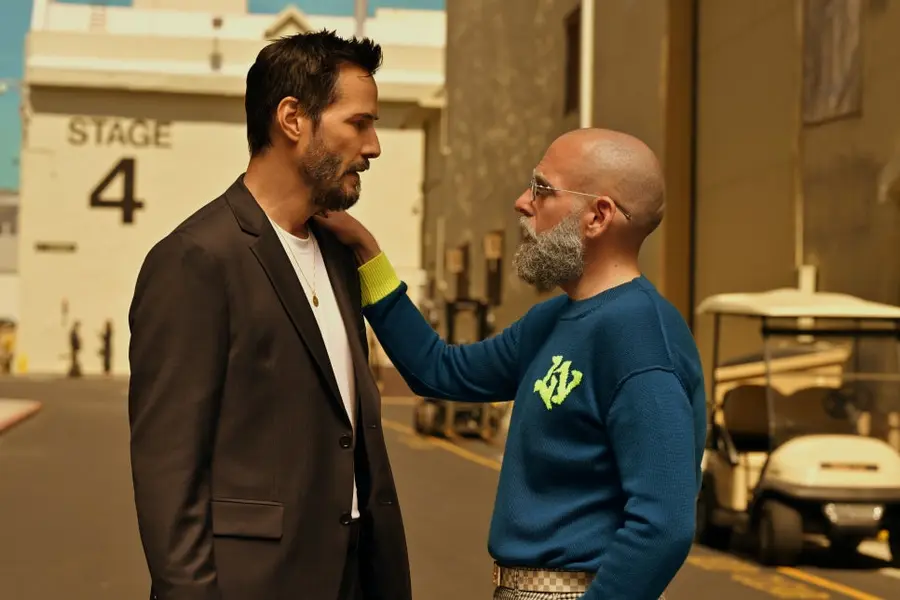
That’s also where the film’s many little flashes of humor begin. It isn’t just Martin Scorsese. Drew Barrymore hosts a talk show. Stand-up comics, activists who champion LGBTQ+ rights, and women’s health advocates appear in roles that strongly resemble real-life versions of themselves—adding an odd sense of reality. In a big way, it’s the real story.
We share an interview conducted with them in Los Angeles via Zoom. Most of the reporters’ questions for the actors, therefore, focused on this: As top Hollywood stars, what do you think about the current phenomenon of “cancel culture”—Keanu Reeves, Cameron Diaz, Matt Bomer, how do you feel about it? That’s definitely an urgent issue. 〈Boomerang〉 will be released on Apple TV on April 10.
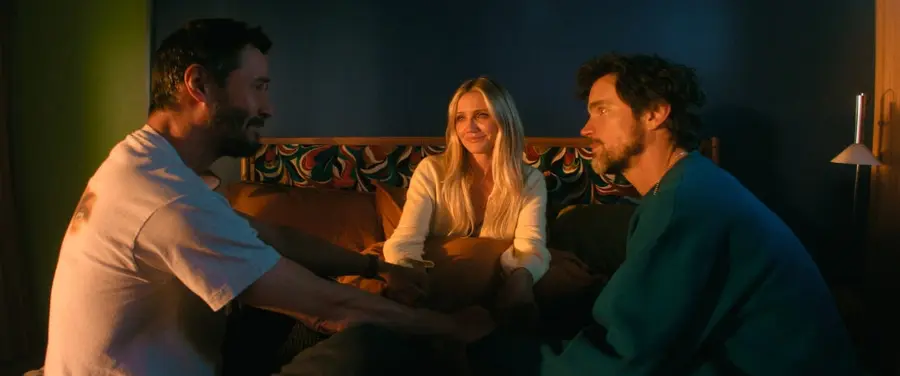
〈Boomerang〉 looks like a warning about the SNS era. In the end, it’s a work that tackles the themes of “responsibility” and “redemption.”
Cameron Diaz It’s about “cancel culture.” When someone’s words or actions spark controversy on social media, collective punishment plays out in public—so I think it’s the kind of cautionary story that warns people about that.
Keanu Reeves Yes, it’s a warning-style comedy—not just a simple comedy. We keep running into and living within systems we don’t fully understand, over and over again—and it feels like that’s always been the case, not just now.
When you read the script, was there anything that resonated with you in relation to life in Hollywood?
Keanu Reeves Jonah is someone with real experience and perspective. In a way, this story feels like a blend of fact and fiction. You can tell he must have been interested for a long time, just from the fact that he wrote the script himself.
Cameron Diaz There are many reasons an actor chooses a project. A lot of factors come into play—who you get to work with, the appeal of the story itself, and more. This time, I had a strong desire to explore how the story would unfold with these actors—especially with Jonah.
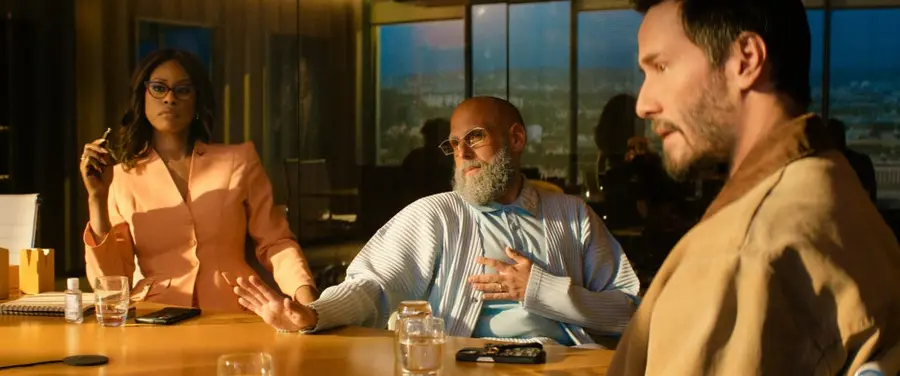
How was it working with director Jonah Hill, who also comes from acting?
Keanu Reeves Lawyer Ira—who Jonah also plays—is a truly intense character. Jonah is a great director and actor, and the time we spent together on set was really enjoyable. As an actor, he’s mostly taken on comedic roles, so as a director and actor, you get to see a completely different side of him.
Matt Bomer It was the first time I’d ever filmed in a set where everyone laughed that much. Jonah’s direction is freewheeling and unpredictable, so every day felt like a brand-new experience. And being able to work in that environment—it felt like a dream.
▶ The interview with Keanu Reeves, Cameron Diaz, and Matt Bomer continues in Part 2.
Cineplay Guest Reporter Lee Hwa-jung






댓글 (0)
댓글 작성
댓글을 작성하려면 로그인이 필요합니다.
로그인하기