


Facing the Collapse of the Korean Film Ecosystem, Urgent Appeals from Major Filmmakers
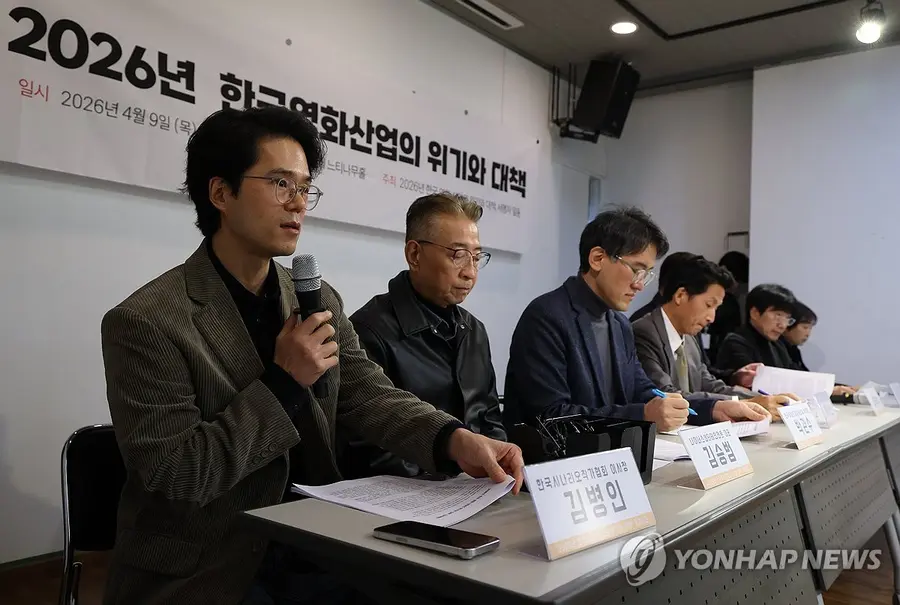
A total of 581 leading figures in the Republic of Korea film industry, led by director Bong Joon-ho, strongly warned about 'the crisis in the Korean film industry' and urged 'extraordinary countermeasures' from the government.
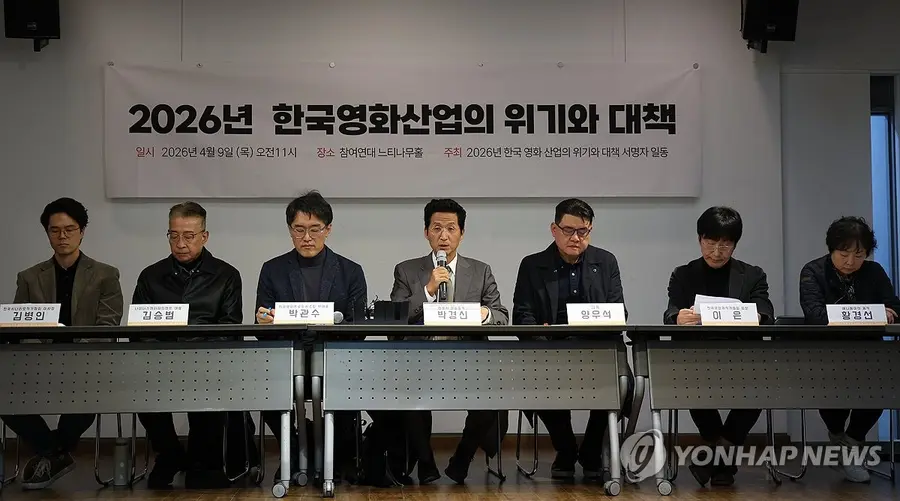
On the 9th, the Korean Film Producers Association and 12 other organizations formed the Film Organizations Solidarity Council and held a press conference at People’s Solidarity for Participatory Democracy in Jongno-gu, Seoul, where they released a statement. The statement was attended by major filmmakers including Im Kwon-taek, Chung Ji-young, and director Bong Joon-ho, as well as Park Joong-hoon, Yoo Ji-tae, Lee Jung-hyun, and others.
They assess that after the pandemic, the film industry’s uphill struggle intensified as the fierce push by 'Netflix' and other 'OTT' platforms combined with big corporations’ 'vertical integration'. In fact, the number of Korean cinema viewers last year was about 100.06 million—an appalling 47% compared with 2019.
![A movie theater in downtown Seoul [Yonhap data photo]](https://cdn.www.cineplay.co.kr/w900/q75/article-images/2026-04-10/b1b205bd-d77e-4e17-971d-6c1b118ac0f5.jpg)
The 'Six-Month Holdback' Bill Becomes a Poison—Demand a Full Withdrawal
On-site film figures said the 'six-month holdback' bill being discussed in the National Assembly is a clear misdiagnosis and demanded a strong rollback. 'Holdback' refers to the grace period until theatrical releases are distributed to other platforms.
The film industry criticizes the bill as a wrong prescription that blocks capital’s 'investment cost recovery' at the root and, as a result, seriously restricts audiences’ 'opportunities to watch'.
Park Kyung-sin, a professor at Korea University, said, "This is not a regulation that limits consumers’ viewing for a long time; the key is protecting films so they can be screened in theaters for an extended period," warning of fatal side effects the proposed revision could bring.
Urgency of Breaking Screen Monopolies and Setting Up a Fund Worth 100 Billion Won
As a core alternative to overcome the crisis, the idea of introducing a 'screen concentration restriction system' has come to the surface. The goal is to eradicate the practice of a small number of blockbuster titles monopolizing screens and to absolutely guarantee screening opportunities for a wide variety of films by limiting a single film’s 'seat occupancy rate'.
In addition, to save the production ecosystem that is just before collapse, the government-led 'creation of a 100-billion-won-class fund' and 'tax reduction and exemption benefits' to attract general investors were cited as indispensable elements.
Director Yang Woo-seok emphasized, "In line with the paradigm shift where investment and consumption are combined, we must create an innovative opportunity for consumers and K-culture companies to invest directly." The chair of the Korea Film Producers Association, Lee Eun, also said, "The current crisis is directly tied to the survival of both theaters and distributors," urging immediate and effective consultations between the industry and the government.
![[First reactions] 'Look Back' Cineplay reporters' star ratings](https://cdn.www.cineplay.co.kr/w300/q75/article-images/2026-09-29/86caa45d-4319-4803-92b7-38b58935b7d3.jpg)
![[On the Ground at BIFF] “Art Is Art”: Zhang Yimou Breaks Silence on Historical Controversy Over “Assassins”; Top Asian Film to Be Named on 15th](https://cdn.www.cineplay.co.kr/w300/q75/article-images/2026-10-07/c4d38025-dc2a-4cf0-919a-792227afc5f5.jpg)



댓글 (0)
댓글 작성
댓글을 작성하려면 로그인이 필요합니다.
로그인하기