


Global online video streaming giant 'Netflix' generated more than 1 trillion won in revenue in South Korea last year for the first time since entering the market. But 81% of that massive revenue was remitted to its U.S. headquarters, leaving the Korean entity with operating profit of just 20.3 billion won, an analysis found.
![Netflix [Reuters-Yonhap News]](https://cdn.www.cineplay.co.kr/w900/q75/article-images/2026-04-24/21f36347-b7c3-40a1-81d7-15482aa66c41.jpg)
800 billion won sent overseas, leaving little operating profit in Korea
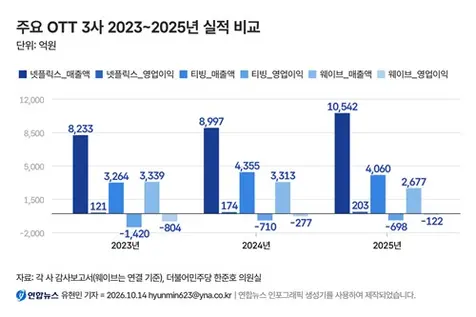
Han Jun-ho, a Democratic Party lawmaker on the National Assembly's Science, ICT, Broadcasting and Communications Committee, conducted an in-depth analysis of Netflix Services Korea's audit report and found that 'Netflix' recorded domestic revenue of 1.0542 trillion won last year. That figure was about 1.7 times the 631.7 billion won recorded in 2021, underscoring the company's explosive growth in the Korean market.
Behind the eye-catching revenue, however, lies a distorted profit structure. A total of 853.9 billion won, or 81.0% of overall revenue, was paid to the U.S. headquarters for subscription memberships and other services. As a result, the Korean entity's operating margin stood at just 1.9%. Despite generating enormous capital in the Korean market, the proceeds are effectively flowing overseas in their entirety.
Domestic streaming services mired in losses as production ecosystem becomes a subcontracting base
As 'Netflix' consolidates its dominance, homegrown Korean streaming services are facing serious financial difficulties. Last year, 'TVING' posted an operating loss of 69.8 billion won, while 'Wavve' lost 12.2 billion won, leaving both companies trapped in the red. According to the Broadcast Media and Communications Commission's 2025 Survey on Broadcast Media Use, 'Netflix' had a paid-user rate of 46.7%, more than triple the 13.0% recorded by No. 2 'TVING', giving it control of the market.
This lopsided market is also having a devastating effect on the 'K-content' production ecosystem. Han Jun-ho sharply criticized the structural problem of 'Netflix' monopolizing intellectual property rights to its original content. Korean production companies currently retain margins equivalent to just 3% to 10% of a project's production budget, making it difficult for them to earn additional profits even when a global megahit emerges.
Han said, "The key driving force that has made 'Netflix' the No. 1 platform in Korea and propelled it to global leadership is none other than 'K-content'." He urged the company to assume social responsibility, including by establishing a fair system of additional compensation proportionate to the platform's enormous influence and commercial success. Urgent institutional reforms and a normalization of the revenue-sharing structure are needed to prevent Korea's content industry from becoming merely a subcontracting base for global platforms.



댓글 (0)
댓글 작성
댓글을 작성하려면 로그인이 필요합니다.
로그인하기