


The Amazing Achievement of 'K-De-Hun'
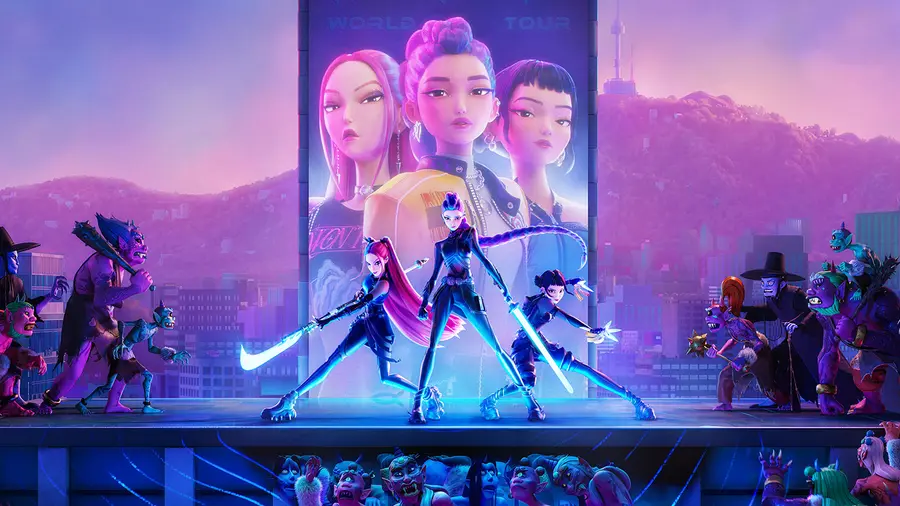
Who would have predicted that a movie about Korean culture produced with Hollywood capital would receive such great interest? The Netflix movie 〈K-Pop Demon Hunters〉 is an action fantasy animation that tells the story of K-Pop superstar group 'HUNTR/X' members Lumi, Mira, and Joy as they act as hidden heroes protecting the glamorous world behind the stage, produced by Sony Pictures.
According to a shareholder letter released by Netflix on the 17th, 〈K-Pop Demon Hunters〉 achieved 80 million views. Furthermore, the success of the film was proven above all by the popularity of its OST. Seven OST tracks, including 'Golden' and 'Soda Pop', entered the Billboard Hot 100.
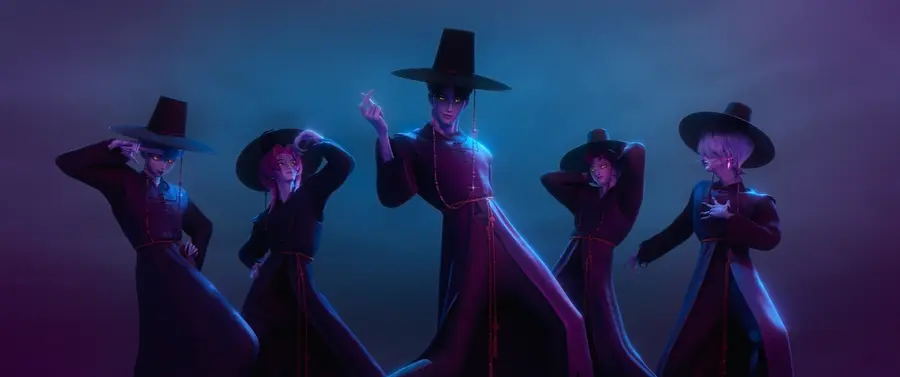
Notably, the music of 'HUNTR/X' and 'Saja Boys' in the work perfectly embodies the characteristics of actual K-Pop. The natural mix of English and Korean, the distribution of parts that highlight each member's individuality, and the catchy hooks and emotional bridges all show that the OST of 〈K-Pop Demon Hunters〉 has a high similarity to real K-Pop.
What 'K-Pop' Represents in 'K-De-Hun'
However, the portrayal of 'K-Pop' in 〈K-Pop Demon Hunters〉 is not limited to musical similarities. The film captures cultural codes and identities surrounding K-Pop, using the term 'hoobae' without translation and featuring scenes of fan signings and award ceremonies.
So, what exactly is 'K-Pop' that a movie like 〈K-Pop Demon Hunters〉 can emerge, indicating that 'K-Pop' has unique and distinctive qualities? In reality, discussions about the boundaries of K-Pop have always existed. Does the 'K' in 'K-Pop' only mean Korea? As the musical distinction between pop and K-Pop has become meaningless, it has become difficult to define K-Pop as a 'music genre'. Additionally, distinguishing K-Pop based on the nationality of the singer has also become ambiguous. For instance, groups like 'Cat's Eye' (under HYBE) debuted with only one member of Korean nationality. Whether the lyrics use Korean or not is not a criterion for determining if it is K-Pop. For example, songs like TWICE's 'Strategy', which are entirely in English, are classified as K-Pop.
Reinterpreting 'K-Pop-ness' from an Outsider's Perspective
What is 'K-Pop-ness'? What is K-Pop that allows foreigners to create such a movie? 〈K-Pop Demon Hunters〉 can be read as an interesting experiment that questions the essence of K-Pop through the eyes of outsiders. 〈K-Pop Demon Hunters〉 reinterprets the core of 'K-Pop-ness' through an outsider's perspective, including the musical formula of K-Pop, collective identity, fandom centrality, linguistic flexibility, and a sense of calling that transcends profession.
The reason a movie like 〈K-Pop Demon Hunters〉 could be born is that K-Pop exists as a code with unique qualities. Ultimately, this work captures the image of 'K-Pop' filtered through an outsider's perspective. So, let’s infer the elements that define the identity of 'K-Pop' through 〈K-Pop Demon Hunters〉.
![A scene from the Netflix animated movie 〈K-Pop Demon Hunters〉 [Provided by Netflix]](https://cdn.www.cineplay.co.kr/w900/q75/article-images/2025-07-15/d49e715b-d00d-4365-a3b6-d65dd9f3628e.jpg)
The 'Fan Love' of Artists
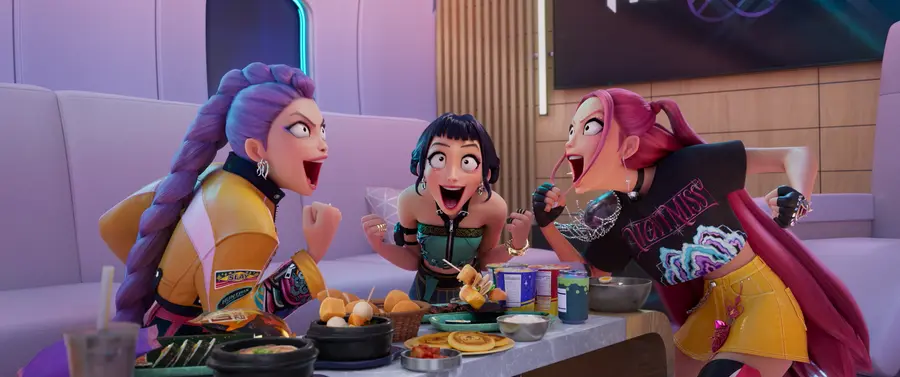
Expressing gratitude towards fans frequently and strongly is a characteristic unique to K-Pop artists. K-Pop artists operate based on a strong fandom and showcase a special bond with their fans.
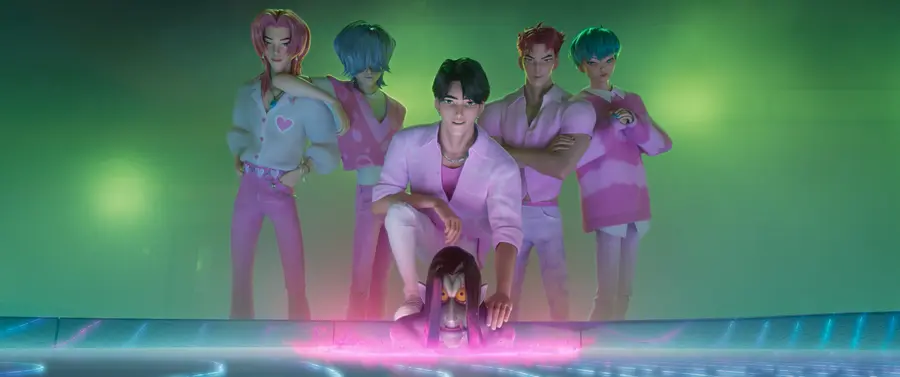
〈K-Pop Demon Hunters〉 made this characteristic of K-Pop a major theme of the film. Beyond simply having 'HUNTR/X' members Lumi, Mira, and Joy frequently say 'I love you' to fans, the film interprets the source of the power of 'honmun' as being the 'fans', illustrating the interdependent relationship between K-Pop artists and fans through cinematic imagination. The film elevates the act of fans showing strong loyalty to artists to the level of 'devoting their souls'. The source of the power of 'honmun' is 'fan love', and the reason 'Saja Boys' was formed is to steal 'HUNTR/X' fans and break 'honmun'. By focusing on the unique bond between fans and K-Pop artists, a unique film titled 'K-Pop Exorcism Action' was born.
Idol as a Calling Beyond Profession
K-Pop artists and fans are extremely wary of idols showing the appearance of being mere professionals. For K-Pop artists, being an idol is not just a job; it is something they must dedicate their lives to. The stories of K-Pop artists' efforts, sincerity, earnestness, and constant self-improvement become as important storytelling elements as their skills and music itself. Thus, K-Pop idols seem strangely detached from reality. They appear to step back from realistic conditions such as money and time.
〈K-Pop Demon Hunters〉 fully utilizes the 'transcendent' characteristics of K-Pop artists and the fact that their profession is akin to a 'calling'. HUNTR/X are 'demon hunters' with a mission to create 'honmun'. The process in which the protagonists of 〈K-Pop Demon Hunters〉 accept their calling as 'hunters' who save the world by giving up their ordinary lives resonates with the lives of actual K-Pop idols. The expression 'we must steal souls' symbolically shows the sense of calling that K-Pop idols must devote everything to their entertainment activities and fans.
![A scene from the Netflix animated movie 'K-Pop Demon Hunters' [Provided by Netflix]](https://cdn.www.cineplay.co.kr/w900/q75/article-images/2025-07-15/1b25809f-9fb0-4802-84f4-81b0de55079f.jpg)
Music Containing Self-Expression and Narrative
The lyrics of K-Pop artists once primarily focused on themes like 'love', but as we moved through the 3rd and 4th generations represented by groups like 'BLACKPINK' and 'BTS', songs of 'self-expression' became central. The songs 'How It’s Done' and 'TAKEDOWN' sung by HUNTR/X in 〈K-Pop Demon Hunters〉 express their confidence, strength, and spirit of challenge.
However, K-Pop artists do not only reveal 'strength' through their music. K-Pop music also embodies the processes of 'anguish' and 'self-overcoming'. The OST of 〈K-Pop Demon Hunters〉 that best reflects this characteristic is 'Golden'. For instance, the lyrics I'm done hidin' / now I'm shinin' / like I'm born to be / We dreamin' hard, we came so far, now I believe dramatically emphasize the message of self-affirmation and self-recovery as 'a being that rises again amidst wounds and hardships'.
Moreover, most K-Pop songs feature emotional solo bridges, which are often used as devices to enhance the narrative of the song. In 'Golden', Lumi's solo bridge To wake up and feel like me / Put these patterns all in the past now / And finally live like the girl they all see expresses the will to affirm oneself, overcoming the identity confusion of being both a demon and a hunter. Additionally, the main narrative of 〈K-Pop Demon Hunters〉 where 'Lumi' overcomes her dual identity can be seen as an extension of K-Pop music into film.






댓글 (0)
댓글 작성
댓글을 작성하려면 로그인이 필요합니다.
로그인하기