



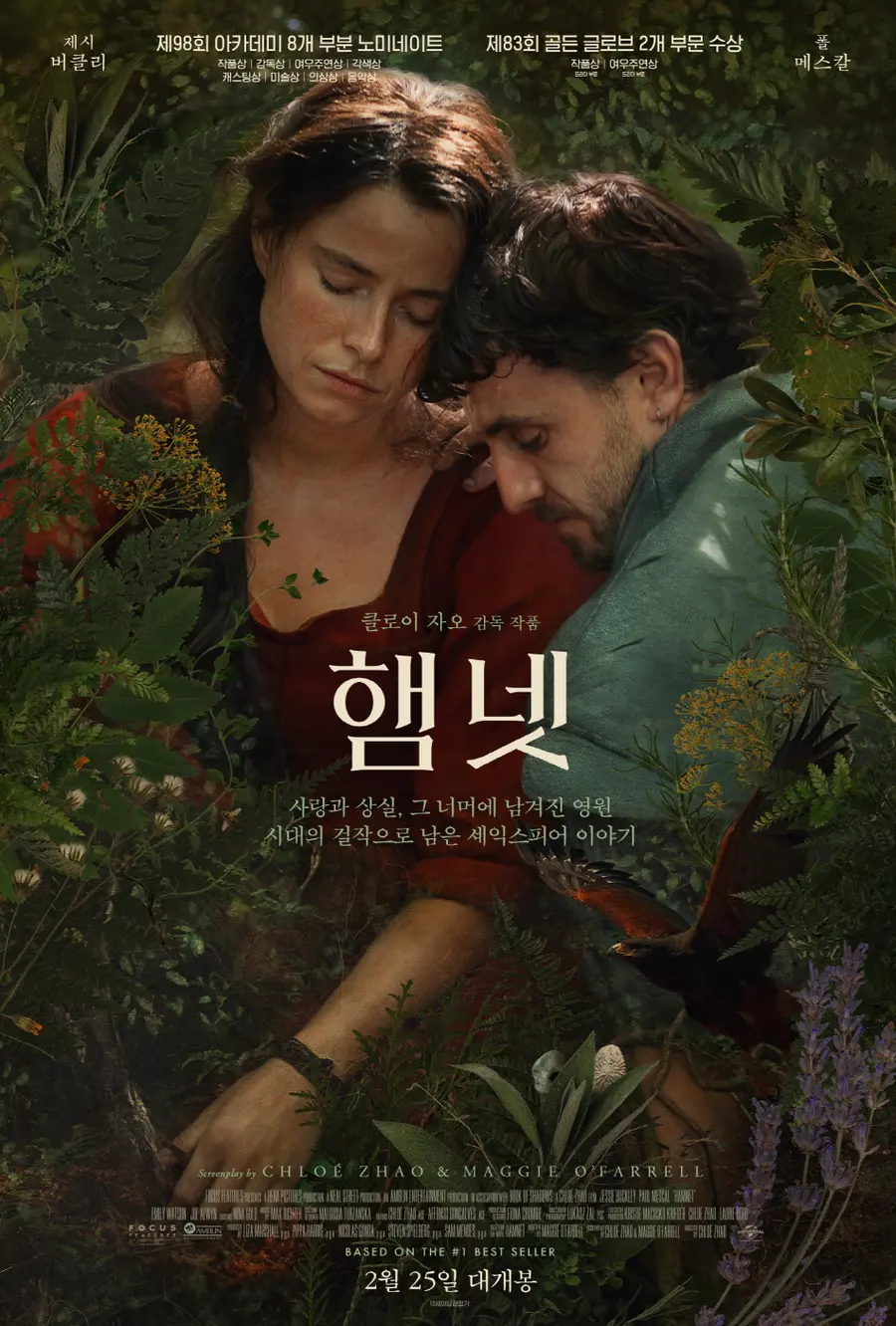
Chloé Zhao's greeting, which allows for a deeper look into 〈Hamnet〉, has been shared.
The film 〈Hamnet〉 will be released on February 10, and director Chloé Zhao has shared her thoughts. Having won the Golden Lion at the Venice International Film Festival and the Audience Award at the Toronto International Film Festival for 〈Nomadland〉, as well as the Academy Award for Best Picture, Chloé Zhao took on direction, screenplay, and editing for 〈Hamnet〉. In a written statement, she expressed, "This is a story about change and transformation," adding, "The deepest reason for making this film was to break the illusion of fear by showing the power of change that exists within humanity and our ability to transform any painful experience."
〈Hamnet〉 is a film that depicts the hidden story behind the birth of Shakespeare's timeless masterpiece and one of the four great tragedies, 'Hamlet', and it will be released in South Korea on February 25. Below is the full statement from director Chloé Zhao.
A Statement from Chloé Zhao
A Statement from Chloé Zhao
〈Hamnet〉 is a work that deals with how love and death, and these two fundamental human experiences, transform each other and are reborn through the power of art and storytelling.
This is a story about change and transformation.
When I choose a project, I often cannot articulate the reason clearly. Most of the time, I am led by instinct, following a force that pulls strongly from deep within my heart. Some stories come to me suddenly, as if they have chosen me, and I cannot resist that call. 〈Hamnet〉 also approached me at first like a whisper, but at some point, it grew into a massive storm. At the end of the journey, I found myself completely disarmed, feeling as if my heart had been softened and shattered. I experienced with my whole being what it means to live with an open heart in the eye of the storm, the beauty and pain within it, the thrill just before annihilation, and the silence that follows.
From the black hole in the old forest to the dark door of the rain-soaked Globe Theatre stage, I descended with brave souls. We held onto each other and surrendered our bodies to the flow rising from beneath the earth in the unconscious. In the chaos, we asked 'Agnes' and 'Shakespeare' to guide our way. We also sought guidance from all the women of the past and present who have suffered great pain and loss, the men who had to suppress their emotions and flee from themselves, and the wild hearts within us that long for the forest, rivers, earth, freedom, and peace. And at some moment, while dancing on and below the stage of the Globe Theatre, the boundaries between reality and fiction, past and present, the visible world and the invisible world, love and death disappeared. In those precious moments, everything was one. I felt with my whole being, deep in my bones, that love does not disappear. It simply transforms and continues to survive.
I have feared death all my life, and as a result, I have also feared love. I did not know how to open my heart and maintain it while facing the transience of life. I have created stories about characters who experience great loss in four films, and 〈Hamnet〉 is the accumulation and fruition of that journey. Within the sacred vessel of Shakespeare's 'Hamlet', I sought to descend into a deeper underworld to reclaim what I had lost, the things that made me fearfully experience love and death simultaneously. Maggie O'Farrell's novel opened a portal and became a bridge that allowed us to connect with 'Shakespeare' in ways we had never known before.
"All things that exist in life must die, passing through nature towards eternity."
"To be or not to be, that is the question."
"All that remains is silence."
'Shakespeare' wrote stories about love and death, and I feel honored and fortunate to be able to interpret his message for today's audience. We knew and felt that he was with us. In this film, 'Agnes' and 'Shakespeare' fall in love and create a beautiful family, but after losing their son, they find themselves standing at a threshold. They cannot go back to the past or move forward. They are drawn in different directions but cannot take a single step, frozen in the space of boundaries.
In that tension, alchemy occurred. In physics, when there are forces pushing and pulling in opposite directions, that force creates tension. And when that tension exceeds limits, movement occurs, and a new state of balance is born. At the very moment 'Shakespeare' stood at the boundary of land and sea, life and death, one of the greatest literary works was born.
Now our world also stands at a threshold. We feel all the immense tension and pressure. We sense that a new state of balance is approaching. Many are frozen in the space of boundaries, afraid to move. I see my own fears in the eyes of others. The fear of not knowing what is to come. The fear that our lives are no longer within our control. The fear that this world is no longer safe. The fear of possibly never knowing unconditional love. And ultimately, the most fundamental fear of possibly facing a meaningless death.
The deepest reason I made this film was to break the illusion of fear by showing the power of change that exists within humanity and our ability to transform any painful experience. We all live feeling the tension of emptiness from the moment we are born into this world. And we must choose whether to open our hearts and pass through that flame.
Love does not die. It only changes form. It is the greatest transformation that occurs in this universe, and I hope this film serves as a small reminder of that fact.



댓글 (0)
댓글 작성
댓글을 작성하려면 로그인이 필요합니다.
로그인하기