



In an era flooded with the meme "I'm quitting my job," the recently concluded Tving original 〈Even the Lottery Winner Goes to Work〉 pushes against that current. The series argues that quitting isn't the only answer, telling its story through Gong Eun-tae (Lee Joon-hyuk), an office worker who wins 1.3 billion won in the lottery yet still finds himself on his usual commute the next morning.
The emphasis in 〈Even the Lottery Winner Goes to Work〉 is on "going to work," not on the lottery. How do you come to terms with the daily repetition of commuting? Putting money aside, what do you actually work for, and what kind of fulfillment are you seeking? The drama asks those basic questions. After winning the lottery, Gong Eun-tae imagines driving a sports car to the office, threatening murder, pouring gasoline around the company, and throwing his resignation letter in his boss's face. But he immediately self-censors, calling the fantasy "too violent," and instead, he settles on taking a half-day off that morning — and still goes to work.
As Gong Eun-tae says, "I thought nothing had changed, but after it passed everything was different," the 1.3 billion won did not alter his commute but it did change him. None of us are exactly like Gong Eun-tae in the drama — we don't all earn 70 million won a year, possess striking looks, or live in a three-room apartment in Seoul — yet the show comforts because the weight of the daily grind feels the same for everyone.
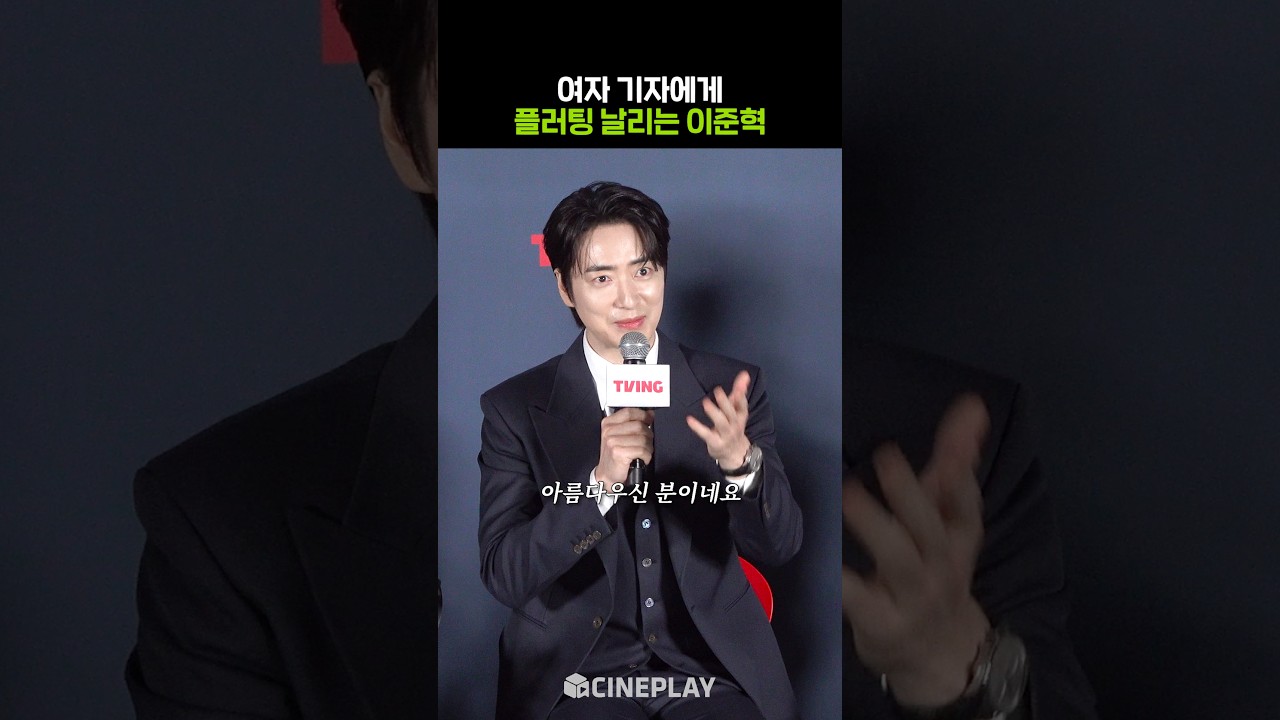
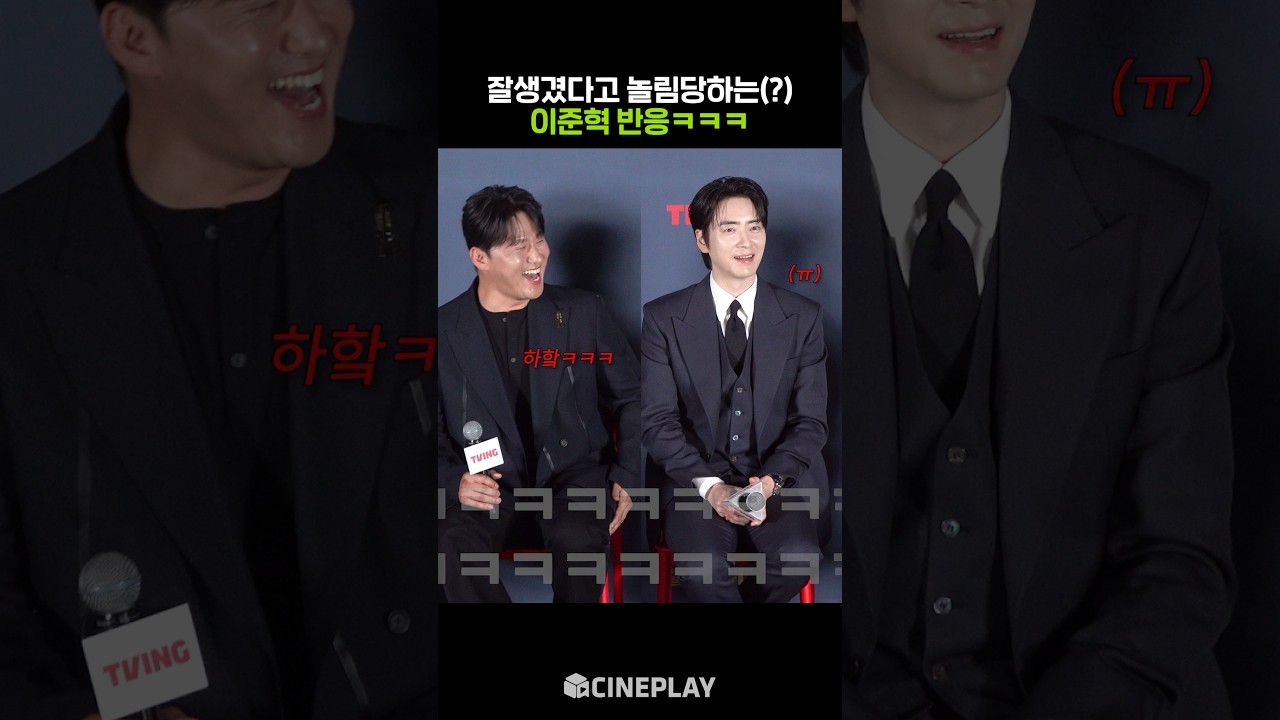
That goes for actors, too. As Lee Joon-hyuk said at the press conference, "Actors sometimes wonder whether a hit will change their lives. In reality it doesn't, and the work goes on." The reasons people work are not only financial: colleagues, pride in one's craft, and the desire to do a job well are all tangled together. Lee compared his muted, tightly controlled portrayal of Gong Eun-tae to the bass in jazz — he said he had to hold the center so everyone else could come alive. He mentioned Tom Cruise, who keeps challenging himself despite earning billions, and Faker, who continues to play at the top; "being able to keep playing this game is itself a kind of luck," he said. I met Lee Joon-hyuk on the afternoon of the 13th at a location in Jongno-gu, Seoul, after he finished work on a show that feels like a comfort to the countless Gong Eun-taes who go to work every day.

I expected from the title 〈Even the Lottery Winner Goes to Work〉 that this would be a light black comedy, but it turned out to be a surprisingly restrained office drama. I imagine you had a similar feeling when you first read the script. What impression did you get on your first read?
That's actually why I took it. If the project had been pure black comedy all the way through, I probably wouldn't have been interested. I watched the film 〈Sully: Miracle on the Hudson〉 (2016) a while back and it made me want to do that kind of work. That movie is based on a true story and it points out when something in the world is wrong. I love and value that kind of storytelling, and it is necessary. But I was curious about the flip side: what happens when everything runs correctly? I had that idea tucked away, and when this project came along it hit that spot. After we finished, I also watched the Apple TV series 〈Ted Lasso〉 (the series about an American football coach who knows nothing about soccer and is hired to coach an English Premier League team, struggling in unfamiliar London), and I loved it. I felt the tone was very similar to ours — the same kind of feeling I like.
You've played big, intense roles such as Seo Dong-jae in 〈Secret Forest〉 and Joo Seong-chul in 〈The Outlaws 3〉. This time, it seems you played a character closer to yourself. Would you agree?
Up until now I've been doing character acting. If I had to fill scenes as a defined character, this time I could bring more of myself to the role. Partly because this time he's not a murderer. (laughs) On the other hand, because I was the character who had to hold everything together in the middle, I had to act more subtly. I had to ride finer rhythms and focus intensely on the other actors' energy, the rhythm of the scene, and the rhythm of the shots. Characters like Seo Dong-jae in 〈Secret Forest〉 or Dong-jae in 〈Good or Bad Dong-jae〉 tend to unleash lots of lines and energy, whereas this project required me to match others' beats and play smaller, more precise rhythms.

Gong Eun-tae's speech pattern and demeanor are striking. He speaks politely even to subordinates and keeps a dry, almost flat tone. How did you build those details for the character?
I felt Gong Eun-tae couldn't waver from the center. I saw him a bit like the bass in a jazz band. Our work is somewhat like jazz: someone comes in and you ping-pong back and forth, you can't predict how a note will land or what the rhythm of the scene will be, so Gong Eun-tae had to anchor the middle and occasionally poke at the others so the whole thing could come alive. I wanted to try that kind of acting. Early on I wasn't that drawn to it; I used to prefer bolder choices. Lately, though, I wanted to try something that felt like a performance where everyone comes alive together.
Gong Eun-tae's loudest or most emotional moments are basically in his fantasy sequences. For an actor, suppressing emotion rather than exploding with it seems even more demanding. Was that harder to play?
If you play big, loud acting it’s easier to fill a scene; with subtler work you have to concentrate intensely on every single line. My movement becomes a very small part of the other actors' rhythms. Because I had to hold that thin middle, I was quite sensitive. Even with long speeches, I thought a lot about how to deliver them. I kept telling the director that there were so many lines (laughs)—but of course there needed to be. For the character to keep the scene centered, the rhythm has to be exact and you have to match the camera, so I paid attention to all of that. The fantasy scenes are, in fact, something I'm grateful to the director for. They show early on, "Lee Joon-hyuk can do this too," and that groundwork is helpful.

The show mixes realistic episodes with fantasy elements, so tempo control must have been important. How did you establish chemistry with the members of Sales Team 5?
Euntae basically can only respond with reactions, but he has to pick the precise moment to jab ever so slightly. That requires a lot of discussion with the director, and it makes it crucial to have costars who can carry my rhythm. Someone like Dong-jae can throw himself into the scene and jab back, filling the frame, while Eun-tae leaves maybe 50% of the frame empty no matter what I do. How much the other actor can fill that gap changes the scene entirely. Fortunately, from the newcomers on up, everyone was incredibly capable. That's a testament to the director's judgment in casting. Because of that trust, I could relax. Otherwise I would have been anxious, trying to fill the void, overacting, or doing more than necessary. But everyone bounced things back like precise ping-pong, and that was both fun and something I appreciated.
The relationship between you and Assistant Manager Yang Jun-ho, played by Seo Hyun-woo, was a central axis of the drama, a combative relationship — or perhaps camaraderie. On set, were there moments when you were particularly impressed by or thankful to Seo Hyun-woo?
Actually, Hyun-woo made me feel like the lead. He supported me so well: skilled on set, capable, and full of affection, and he did it willingly. That willingness mattered a lot. I was moved by how gladly he supported me. I do a lot of supporting work myself, so it reminded me that such support is not in vain. Having experienced that support, I'm truly grateful. Hyun-woo follows my condition and every rhythm I bring. Of course I follow him, too, but feeling that warm energy on set meant Hyun-woo had put that much effort in. I hope he becomes a superstar soon, lands many commercials because of this show, earns a lot of money, and celebrates by treating himself to good food. (laughs)
The chemistry among the Sales Team 5 actors was very cohesive. If a second season were made, what would you like to show with the Sales Team 5 members?
Can I say it out loud? (laughs) I hope their pay goes up, and that within the drama their ranks rise too, so everyone's status is elevated. (laughs) Actually I haven't been a big fan of serialized seasons because I prefer short, intense projects and I get bored quickly. But after watching 〈Ted Lasso〉, I realized you can grow attached to actors and want to see more of them. I think I felt that with this group.
In the making-of for 〈Even the Lottery Winner Goes to Work〉, the actors made a bet to buy lottery tickets for one another. Have you ever actually won?
I bought a lottery ticket for the first time. I used to think you shouldn't waste luck on a lottery; luck should come through projects. But on set we joked that if someone actually won, what a great headline that would make. I kept buying tickets because I wanted to see the headline "〈Even the Lottery Winner Goes to Work〉 Lee Joon-hyuk wins the lottery." That never happened. (laughs) I won exactly 5,000 won.
This interview with Lee Joon-hyuk about 〈Even the Lottery Winner Goes to Work〉 continues in Part 2.

![[Interview] Lee Joon-hyuk on the comfort of 〈Even the Lottery Winner Goes to Work〉 for office workers](https://cdn.www.cineplay.co.kr/w300/q75/article-images/2026-10-15/7c0fdbab-81c6-4bb3-b984-b6e73a1637a9.jpg)

댓글 (0)
댓글 작성
댓글을 작성하려면 로그인이 필요합니다.
로그인하기