


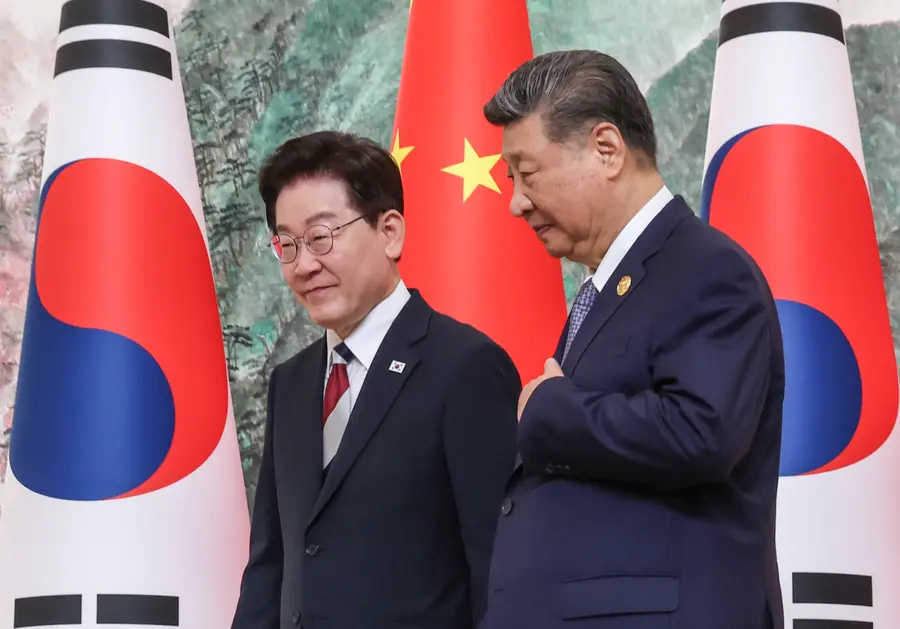
A signal of institutional barriers easing… Actual market access and implementation measures will be key
After South Korea and China made a surprise agreement to expand cultural exchanges between the two countries at their summit, Chinese-language media are closely watching whether China’s “ban on Korean culture” (限制韩流令, restrictions on the Korean Wave)—which has blocked the distribution of Korean pop culture for the past 10 years—is entering a genuine thaw.
On the 19th, major Chinese-language outlets, including Singapore’s Lianhe Zaobao and Hong Kong’s Sing Tao Daily, focused on the outcome of the summit held the previous day between President Lee Jae Myung and Chinese President Xi Jinping at Qilin Villa in Shenzhen, Guangdong province. According to the reports, Xi expressed a willingness to gradually expand cultural exchanges, and China pledged to grant South Korea “most-favored-nation treatment” in film and gaming.
Hong Kong’s Sing Tao Daily highlighted that the agreement was reached on the basis of substantive progress in follow-up negotiations on services and investment under the “China-ROK FTA” (free trade agreement). The two countries officially agreed to apply the principle of nondiscrimination based on nationality in the prior review of cultural content, including films and online games. The move is being interpreted as a significant signal that restrictions on Korean culture are easing in practice.
China has tightly restricted the entry of South Korean popular culture through unofficial channels since 2016, when South Korea decided to deploy the U.S. military’s Terminal High Altitude Area Defense (THAAD) system in the country. However, because the Chinese government has never officially acknowledged the existence of a ban on Korean culture, this measure appears aimed at bringing about practical change through institutional steps—such as easing content reviews and approvals and expanding the scope of “co-productions”—rather than declaring a blanket end to restrictions.
The two countries agreed to significantly broaden their existing, film-centered cooperation framework to cover dramas, animation, variety shows and documentaries. Still, some say a cautious approach is needed before this leads to full market access. Taiwan’s Central News Agency noted that even with a ban on discrimination based on nationality written into the agreement, it does not automatically guarantee that individual works will pass China’s strict reviews or receive broadcast approval. A key limitation is that the agreement does not yet explicitly allow Korean singers to hold concerts in China that draw large audiences, or Korean dramas to air regularly on terrestrial and satellite television.
Local experts see the summit as significant because it structurally upgraded the framework for economic cooperation between the two countries. “As China-ROK economic cooperation expands beyond trade in goods to institutional opening centered on services, investment and rules, it will provide businesses in both countries with a more stable and predictable business environment,” said Zhan Debin, a professor at the Center for Korean Peninsula Studies at the Shanghai University of International Business and Economics, according to the state-run Global Times. Lü Chao, a researcher at the Liaoning Academy of Social Sciences, also stressed that relations between the countries are now on a stable trajectory and praised the opening of new horizons for cooperation.
Industry practitioners are watching for concrete implementation measures and how the local market responds. “This agreement marks a step forward for the cultural content industry as a whole,” said Kim Gi-heon, director of the Beijing Business Center at the Korea Creative Content Agency. “The key will be whether specific cooperation projects take shape and how China’s authorities implement reviews in practice, as well as how the market responds.”





댓글 (0)
댓글 작성
댓글을 작성하려면 로그인이 필요합니다.
로그인하기