


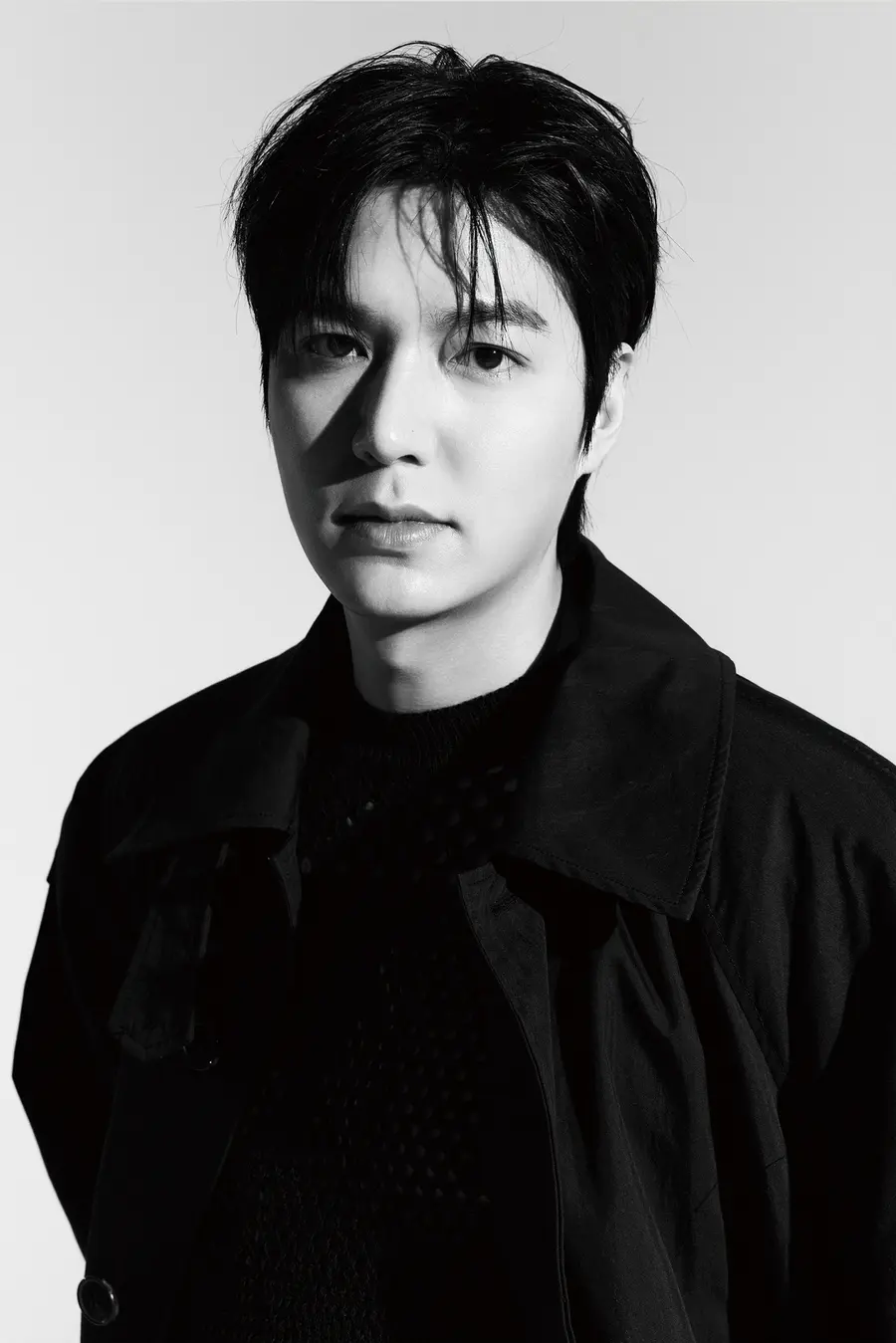
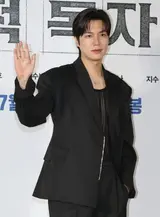
Actor Yoo Min-ho meets the audience in theaters for the first time in 10 years with the movie 〈Omniscient Reader: The Prophet〉. In this work, he plays the role of Yoo Junghyuk, the protagonist in the novel who clears all scenarios with overwhelming skill, calm judgment, and strength. Yoo Junghyuk is a character with a contrasting attitude towards life compared to the protagonist Kim Dokja (Ahn Hyo-seop), who works with his colleagues to change the predetermined ending of the scenario, showcasing a tense clash of values. Yoo Min-ho's veteran acting, which carefully grasps the themes and worldview of the original work, fills the gaps of 〈Omniscient Reader: The Prophet〉 compressed into 117 minutes. Ahead of the release, we met with actor Yoo Min-ho to hear his thoughts on the work, the character, and his life. Each sincere answer reveals the intense contemplation he has gone through.
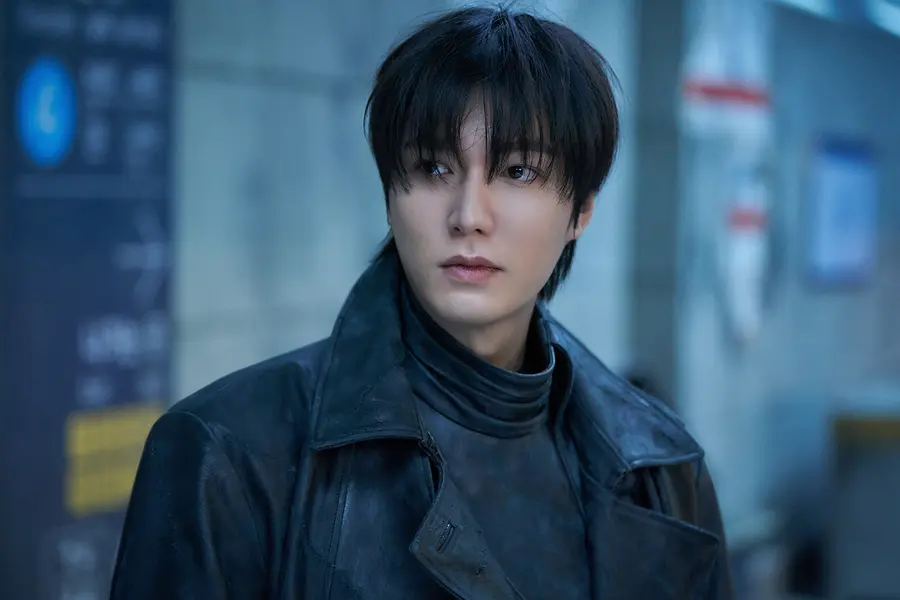
During the press conference, you mentioned that you are returning to film after 10 years. I'm curious about your feelings about meeting the audience again after such a long time.
I'm not usually a very nervous person. But I am a bit nervous. Since this is a work that can lead to more, I have a strong hope that it will do well.
Director Kim Byung-woo said, "Yoo Min-ho has a fantasy-like face," and I'm curious about your experience working with him this time.
I think the director's language world is a genre and a fantasy. (laughs) He speaks very well. The point I was most satisfied with was that he was a person whose end of contemplation was a question mark. So throughout this work, I don't think he ever conveyed anything to me as a period, but always asked, "What do you think?" as a question mark. So there is no answer to that question mark. There was a lot of room to share stories in a state where there were no answers.
What attracted you to the character Yoo Junghyuk when you chose this role?
I think there were aspects of his attitude towards life that I wanted to emulate. I feel that Yoo Junghyuk is a character who is not just living but enduring. Even if the end is not a comedy but a tragedy, he quietly does his best in his given situation, and when I applied that to my life, I wanted to be that kind of person. That was the main point that attracted me to Yoo Junghyuk.
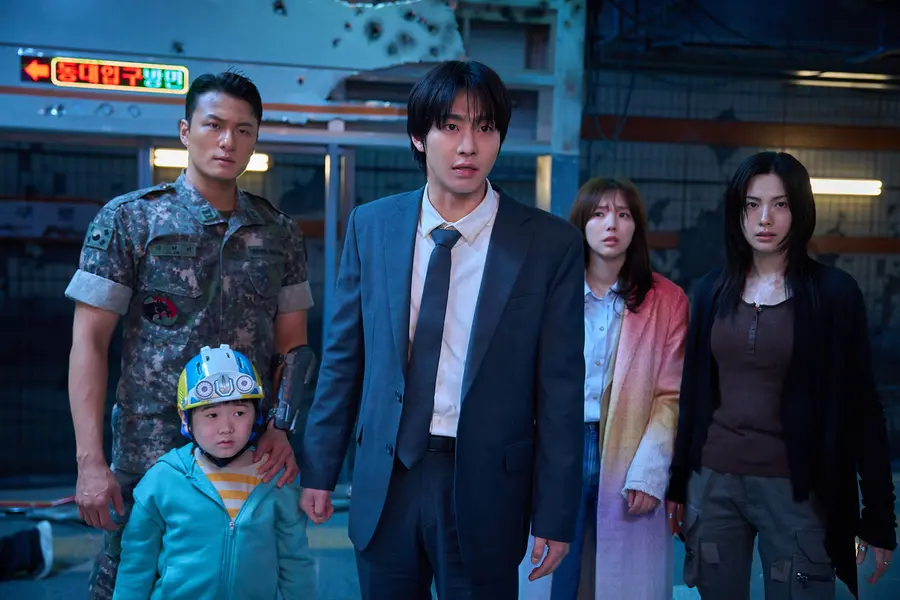
Although you are the lead, your screen time is relatively short. I'm curious if that was frustrating or if it was actually comfortable for you.
If you think about it, it's a role that is the protagonist's protagonist. Usually, when we think of a protagonist, we build up the narrative or emotional lines of that character within the work. However, since the character Yoo Junghyuk has those processes omitted in this film, I think I had a lot of concerns. The big question for me was how to fill in those omitted points convincingly, and I think that was the position I had to fulfill.
Yoo Junghyuk feels a sense of fatigue from life as he repeatedly uses his regression skill, and he can be seen as a somewhat cynical character. What are your thoughts on that?
You might feel that way just by looking at the film, but if you dig deeper, Yoo Junghyuk doesn't have to do anything and doesn't have a reason to clear missions. Even if he clears them, they reset, and he is someone who quietly navigates through moments while waiting for something undefined like hope. I want to be that kind of person too. So while my end is predetermined, there is a time given in life, and if I only look at the end during that time, I could do nothing. I could just live for personal happiness, yet I noticed the process of always doing my best in the given environment or situation and leaving some memories behind.
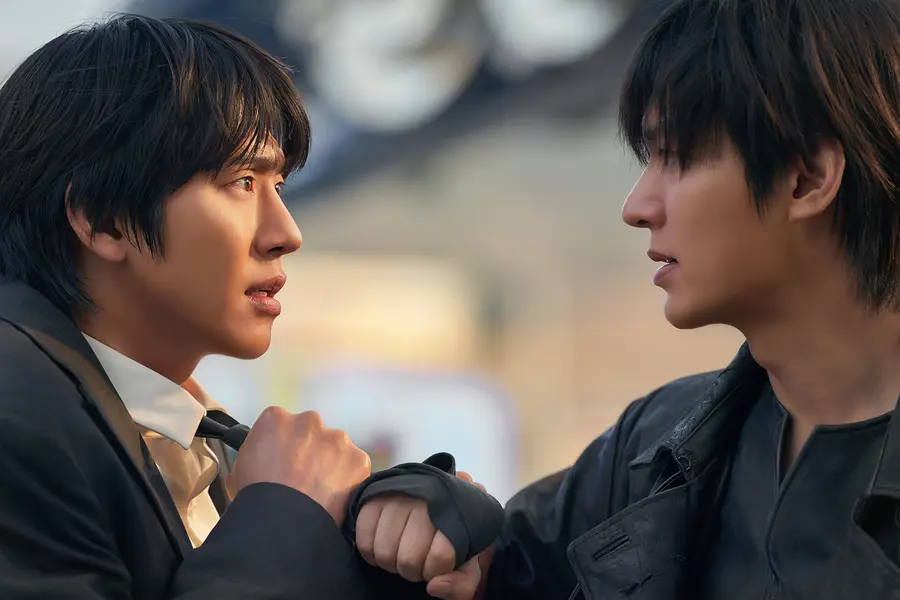
Yoo Junghyuk tries to follow the predetermined scenario, while the reader is trying to break it. I'm curious about how you think these two characters act differently.
I see Yoo Junghyuk as someone who reduces unnecessary energy and chooses a rational way through many experiences. In contrast, Kim Dokja is a character who still believes in hope and insists that they can work together, and I found this clash of values very attractive. Yoo Junghyuk is also aware of his feelings towards Kim Dokja and the direction Kim Dokja is pursuing. Nevertheless, I think Yoo Junghyuk insists on that stance to test the reader.
You mentioned that you want to emulate Yoo Junghyuk's quiet determination to follow his path, but in the scene at the Green Zone of Chungmuro Station, he tells Kim Dokja to abandon the child and says, "You come in." I wonder if that conflicts with your actual values.
In fact, I think the biggest charm of Yoo Junghyuk, when his lines and various elements are layered, is the inconsistency between his words and actions. I believe that rather than truly abandoning the child and telling him to live, it carries the underlying meaning of "What will you do?" He keeps throwing questions. And I think Yoo Junghyuk is someone who observes how the reader resolves those questions.
You said Yoo Junghyuk is a character who poses questions to the reader. In that sense, I wonder if Yoo Junghyuk plays the role of the author who creates the novel within the work. What do you think about this?
In a way, I felt like a proxy for the author, but I'm not sure. I am cautious about discussing how the original work will be adapted differently… I acted while imagining that there might be something invisible beyond what is clearly visible within it, but I don't know how that will be expressed.
When the director first gave the script to Yoo Min-ho, he was worried that you might complain about the amount of your role, but he said you didn't at all, and he was really grateful for that. Can we think that you value the meaning of the work much more than the amount of your role when choosing a project?
Yes. I don't think it's just as an actor; I think I, as a person, prioritize the most important essence. Then I think about the role within that and what I need to do now. So when I first met the director, I think I talked about Kim Dokja about 80% of the time rather than about Yoo Junghyuk. I believe that the character of the reader needs to be persuaded for Yoo Junghyuk to come into play. At the same time, since Yoo Junghyuk is a character who must clearly represent this worldview, I discussed how to incorporate this worldview into Yoo Junghyuk afterward.
I want to ask about Yoo Junghyuk's personality. I think one of the things that changed his attitude towards life is his immortal life. He might have had some human aspects in the beginning, like Kim Dokja. But I think he might have lost his humanity or changed through his immortal life. What are your thoughts on this, and how did you approach this in your acting?
In the early part of the film, when the reader explains the novel, he briefly mentions, "In the beginning, Yoo Junghyuk also had companions." I think the question you asked is about whether experience is always beneficial to humans. I think people are likely to dream of an immortal life. But then, I pose the question, "Can one truly be happy?" through this work.
I am most cautious about basing my life on my experiences. The moment experience becomes the standard, I can become trapped in my inner world, and I live with that caution. In that sense, Yoo Junghyuk is in a situation where he has to continue experiencing too much, even if he doesn't want to. I think he would have thought that the only way to survive is to think as efficiently as possible.
If you were given an immortal life, what do you think it would be like?
I think it would be very unhappy. So when I was asked what ability I would like to have, I think I said I really wouldn't want Yoo Junghyuk's regression ability. Ultimately, I think the reason I can feel beauty now and accept every moment as a miracle is that the end is predetermined.
You appeared in a film after 10 years. I'm curious about the reason you haven't done films for such a long time.
In my 20s, when I went to the theater, I was looking for films that provided some emotional relief or something deep. I think I thought that I wanted to work on films after turning 30. I wanted to work on films when I could contain more things, but now that 10 years have passed, the boundaries between films and dramas have blurred a lot. Now, I personally prefer strong stories compressed within two hours. I feel a greater joy when working on such projects.
Of course, it might be that you considered your next project, which is why your role as Yoo Junghyuk was short in this film, but do you feel any regret in introducing the character?
If this work were to end with just this one, then I think I could say I would feel regret. I was asked, "What significance does this work give to Yoo Min-ho as an actor?" and I think that once the next projects are completed, not only this work but also my future filmography's fifth or sixth projects will clarify why I did 〈Omniscient Reader: The Prophet〉 at this time. So if the next projects come out, I think I can explain more clearly why I did this work, and I believe many people will understand.
The original work has a vast worldview. There are many special settings like constellations and behind-the-scenes elements. How much did you keep those settings in mind while filming?
I think there are several important points in how I interpreted this work. One of them is that we seem to be moving towards an increasingly personalized era. In that sense, the important theme of the original work is that people can shine and create greater stories when they are together.
Another point is that it is broadcast in real-time streaming. In a way, that is not much different from our current reality. We are moving towards a time where we seek more stimulating content and show stimulating things to attract attention. In that sense, I think the only thing that has changed is the subject, but the direction of the current era is not much different, and I empathized with that. My favorite line is, "Why have humans become like this?" and I wonder if we are moving towards a time where we will have more opportunities to ask that question.
Most scenes underwent VFX work. Was there a scene that particularly moved you when you saw it in reality?
I think it was the full shot of Dongho Bridge. I can't help it; what I'm most interested in is ultimately people, so the moment when people meet is very significant to me, regardless of whether it's dramatic or not. So no matter how well-made the CGI scene is, I think the moment when they meet on Dongho Bridge is the best.
Did your interest in people come from the beginning, or did it change at some point?
I think it naturally developed when I experienced love in my 20s. The most important thing is the cycle of love, right? I need to know how to love someone as much as I receive love to be healthy. If I only receive love, I feel like I get sick, and if I only give, I feel like I get sick too. Ultimately, as we live, we can be influenced by many things, but I think the power of love is important.
It has been 16 years since 〈Boys Over Flowers〉 (2009) aired. Since then, you have remained a star. It must have been a time filled with both blessings and many concerns. At some point, it felt like you had been playing a uniform character for a long time. However, after watching 〈Pachinko〉, I felt a significant change in you. Did you feel anything during that turning point?
I think my 20s to early 30s were a period of experiencing things. I lived with a sense of responsibility as a driving force to respond to the great love I experienced. After doing that for over 10 years, I felt a bit exhausted when I thought about the next 10 years. I felt that the way I had been doing things until now could not fill me.
So it took about 5 to 6 years to define that experience. Now, I have a growing desire to return to a period of experiencing and feeling many things. Fortunately, at the moment when the depth of my concerns deepened, I encountered the work 〈Pachinko〉, which completely transformed me. It was a project where I felt that the way I was looking for was this, and I gained confidence that it was okay to go this way, which changed many things in my life and my way of thinking.
I saw on your personal Instagram that you seem to be really into cycling these days. I'm curious about what you do in your daily life and what your interests or hobbies are.
I think I am someone who heals when I am clearly in nature. In that sense, cycling is one of the best means for me. I don't really enjoy drinking, so I don't have many opportunities to go out. But now, through cycling, I go out more often, and I see people comfortably enjoying the Han River. I feel much more relaxed. I just go out in my cycling gear. I think those things are becoming much more comfortable for me. And I now view the world through YouTube. On my days off, I watch a variety of topics on YouTube for 5 to 6 hours, including economics and stories of ordinary people living their lives.
As an actor, what points do you feel joy in? Is it from what you gain on set or from seeing the audience's reactions?
I feel the most sense of achievement when I meet those who like me closely and feel their gazes. And after working for a long time, when I hear the stories of fans with very diverse backgrounds, I realize that I am a more meaningful person than I thought. When I feel that I can provide comfort to many people, it creates a desire in me to become a better person.
Ultimately, what goal do you have in your acting career?
Now that I am in my mid-thirties, I feel the significance and preciousness of this profession more deeply. As we enter the era of AI, I believe that the most important question will be, "What does it mean to be human?" In that sense, having this profession is very precious. I believe that a good actor must be a good human being, so I want to create myself in a state where I can accept more stories as they are. I think I can become a good actor when I become a person who can embrace more stories. For now, I define myself as someone who needs to have many experiences in an open state.
![[First Reactions] <Omniscient Reader> Cineplay Reporter Star Rating](https://cdn.www.cineplay.co.kr/w160/q75/article-images/2025-07-16/434270f5-0184-4686-b1c7-5035f1225a69.jpg)
댓글 (0)
댓글 작성
댓글을 작성하려면 로그인이 필요합니다.
로그인하기