



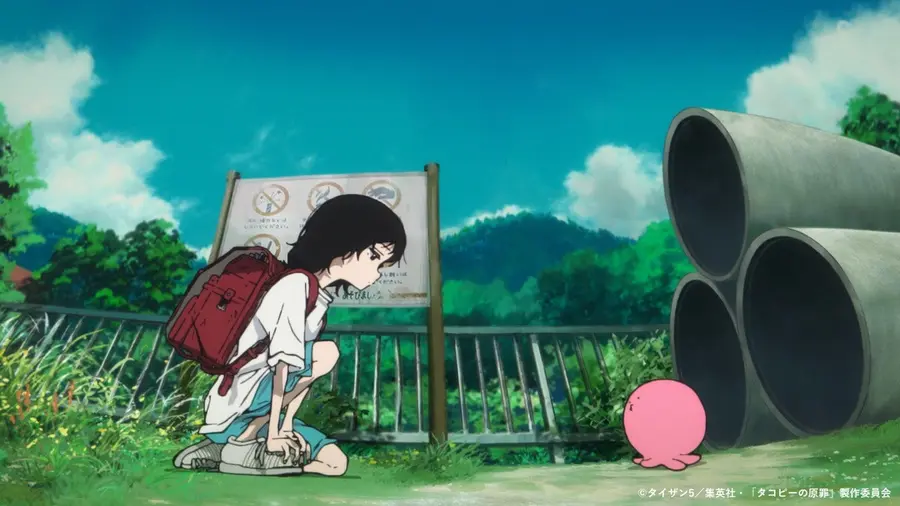
It's so cute, yet it got rejected by the broadcasting station. With such young friends appearing, it received a rating of not suitable for teenagers. The cartoon counters the outdated notion that "cartoons are only for kids". 「Takopi's Original Sin」 has returned as an animation, and it has already been releasing one episode weekly since the first week of July overseas, while it started airing domestically on July 18. The story of the happy alien Takopi and the human girl Shizuka is said to be thrilling enough to create a 'reaction boom' overseas, but what exactly moved them? Let's meet the drama of twists, the art of fishing, and the necessary pre-warning of 〈Takopi's Original Sin〉.
〈Takopi's Original Sin〉 is irony itself. Not only is the story of the work ironic, but the work itself is as well. The impact of this work is magnified when viewed without any prior knowledge, but conversely, it contains significant 'triggers' (elements that remind one of painful experiences) that require caution. Therefore, this animation inserted a warning from the very beginning. The text reads as follows: "This work contains some sensitive depictions related to life. It is expressed in video to respect the original intent and does not encourage such actions in any way." Thus, even if it is a 'fictional story', I would not recommend it to viewers who find it difficult to see depictions of extreme pain, environment, and psychological states.
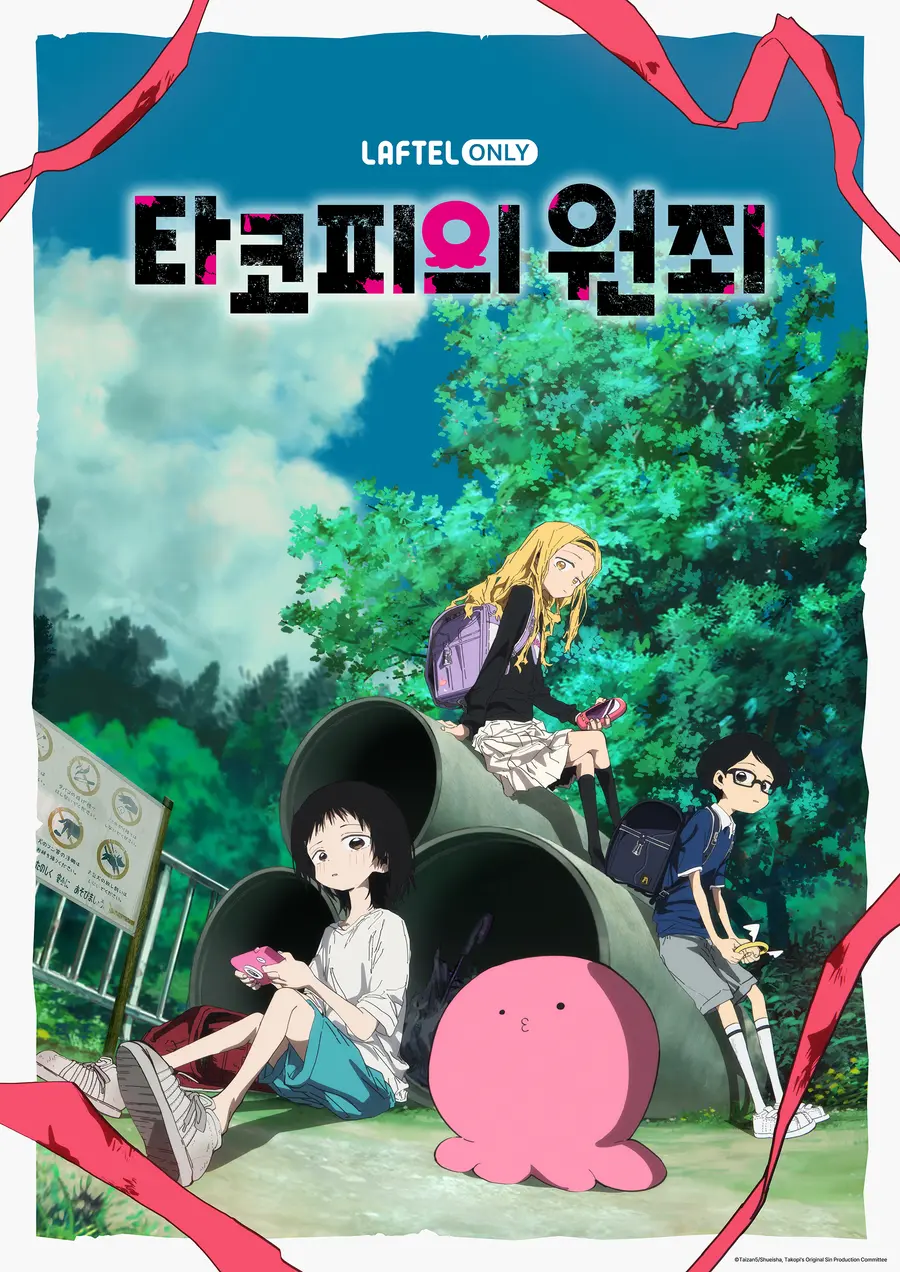
The happy alien Takopi meets a girl named Shizuka on Earth. Shizuka gives the octopus-like alien the name 'Takopi' (where 'tako' means octopus in Japanese) as he ends every sentence with the suffix 'pi'. Takopi, who comes from a planet where everyone is happy and happiness is the highest priority, wants to make Shizuka happy. However, contrary to Takopi's desire to make Shizuka happy, her daily life is already far from happiness, leading to a life-changing event.
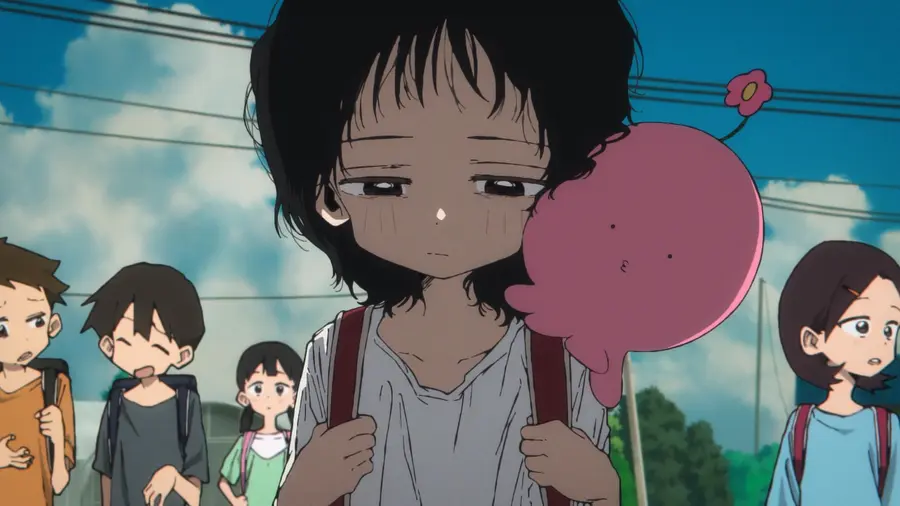
Looking at the pink, round Takopi and the various tools he gives to Shizuka, one naturally thinks of 「Doraemon」. Both characters try to help the protagonist with tools that current science cannot reach, and they are certainly benevolent. However, there is a significant difference between Doraemon and Takopi: their understanding of humans. Doraemon is fundamentally a robot created by humans, so he has a decent understanding of humans and society. In contrast, Takopi from the happy planet only understands the biological characteristics of humans and is ignorant of human traits and society. Therefore, he does not understand the hidden meaning behind Shizuka's words, "Nothing will change anyway." He does not comprehend the significance of a worn-out bag, the scars on her face, or her behavior of hiding in an empty lot when someone passes by. Because Takopi, who prioritizes happiness as a mission, is even more so.
Ultimately, the misunderstanding of humans leads to catastrophe. Takopi, unable to read the signs in Shizuka's actions, tries to correct this catastrophe. However, the more he tries, the more extreme situations arise. Takopi's help provokes Marina, who torments Shizuka, and Marina further harasses Shizuka. Takopi, who knows nothing of violence or bullying, finally understands Shizuka's painful situation, but the situation does not easily resolve. The always exemplary class president Azuma tries to take care of Shizuka, but that alone cannot stop the fundamental bullying.
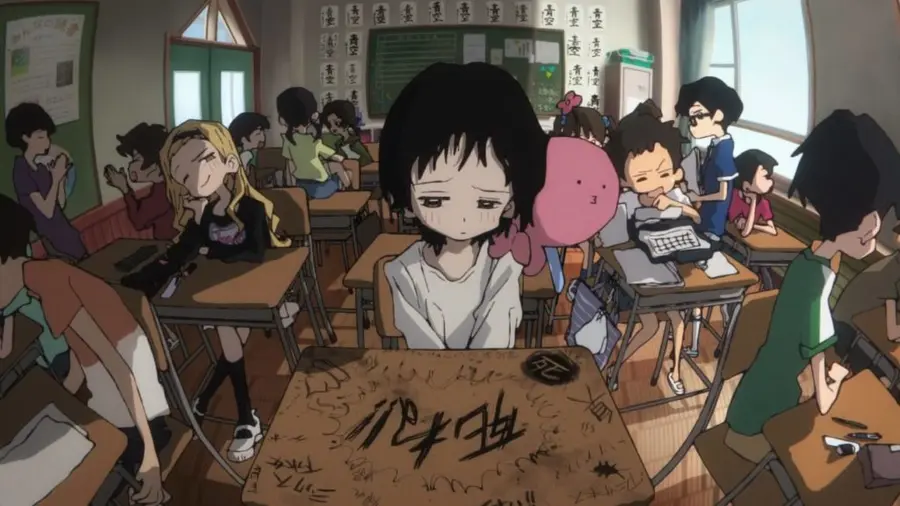
And here, irony occurs again. Marina does not simply bully Shizuka. The moment the true culprit behind the bullying is revealed, viewers unknowingly find some degree of understanding in Marina's actions. While bullying itself can never be condoned, the fact that this child has her own reasons makes one deeply feel that both Shizuka and Marina are essentially not so different as children. As the story unfolds, Marina becomes the victim, and Shizuka transforms into an incomprehensible perpetrator, further confusing the viewers.
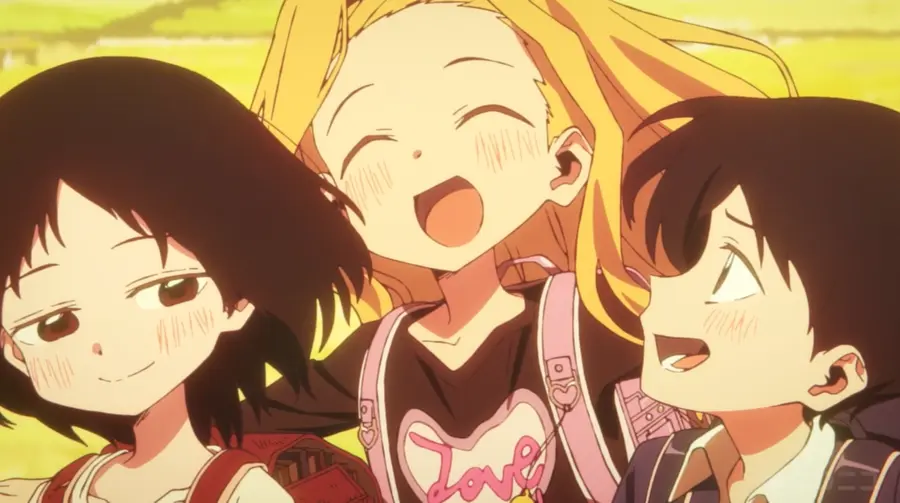
Thus, 〈Takopi's Original Sin〉 presents a world of absurdity that children cannot understand, despite featuring children. The pain felt by children, who cannot easily resist what happens, makes viewers feel the helplessness in the face of absurdity. When the truth of why Takopi's actions are labeled as 'Takopi's Original Sin' is revealed, one realizes the layered absurdity and ironic fate. Moreover, this original sin is not only present in the alien being Takopi but also exists in the world of adults who are responsible for and care for children, which evokes even greater sighs from the viewers.
However, the ending is not entirely absurd. The small steps taken to advance at every moment create a significant change by the end of the work. Although overcoming this tragedy is also riddled with contradictions, the courage to endure it becomes the nutrient that ignites the small seed of hope. Thus, Takopi's 'original sin' subverts the phenomenon of violence that permeates the entire work and opens a path, however weak, towards happiness.
A time of anxiety and pain, yet a faintly flickering hope and steps of living. The message that 〈Takopi's Original Sin〉 conveyed from the original work is still clear in this animation. The courage of the production team to directly translate an unacceptably sensitive subject into video may provide viewers with an opportunity to reflect on their own 'original sins'. 〈Takopi's Original Sin〉 can be encountered through the OTT platform 'Raptel' starting July 18.














댓글 (0)
댓글 작성
댓글을 작성하려면 로그인이 필요합니다.
로그인하기