


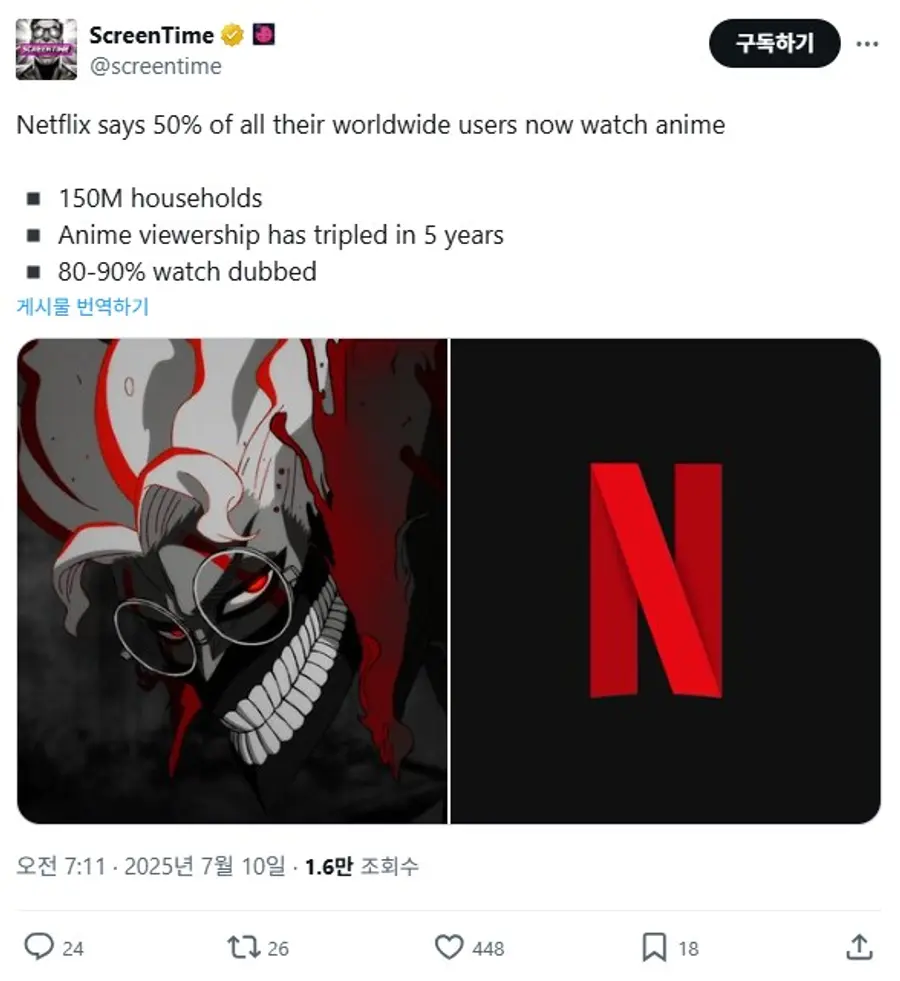
More than 50% of Netflix's global users watch animation, which corresponds to a total of 150 million households, approximately 300 million viewers, Netflix announced at the Anime Expo held in LA. In particular, the spread of multilingual translation of Japanese animation content has been shown to drive this global growth.
According to Netflix, the viewership of animation on the platform has tripled over the past five years, and 2024 is set to be a record year in animation history. This year, a total of 33 animated works have entered Netflix's global Top 10 (non-English) ranking, which is more than double the number from 2021.
At the core of this growth is the global spread of Japanese animation along with the expansion of high-quality translation and dubbing services. Netflix is currently translating Japanese animation into over 40 languages and is actively investing in localization that reflects the cultural characteristics of each region.
Notably, animation is no longer limited to specific age groups or regions, but is loved by all age groups worldwide. According to Netflix's analysis, the age range of animation viewers is evenly distributed from teenagers to those in their 50s, with a particularly rapid increase in the proportion of adult viewers.
Representative success stories include 'Demon Slayer', 'Jujutsu Kaisen', and 'One Piece'. All of these works are translated into dozens of languages worldwide through Netflix and are receiving enthusiastic responses from viewers in various countries.
In the case of 'Demon Slayer', it has been dubbed in various languages including English, Spanish, French, German, as well as Arabic, Hindi, Thai, and has gained popularity comparable to local productions in each region. Additionally, subtitle services are provided in over 60 languages, completely eliminating language barriers.
Industry insiders analyze that the global success of Japanese animation is not only due to the excellence of the content but also supported by advancements in translation and dubbing technology, as well as meticulous localization work tailored to each cultural context.
Thanks to this success, Netflix has announced plans to significantly increase its investment in Japanese animation production in the future. They also expressed their ambition to actively invest in the development of AI-based real-time translation technology to build a global content platform without language barriers.
Experts predict that this trend will spread not only to animation but also to other genres of Japanese content, forecasting that Japanese content will become one of Netflix's core competitive advantages within the next five years.














댓글 (0)
댓글 작성
댓글을 작성하려면 로그인이 필요합니다.
로그인하기