


![Han Kang's 'The Funeral'[Provided by Arko. Prohibited for resale and database use]](https://cdn.www.cineplay.co.kr/w900/q75/article-images/2026-03-19/539dac9c-44f0-4cd9-9d73-fd4757da150b.jpg)
Nobel Prize-winning author Han Kang will showcase installation art at the 61st Venice Biennale. The theme for the Korean Pavilion in 2026 has been confirmed as Liberation Space: Fortresses and Nests. Han Kang's work, The Funeral, is a visual outcome mourning the historical wounds of the Jeju 4·3 Incident. The charred black trees in a snowy field symbolize the victims and represent a masterpiece that recreates the key motif of her renowned novel No Farewells and the author's dreams. The great artist's perspective, which transcends literature into the realm of art, is drawing global attention in the art world.
![Noh Hyeri's 'Bearing'[Provided by Arko. Prohibited for resale and database use]](https://cdn.www.cineplay.co.kr/w900/q75/article-images/2026-03-19/8304e13e-46cf-4bf6-bd7d-14e2a74caa22.jpg)
The interior of the Korean Pavilion transforms into a massive Liberation Space. At its center lies Noh Hyeri's Bearing. A giant hut made from over 4,000 crosspieces is composed of eight stations encompassing mourning, remembrance, and perspectives. Han Kang's The Funeral perfectly unites with the Mourning Space. This collaboration, which breaks the boundaries of literature and sculpture, presents a new artistic practice aimed at healing historical wounds.
![Choi Goeun's 'Meridian'[Provided by Arko. Prohibited for resale and database use]](https://cdn.www.cineplay.co.kr/w900/q75/article-images/2026-03-19/f235fd5d-ee7e-4a33-9964-98e4c1b21556.jpg)
Choi Goeun's Meridian penetrates the physical limits of space. Utilizing copper pipes used for plumbing, this work crosses the interior and exterior of the building, forming a Path of Qi that unblocks stagnant flows. Notably, it pursues a groundbreaking mutual intervention that extends the artwork into the neighboring Japanese Pavilion. This is regarded as a groundbreaking effort to dissolve the boundaries between national pavilions and foster genuine solidarity through art.
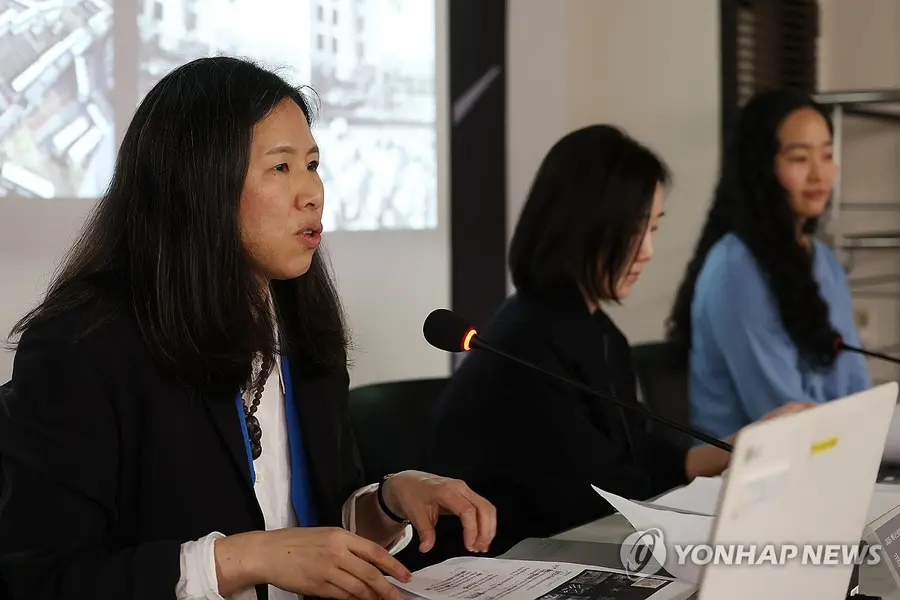
Art Director Choi Bitna, who oversees the 2026 Korean Pavilion, defined this exhibition as a currently unfolding movement space. Going beyond the historical context of liberation during the Japanese colonial period, it embodies a philosophy seeking new practices of sovereignty in the turbulent waters of modern history, such as the recent emergency measures of December 3rd. It heralds the birth of a Liberation Space that will present a strong inspiration and a milestone of change in a world divided by ideological conflicts and extremism.
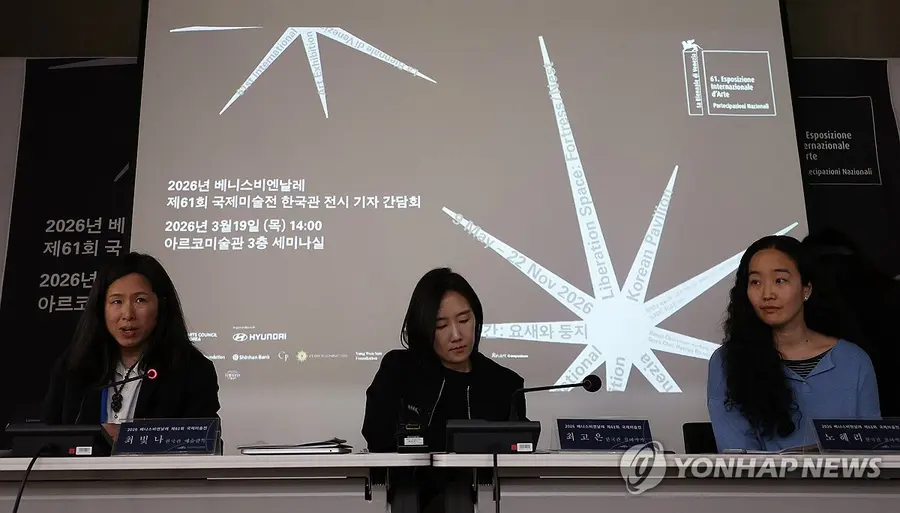
The briefing session held at Arko Art Center on the 19th was a platform to announce to the world the blueprint of the Korean Pavilion for the 2026 Venice Biennale. Under the direction of Choi Bitna, the collaboration of Choi Goeun, Noh Hyeri, and Han Kang transcends the mere national pavilion exhibition. Fellows from various fields, including farmers, musicians, and photographers, are expected to join together to create diverse discourses. A stage is being prepared to prove that art is the most powerful weapon to soothe the wounds of the times and envision the future.

![[Photo &]](https://cdn.www.cineplay.co.kr/w160/q75/article-images/2026-02-13/871e59d5-ffd0-4698-aacc-102a1872d1e0.png)

댓글 (0)
댓글 작성
댓글을 작성하려면 로그인이 필요합니다.
로그인하기