


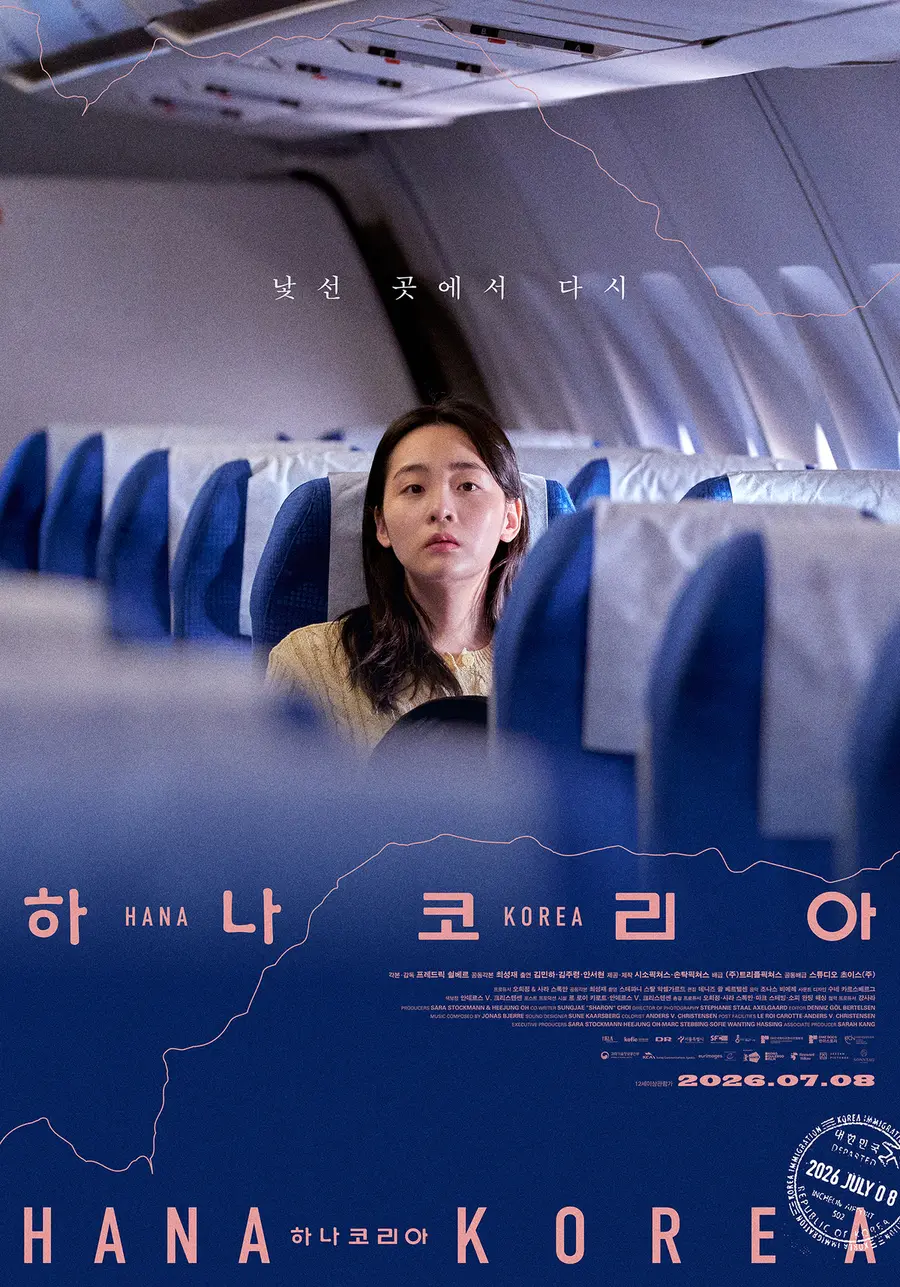
〈Hana Korea〉 tells one of Korean cinema’s most familiar stories in one of its most unfamiliar forms: a film by a Danish director, set in Seoul, about a North Korean defector. At times it unfolds like a Scandinavian film, yet its setting and faces are unmistakably Seoul, with Kim Min‑ha at the center. 〈Hana Korea〉, which opens on July 8, was directed by Danish filmmaker Frederik Solberg / Frederik Shilberg and centers on the story of a woman who defected from North Korea. With its static mise-en-scène, restrained emotional arc and distinctive synthesizer score, the film sits at the opposite end of the spectrum from typical content that uses North Korean defectors as spectacle.
Although directed by a Danish filmmaker, the film avoids consuming defectors’ stories as spectacle and refuses to confine its view to unrelenting pity or sympathy. It does not spotlight the toughness of women who defected, dwell on the details of their arduous escapes, declaim the tragedy of division, or gussy up South Korea as a land of unalloyed freedom. Instead, the film dryly traces the emotional shifts experienced by a defector who has settled in Seoul. Along the way it captures everything from the first flutter of settling in to the hollow, cold aspects of Seoul that sit behind the fantasies spawned by K-dramas. It feels truly Seoul-like precisely because it also feels alien.

Kim Min‑ha is striking here, carrying the film’s national and personal history with remarkable restraint. 〈Hana Korea〉 lines up internationally recognized actors, including Kim Min‑ha of Pachinko, Kim Joo-ryung of Squid Game, and Ahn Seo-hyun of Okja. In addition, screenwriter Choi Seong-jae (Sharon Choi), well known as director Bong Joon-ho’s interpreter, co-wrote the screenplay with Frederik Solberg / Frederik Shilberg. Over roughly five years they interviewed about 30 North Korean defectors to deepen the film’s authenticity.

On the afternoon of the 26th, CGV Yongsan I'Park Mall hosted a press screening and press conference for 〈Hana Korea〉. Director Frederik Solberg / Frederik Shilberg, co-screenwriter Choi Seong-jae (Sharon Choi) and actors Kim Min‑ha, Kim Joo-ryung and Ahn Seo-hyun attended and answered questions from domestic reporters.


At the event, director Frederik Solberg / Frederik Shilberg framed 〈Hana Korea〉 as a film that “focuses on what happens at the place of arrival rather than the place left behind,” clearly distinguishing it from existing works about North Korean defectors. Screenwriter Choi Seong-jae said, “Stories about young women who have made that journey tend to be consumed as spectacle,” and added that with 〈Hana Korea〉 he wanted to tell “a story about the emotional journey.” Choi said, “When we met people who came from the North during our research, what many of them said was that life became harder after settling in South Korea,” and he added, “We tried to dig deeper into the loneliness and isolation of not being able to share with others, and the emotional difficulties that follow.”

After her breakout role in Apple TV+’s 〈Pachinko〉, Kim Min‑ha plays Hye-seon, a woman who defected and now stands alone in an unfamiliar world. Hye-seon is a character who arrived in South Korea with her life hanging in the balance, and Kim Min‑ha delicately renders Hye-seon’s quiet resolve, her endurance and forward motion, and, at times, the childlike excitement of tasting freedom for the first time. The film begins with Hye-seon reciting a letter to her mother, and because it does not force emotion, the scene feels all the more moving. Kim said, “Because the film was inspired by real people, I felt we had to treat it with great care,” and she added that she divided Hye-seon’s emotional shifts after arriving in South Korea into fine-grained phases and worked to guide them herself.


The film also traces the diverging emotional journeys of three women who have settled in South Korea: Hye-seon, the resilient Suk-hee (played by Kim Joo-ryung) who, despite her own pain, looks after others, and Bomi (Ahn Seo-hyun), who is placed in a new environment and radiates naïveté. Kim Joo-ryung, who plays Suk-hee, said, “Suk-hee is not someone who has overcome her wounds; she is someone who first learned how to carry them and endure,” adding that she focused more on swallowing feelings internally than on overt expression. Ahn Seo-hyun, who plays Bomi and revels in the freedoms of South Korea, said the character 'expresses herself instantly rather than maintaining a long cadence' and 'responds instinctively from moment to moment rather than moving through scenes in a single emotional register.'

〈Hana Korea〉 is a distinctive film that presents a story about Korea through the eyes of a Danish director. On that point, Frederik Solberg / Frederik Shilberg said, “If there is something Hye-seon and I share, it is an outsider’s perspective of not belonging to Korean society,” explaining why he told the story of defectors and Seoul from an external viewpoint. Because of that outsider’s lens, 〈Hana Korea〉 includes scenes that may feel oddly unfamiliar to Koreans precisely because they are so familiar. Kim Min‑ha singled out the Olive Young scene among the Seoul images captured from an outsider’s view as particularly striking. She said, “I found the scene interesting from the script. If you think about it, Olive Young’s hollow friendliness represents a part of Seoul. It can feel like you are with someone while still having a private, solitary feeling — a kind of invisible wall. Those things clearly appear in Seoul, and the film captured that underside.”
The film 〈Hana Korea〉 opens on July 8.




댓글 (0)
댓글 작성
댓글을 작성하려면 로그인이 필요합니다.
로그인하기