


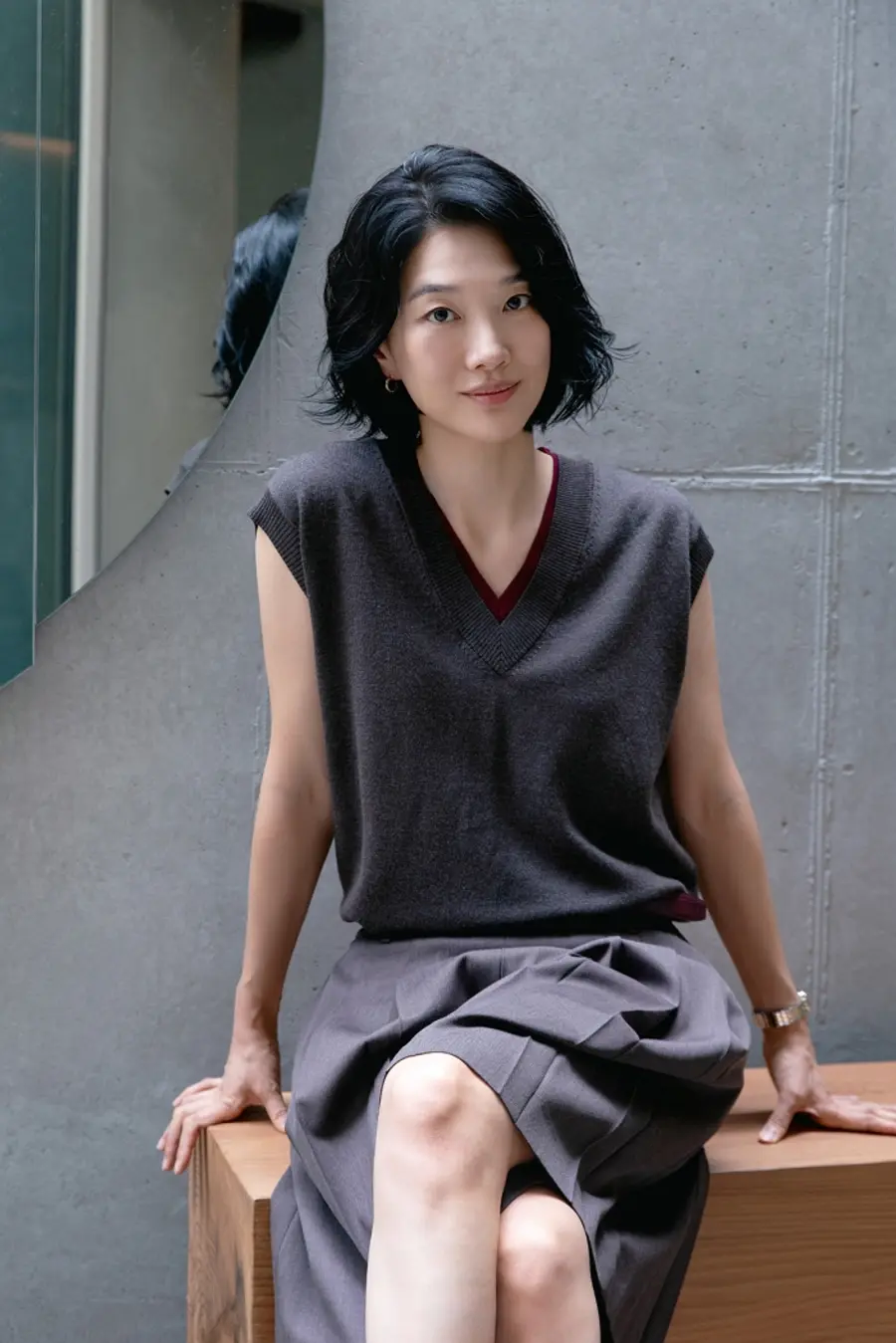
Actor Jeong Yun-ha reflected on her turn as the villain Kusunagi Jin in Disney+ original series 〈A Shop for Killers〉 Season 2, sharing affection and reflections in a post-finale Q&A released by Saram Entertainment on the 18th, after all Season 2 episodes were made available on the 12th.
〈A Shop for Killers〉 Season 2 is an action series in which Ji-an (Kim Hye-jun), now the shopping mall's new chief, joins forces with her uncle Jin-man (Lee Dong-wook), who has returned alive, to take on the powerful organization "Babylon." Jeong Yun-ha joined this season as a key player in the role of Kusunagi Jin, who oversees Babylon's East Asia branch and drives the show's narrative as a central villain. She drew praise for moving among Korean, Japanese and English and for charting the character's shifts from icy restraint to explosive fury.
Jeong said she entered filming just two to three weeks after her casting was confirmed, adding, "I was doing a theater run at the time, so I was frantically preparing a script in three languages and firearms action, but that made the project all the more dear to me." Of Kusunagi she said, "He is a thorough result-oriented person and a sociopath who does not care about the process for the sake of outcomes. I aimed to portray, in a nuanced way, the sense of deficiency and the compulsive desire of an 'outsider' who belongs nowhere."
Below is the full Q&A with Jeong Yun-ha.
Q1. All episodes have been released. How do you feel about finishing the project?
- I feel relieved that Kusunagi Jin's story has finally been fully revealed, but I also feel a sense of loss at the parting. In fact, I started filming just two to three weeks after my casting was confirmed. I remember being incredibly busy because I was also performing in a play at the same time. With a script in three languages and firearms action to prepare, there was a lot to do, so looking back now the project feels even more dear to me.
Q2. Kusunagi, newly introduced in Season 2, is the head of Babylon's East Asia branch and a core villain. What was your first impression of Kusunagi when you read the script?
- I interpreted Kusunagi as a strategist who wants to be the "grandmaster of chess," someone who designs the board and manipulates it. He is a thorough result-oriented person who doesn't care about the process if it serves the outcome. Underneath that, I felt there is an inferiority rooted in being neither Korean nor Japanese—an "outsider" who cannot belong anywhere. That sense of lack turns into a competitive drive to win and prove himself. I approached that drive as akin to a primal appetite and a compensatory urge. I wanted to portray a character who believes he controls his obsessive, distorted desires but is in fact being ruled by them.
Q3. Kusunagi served as a central axis of Season 2's narrative. To convey his ambition, deficiency and cold inner life, what acting points did you focus on most?
- I thought Kusunagi was a different kind of villain than Veil. If Veil is closer to a psychopath who can kill without emotion, Kusunagi is a sociopath. He can feel emotions but suppresses and calculates them ruthlessly for his goals. I was always curious how viewers would perceive that.
Because Jin-man, Ji-an and their allies in Season 1 had already established such powerful storylines, I felt a heavy responsibility coming in as a new character in Season 2. It's great to face off with powerful action, but I wanted to create Kusunagi's unique charm. Like masters in the martial world—think of the 'Drunken Fist' archetype—great fighters often have something distinct about them. I wanted to differentiate Kusunagi by giving him an unpredictable, uncomfortable edge.
Q4. Your multilingual performance in Korean, Japanese and English stood out. What work did you do to build the charisma of a global commander while delivering lines in several languages?
- I wanted each language to reveal a different face of the character. With English, I preserved a formal, almost bookish tone to convey a certain elegance. With Japanese, I used a masculine, mercenary-style register appropriate for a hired-soldier organization. With Korean, I placed the speech closer to the language of a businessman running an enterprise rather than that of a mercenary. It wasn't easy in a short preparation period to make the texture of three languages distinct, but it was necessary to establish the character's layered facets while maintaining overall coherence.
Q5. Kusunagi exerts a chilling strategy and precise tempo control when pressuring opponents. How did you plan micro-expressions or gestures when acting opposite so many different characters?
- I wanted to express psychology through action, which naturally led to many psychological gestures involving the hands. Vocally, I deliberately broke the flow of consciousness with a staccato rhythm and tried to disrupt conventional breathing patterns. I thought that the mismatched tempo itself would create alienation and discomfort for viewers and be the most precise way to reveal Kusunagi's twisted interior.
Q6. From the restrained relationships with Q, J, and K to the tense dynamics with Jin-man, Ji-an and Veil, how was the chemistry with the other characters? Are there memorable behind-the-scenes moments or exchanges of acting energy on set?
- First, Kim Hye-jun, who plays Ji-an, has a presence that draws people both on and off camera. She helped the new characters in Season 2 integrate naturally into the story, and I received a lot of support from her.
Senior actor Lee Dong-wook was a major figure in the project and a great mentor. With his experience and veteran status, I received much advice from him. For the sake of the realism of my performance, he even performed with me in scenes where he had to lie on cold concrete, acting fully in each take.
Thanks to the actors from Season 1, Kusunagi came to life. I am grateful.
Q7. Kusunagi goes on a rampage in the latter part of the story and ultimately meets his end, leaving a powerful afterimage. What did you feel acting the character's final moment, when many emotions collide?
- It was the moment a person who had been swinging rapidly between cold reason and burning desire finally collapses. He was someone who had compulsively suppressed his impulses but was instead dominated by them, so when that control completely breaks, I wanted his most petty, shabby self to surface. I hoped the end of that desire would feel empty and hollow.
Q8. You have built a diverse body of work across film, television and theater. What significance will 〈A Shop for Killers〉 Season 2 and the role of Kusunagi hold in your filmography?
- Some viewers may have found my acting approach unfamiliar. But that process became an opportunity for me to deeply consider diversity as an actor. At the same time, as someone who works in popular entertainment, I realized that thinking about and maintaining a close connection with the public is also part of an actor's craft. Kusunagi Jin was both a challenge and a lesson—a character that will stay with me for a long time.
Q9. Please give a final message to viewers who watched 〈A Shop for Killers〉 Season 2 and followed Kusunagi's journey to the end.
- Thank you sincerely for watching and following this character to the end. I poured myself into creating this role in a short preparation period, so I am truly grateful you stayed with us. I will work to show even more varied sides of myself and to draw closer to audiences in the future. Stay healthy and be happy.


![[4K/FULL]](https://img.youtube.com/vi/KqwXgRV7R58/maxresdefault.jpg)
댓글 (0)
댓글 작성
댓글을 작성하려면 로그인이 필요합니다.
로그인하기