



Sung Ki-hoon is what kind of existence to you? A pathetic middle-aged man who digs into his mother's chest in the swamp of loan sharks and gambling, a warm soul who cannot turn away from the pain of others even in the face of death, a tragic figure who tries to save everyone but instead leads to destruction... All these aspects are Sung Ki-hoon. <Squid Game 3>, which revealed itself to the world on June 27, captured the shocking end of Sung Ki-hoon. The person who must have been more curious about Sung Ki-hoon's end than any audience would have been Lee Jung-jae, who played him. Meeting actor Lee Jung-jae at a cafe in Jongno-gu, Seoul on the 3rd, he shared honest and in-depth answers to the many questions surrounding <Squid Game 3> as the companion who has spent the longest time with the character Sung Ki-hoon.
I can't help but talk about the performance of <Squid Game> Season 3. It is said to be a record-breaking achievement for Netflix. It recorded 60.1 million views just three days after its release, causing Season 1 and Season 2 to also gain traction. You must feel very proud.
First of all, thank you so much for the great interest. I think it is significant that Korean content has set such records on Netflix. The phenomenon of people gaining interest in Korean content through <Squid Game> and looking for more is the most gratifying thing. We have to keep going in the future.
You have been doing global promotions continuously. (Since last October, <Squid Game> has held large-scale fan events in Europe, South America, and North America.) If there is a moment that stands out the most, when would it be?
The reactions from fans are the most impressive. Seeing fans come to events dressed in <Squid Game> costumes made me feel that they are truly enjoying the work. I also thought it was great that Netflix organized such a large-scale event with attention to very detailed aspects. I appreciate that they are spending that much money to promote Korean content.
The finale of this event was at Gwanghwamun Square in Seoul, right? (On June 28, there was a 'Squid Game Parade' co-hosted by Netflix and the Seoul Metropolitan Government. About 38,000 fans gathered for the parade.) It was an event unlike anything seen in Korea before. It must have a special meaning.
Honestly, I talked a lot about this with Hyung-bin (Lee Byung-hun). "Is this really okay?" It felt like the return of Olympic athletes in the 80s... (laughs) I was worried that citizens might feel uncomfortable. I could see that the people preparing for it must have struggled in the very humid weather. It was an event that brought more concern than joy and happiness.
*The following contains spoilers about <Squid Game 3>.
In a past interview with foreign media, you mentioned that you were surprised to see the scripts for Season 2 and Season 3. I'm curious about what surprised you when you first saw the script.
It was definitely Sung Ki-hoon's choices and actions at the end. I was actually so curious after receiving the script that I thought, 'Should I read it from the end?' (laughs) But I usually save the fun parts for later. So I read through it, and I was surprised to face an ending I didn't expect. On one hand, I thought it was an ending that could satisfy all the viewers who liked <Squid Game> Season 1.
On the other hand, I thought Director Hwang Dong-hyuk is an amazing person. Of course, he wrote a good script, but he could have wanted to extend a successful project longer, but he decisively cut it off with Sung Ki-hoon's death. When I first received the script, it wasn't planned to be divided into Season 2 and Season 3; it was just 13 episodes of Season 2. It was impressive that he decided to finish it with those 13 scripts without looking back. I felt that was a great courage.

While reading the script, was there another scene besides Ki-hoon's ending that left a strong impression?
The scene where Jun-hee gives birth. It was so horrifying. (laughs) In Season 1, there were 456 beds set up, and 456 people sleep and wake up there. As the game progresses, the beds and characters disappear, and in the end, only three remain: Sang-woo, Sae-byeok, and Ki-hoon, with only three beds left, and it felt so empty. The floor was soaked with blood. This is an image that remains in my memory from filming Season 1. When I entered to shoot the first accommodation scene this time, it was the same. I thought, 'This clean floor will be stained with blood,' and I felt that feeling from back then. But to give birth in such a place! It was horrifying as I read the script.
As you mentioned, reactions to the ending of <Squid Game> Season 3 are divided. I imagine you must have thought about how to persuade people about this as an actor who has to perform it.
I think most filmmakers would know that this ending is not one that most people will like. (laughs) Anyone in this game would know that. Moreover, Hwang Dong-hyuk, who made <The Beauty Inside> (2014) and <The Fortress> (2017), is not someone who doesn't know what the public will respond to. But this director values the message of the work more and chooses it, knowing what kind of reactions might come.
There are also many differing opinions about Sung Ki-hoon's character. In fact, Sung Ki-hoon is a very human yet heroic figure, a character with duality. How did you analyze the character of Ki-hoon?
Should I call it a 'revolution'? (Or should I say 'rebellion'?) 'People's uprising'? Please use the best word. (laughs) I placed significance on the fact that Ki-hoon tried everything he could until the end. He did as much as he could within this worldview, but he failed. Psychologically, it was heartbreaking to see him show a tendency to shift his mistakes onto others. It was the same in Season 1. When he approached Sang-woo (Park Hae-soo) while he was sleeping to kill him, Sae-byeok (Jung Ho-yeon) stops him, saying, "You're not that kind of person, uncle." But in Season 3, he ends up doing such actions. It was sad to see him engage in such misguided behavior.
And then another temptation comes. The Front Man gives him a knife and says, "If you want to save the child, kill those people." At that moment, he wavers. At that time, he sees a vision of Sae-byeok again. Although Sae-byeok appears in image form, Ki-hoon's conscience, which had failed by killing Dae-ho (Kang Ha-neul), is restored, and it seems to be an important turning point not to make a second mistake. And this leads to the choice to save the child. From Ki-hoon's perspective, it's a tremendous narrative.

Ki-hoon also has a daughter. There are reactions that it is hard to understand that he sacrifices for a child he doesn't know, even though he has his own daughter outside the game. What do you think about this?
I think viewers may not understand it in their own way, and it may not make sense logically. From my perspective, I wonder how much probability I have of winning the game if I abandon this child. Even if I leave this child behind, I wonder if I can survive and get out for my daughter.
On the other hand, the scene where Ki-hoon stares at Dae-ho in the early part of the work is gaining attention.
When we first had a screening in the U.S., the audience laughed. The director was a bit taken aback at first, thinking, 'Is something wrong?' I heard that in America, they laugh out loud when it's funny.
I think it must be frustrating that my intentions are not being conveyed in the phenomenon of divided reactions to <Squid Game> Season 3.
Of course, it's frustrating, and sometimes I want to explain or make excuses for it. But I've been doing this for a long time. When I was younger, I used to divide films into commercial and art films. There were comments like, 'That person makes money-making movies,' or 'I'm an art film director.' But now, the boundaries between commercial and art films are blurred. I don't know how others think, but personally, I think it's good to try new things like this.
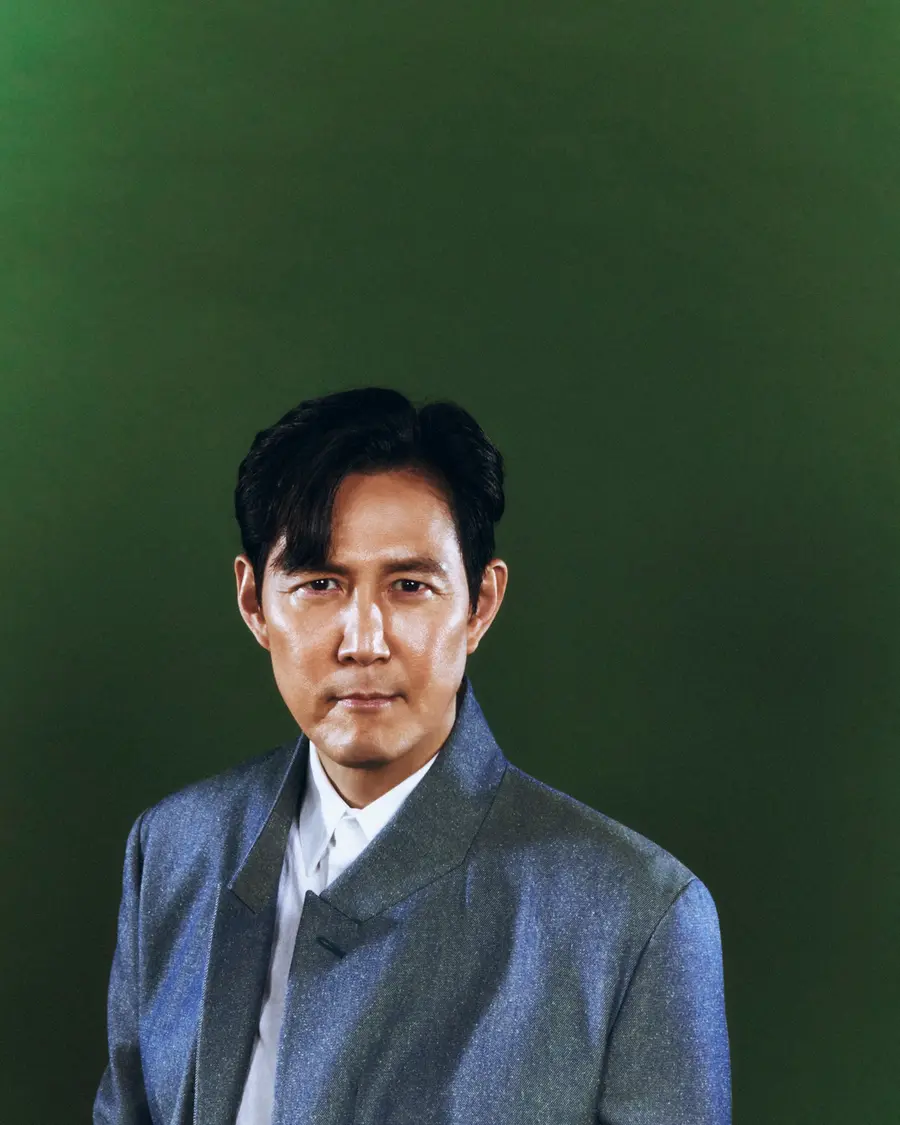
I think this might be the busiest time in the last five years of actor Lee Jung-jae's career. You didn't just do <Squid Game>, but you also directed, wrote, and produced with <Hunt> in 2022. You also appeared in the Disney Plus drama <The Acolyte> after moving to Hollywood. What is the reason for your challenging path, and what is the source of this tremendous energy?
I have a bit of a sense of responsibility. It's not something I intended, but it's true that my area has expanded due to good opportunities. Also, I gained a lot of experience from <Squid Game>. I want to share these experiences with many colleagues. I hope that the next success will be theirs, and that it will lead to better Korean content. The film market has shrunk a lot now. I want to try until it works.
So, are you still writing scripts even in the midst of this busy schedule?
Yes, I just finished one and sent it to the U.S. (laughs)




![[Interview] 〈Squid Game 3〉 Wi Ha-jun](https://cdn.www.cineplay.co.kr/w160/q75/article-images/2025-07-10/13b6bd68-b64a-4cb8-9970-237c8fbc06c9.jpg)
댓글 (0)
댓글 작성
댓글을 작성하려면 로그인이 필요합니다.
로그인하기