


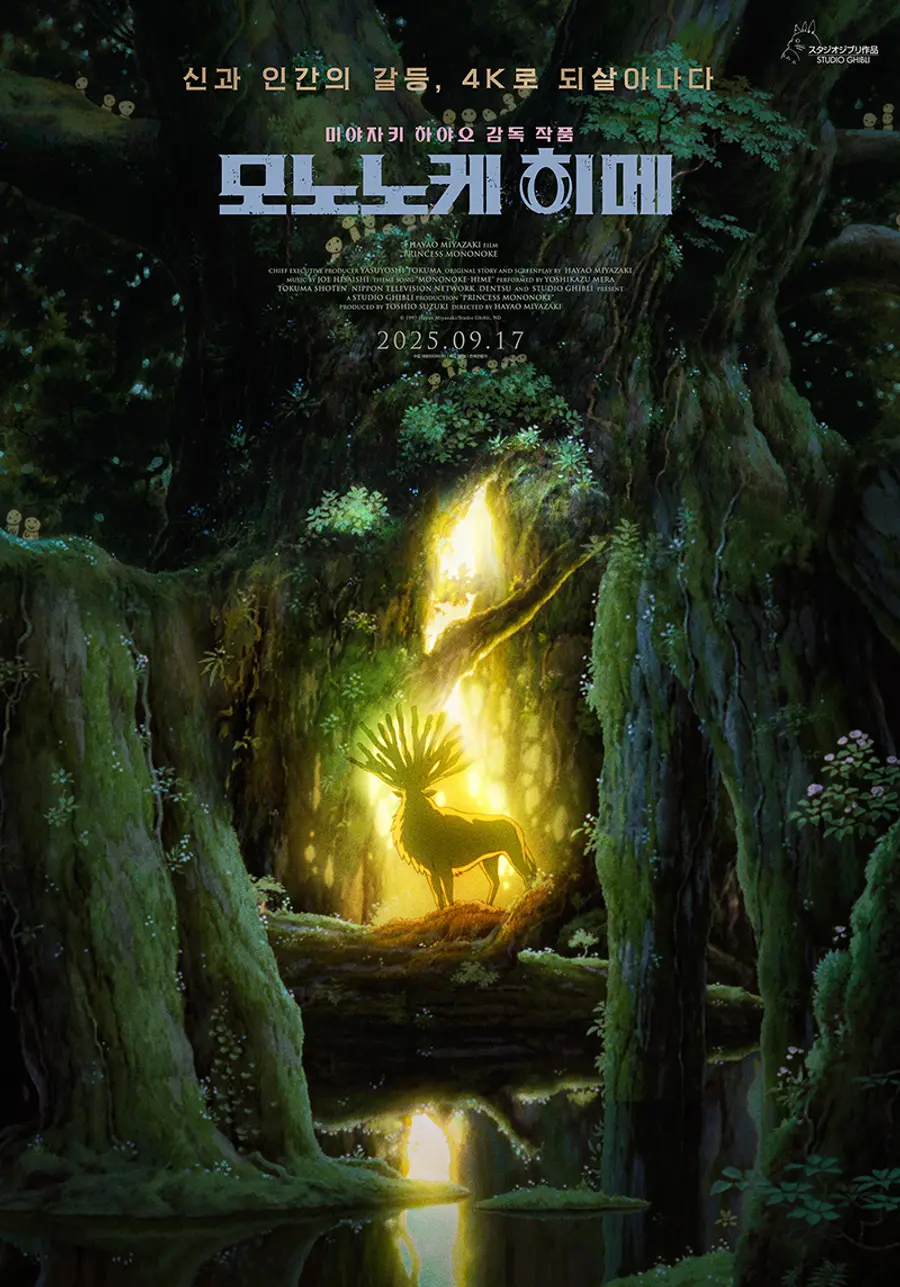
The film 〈Princess Mononoke〉, which is the first of Studio Ghibli's re-releases to confirm an IMAX 4K remastering premiere screening, has revealed its production behind-the-scenes. 〈Princess Mononoke〉 is a fateful epic that depicts the struggle for coexistence between humans and nature, featuring 'Ashitaka', who is cursed by the God of Disease, meeting the forest spirit 'San'. This work, considered the essence of director Hayao Miyazaki's direction, conducted numerous outdoor shoots in the forest to realistically capture nature, bringing realistic landscapes to the screen. Furthermore, it directly filmed the elusive primeval forests that are not easily accessible, creating a wondrous and fantastic visual representation of the forest, which is the core of the work's world. Additionally, meticulous attention was paid to sound effects production to enhance the perfection of the forest. The flow of air and the faint sounds made by trees, recorded deep in the mountains, vividly express the breath of calm and peaceful nature, as well as the tension of anger directed towards humans.
The 'Emishi' village, where 'Ashitaka', who is cursed while protecting the village from the God of Disease, grew up, is modeled after Japan's Shirakami Mountains. The Shirakami Mountains, a UNESCO World Heritage site, is an area where primeval forests are fully preserved, holding a mysterious landscape that is not easily accessible. The characteristics reflected in the 'Emishi' village add a unique sense of mystery that guides the audience from the beginning of the work. Additionally, the costumes of the villagers were designed by borrowing traditional attire from the Bhutanese highland ethnic group to highlight their characteristics, which are isolated from the outside world, reinterpreting colors and shapes. This emphasizes a realistic ethnic texture while completing an original cultural hue that fits the film's worldview.
In contrast, the 'Tatara' village located in the west reveals a facet of human society that destroys nature for the advancement of civilization. A massive ironworks factory stands within a structure resembling an autonomous village, and the name 'Tatara' is derived from the traditional Japanese iron-making method. This method requires constant foot-pumping to blow air, accompanied by extreme labor that involves continuously applying high heat to charcoal fuel for three days and nights. The 'Tatara' village in the film is not just a simple iron production site but serves as a key stage that shows the clash between civilization that seeks development by destroying the forest and nature that strives to protect it.
Set in the medieval Muromachi period, 〈Princess Mononoke〉 is the first period drama directed by Hayao Miyazaki. The Muromachi period, which experienced upheaval in politics, economy, and culture, is defined by the director as a turning point when "the relationship between nature and humans began to change," and the work delves deeper into the message of 'coexistence between nature and humans' that he has consistently presented through various works. In particular, 〈Princess Mononoke〉 does not simply define 'evil' but poses new questions to the audience. While beings that harm nature are commonly perceived as 'evil', in the work, those who destroy the forest are depicted as humans working for survival and development. This vividly reveals the realistic dilemma between the effort to protect human life and the value of preserving nature. Thus, 〈Princess Mononoke〉, which takes the complex relationship between humans and nature as its core theme, transcends a simple good-and-evil dichotomy and resonates deeply, establishing itself as a timeless masterpiece.






![[Korean Box Office] Movie 'Zombie Daughter' Dominates for 4th Week... 'Demon Slayer' Takes the Top Spot in Pre-sales](https://cdn.www.cineplay.co.kr/w160/q75/article-images/2025-08-08/a3204888-0a5a-48c6-9693-9a3495637c93.jpg)






댓글 (0)
댓글 작성
댓글을 작성하려면 로그인이 필요합니다.
로그인하기