


![Friend of Silence movie poster [Provided by Andamiro]](https://cdn.www.cineplay.co.kr/w900/q75/article-images/2026-04-01/2bac7ff7-3aa7-432b-a1f6-b1f8242e1b8c.jpg)
With her latest work, Hungarian-born director Ildikó Enyedi, 〈Friend of Silence〉, is drawing attention as the second film in which Tony Leung has appeared outside the Chinese-language sphere since 〈A City of Sadness and Flower of Shanghai〉 (2021). Set in 2020, while neuroscientist Tony (Tony Leung) is working in isolation at a university in Germany, the film interweaves the stories of Grete (Luna Baderler), who becomes the campus’s first female student in 1908, and Hans (Enzo Bloom), who falls in love with plants in 1972. What’s easy to summarize is a human-centered synopsis, but the ambition carried by 〈Friend of Silence〉 goes far beyond that. I met with director Ildikó Enyedi, who visited Korea with actor Tony Leung.
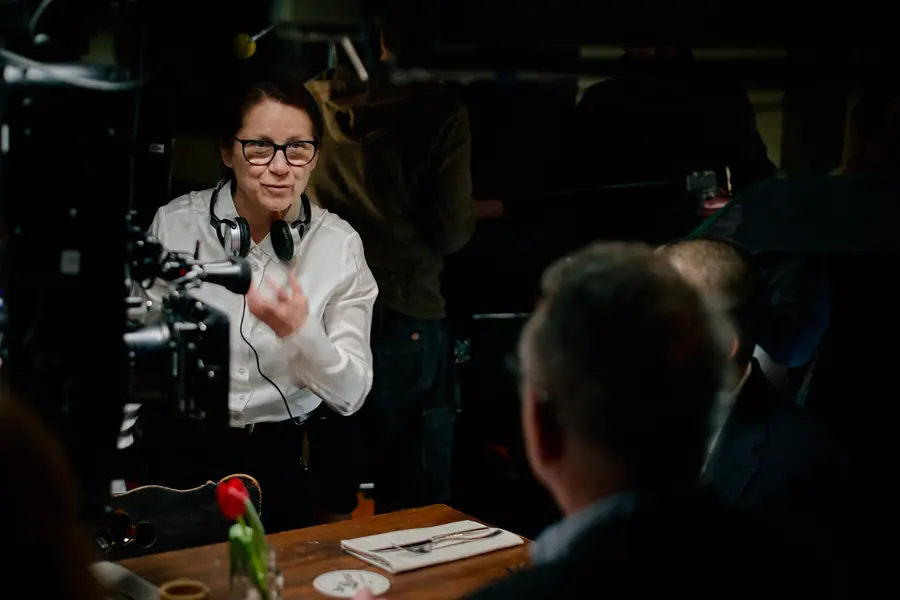
〈Friend of Silence〉 is a quiet film—yet, at the same time, it’s packed with nonstop kinetic energy beneath a calm, still-life-like surface, as if it were a movie where trees and flowers simply rest.
You said that since the plants don’t move, it feels like a still life—but actually, that’s something we’ve misunderstood. It’s a human illusion. We interpret other things through the timeline of humans. Even the sense of time we feel isn’t fixed with precision. Seeing 30 frames per second, or measuring a heart rate of 60 beats per minute within a minute—those all vary depending on a person’s physical condition; nothing is absolute. Mimosa pudica, which scientist Alice—played by Léa Seydoux—explains, is a perfect example. We say it seems like the mimosa moves, it reacts—but that’s an extremely human way of looking at it. It’s just that a point of contact between plant time and human time happens to form, becomes visible to our eyes, and then we call that “reacting” to humans. Even the very definitions of “living” and “dying” differ between mammals and plants. Of course, since we watch the film from within many human conditions, we can’t fully step outside. But at least when audiences watch 〈Friend of Silence〉, I hope they’ll recognize that there is another world beyond a human-centered way of thinking—and feel curious about it.
In an interview from 2018, you said you were writing a screenplay for a new work, 〈Friend of Silence〉, with a tree as the main character. That was before the COVID-19 pandemic—so how did 〈Friend of Silence〉 change before and after the pandemic?
The structure itself didn’t change. There was already a setting where a professor arrives in Germany in 2020 and lives in isolation, but when I wrote the script, I set aside the parts that included my personal story at the time. Then the pandemic arrived, daily life collapsed, and I went through a completely new experience—one that made everyone reconsider their routines and think about how to live. That’s when that section came back. We kept the structure, but rewrote everything from the beginning.
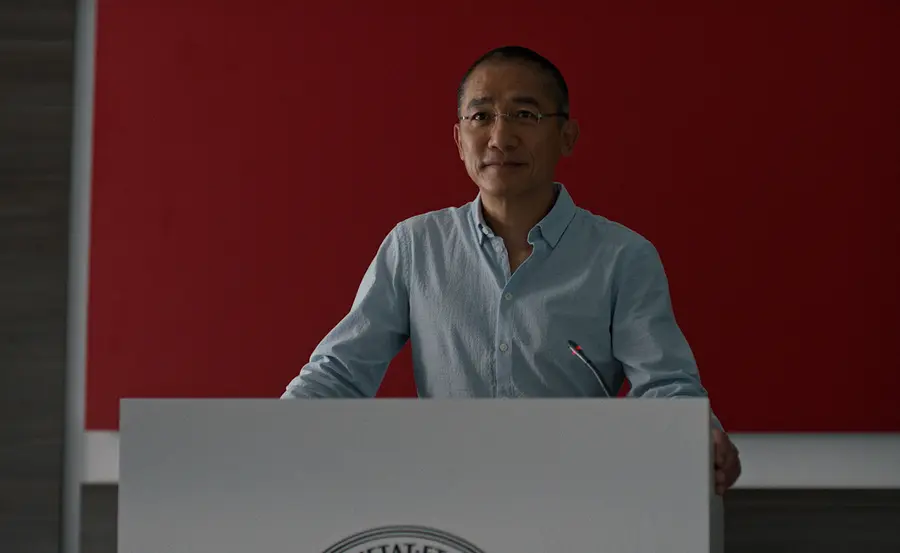
1908 is when the University of Marburg first admitted female students, and 2020 is the peak of the pandemic. Why did you set the 1972 episode in that period? It connects to the director’s time when she was about college age, and the fact that a student studying a different major opens their eyes to the world of images also brings her personal history to mind.
Since I thought the differences between each era would need to show clearly, I limited the space—using the same garden, the same walking path, the same library, and so on. Choosing 1908, 1972, and 2020 was meant to capture the moments when people’s “way of seeing” the world changes. In Europe, people say that during the pandemic, consumption of potted plants surged dramatically. Did our perspective on nature change? After the student movement of 1968, in Europe and the United States in the 1970s, young people decided that we would redefine our place in the world—and that the relationship between humans and non-humans would need to be rebuilt, too. It was a huge period when perspectives on life changed completely. There were so many experiments then—especially sensory ones. Whether through psychedelics, or simply living day by day, or encountering many cultures while traveling, the experiments suggested this: perhaps not animals or humans—but could plants have consciousness too? Maybe plants could communicate among themselves. Maybe they have their own world. And then large-scale experiments began. What we see in the film were experiments that actually took place in the early 1970s.
![A scene from ‘Friend of Silence’ [Provided by Andamiro]](https://cdn.www.cineplay.co.kr/w900/q75/article-images/2026-04-01/443ba24e-9f09-476c-bc39-b602ee98e57c.jpg)
When I read the synopsis, I thought it would take the form of an omnibus film that ties together three short stories at a glance—but it isn’t. It’s a structure where the two stories seen from the perspective of 2020 cross each other through that ginkgo tree. Why did you choose this kind of structure?
I didn’t design the structure with the intention of moving from one era to another step by step. I just had a principle: the point where the transition happens shouldn’t be framed as “a human thing.” I edited it so that the audience could feel the tree’s sense of time—so it became very sensory and musical.
You wrote Tony the neuroscientist’s role with Tony Leung in mind. The fact that, in the film, the actor’s name (Tony Leung) is the same as the character’s name is probably for that reason, too. What did you find strongest about Tony Leung in one of his movies?
Not only his acting skill—his presence itself is different. He’s a performer who shines even within simplicity, without relying on gimmicks like action or dialogue. I’ve watched Tony Leung’s work not just in art-house films but also in action films. Since he’s delivered excellent acting in every movie, it’s hard to point to any one film and say, “That’s why.” I’m not the kind of director who makes films on a large scale. Even when everything goes smoothly, it takes about three years. So it’s important to work alongside capable actors as part of a good team, just like that. Human Tony Leung already grasped the core of my story and my philosophy. While writing the script, I had an instinctive feeling that Tony Leung would be a perfect fit—and in our first Zoom meeting, I was able to confirm that I was right. I was so happy.
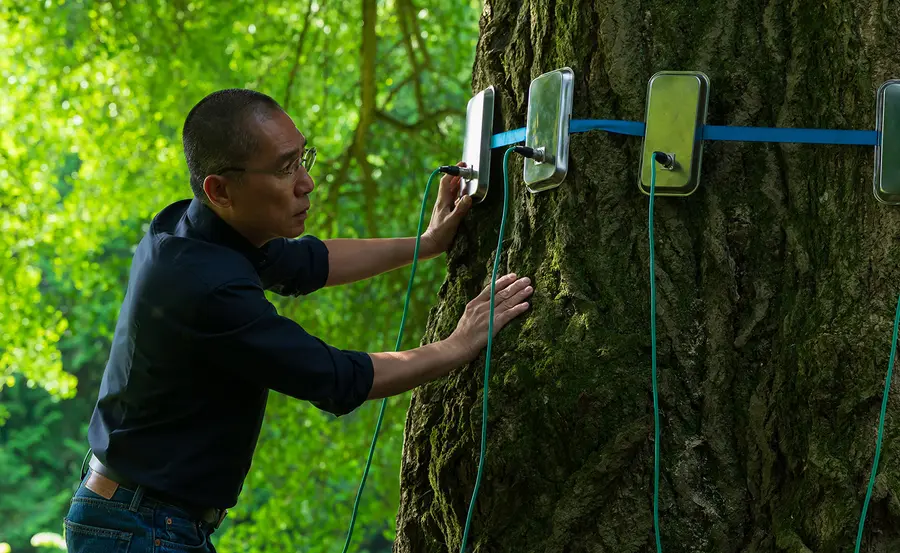
In the film, Tony appears again and again specifically as “a being who eats.” Of course, I understand that it’s also meant to show a different atmosphere when he’s with someone versus when he’s alone—but it amused me that it connects so naturally to the act of eating. I also suddenly remembered 〈The Untranslated〉 and 〈Flowers of Shanghai〉—both of which are Hou Hsiao-hsien films featuring Tony Leung—where “the table” is filmed as something important.
It’s a part I’ve never considered with intention, so I’m genuinely grateful for your comment. All three protagonists are outsiders. Grete is the only woman at a school full of men. Hannes came to the university from a farm. And Tony came from faraway Asia. For Tony, this German city will feel extremely exotic, so he’ll sense his homeland through food. I teach film directing at a university in Transylvania, and I’ve heard that friends who come from far away say they’ve never truly been able to eat the “right” things. When you eat something while you’re geographically and culturally far from where you’re from, it can feel like you’re visiting your original place while you eat—so maybe it’s just my instinct to include those food-related “gods.” Also, the school security guard giving Tony something to eat—someone who initially seemed very distant to Tony—seems like a way to show that hearts connect without words.
It also brings me back to my own personal experience. My husband is German, and he grew up on a very small farm that once connected to the Netherlands. When we were dating, I met his future mother-in-law. She cooked farm food that was incredibly delicious, but also too heavy—and when I ate it, I got a stomachache. But once I started to feel affection for her, I ended up liking even that food. I remember thinking then that food can be a way to accept other people. Last year, at the Busan International Film Festival, I did a GV with 〈Friend of Silence〉. A German audience member talked about food and openly admitted how awful German food is everywhere, saying it was great—then Tony said, clearly, that German food is so bad he gets “homesick” for it. (laughs)
![A scene from ‘Friend of Silence’ [Provided by Andamiro]](https://cdn.www.cineplay.co.kr/w900/q75/article-images/2026-04-01/0b74ab7f-81e1-4cfa-b4de-c9c246991576.jpg)
Personally, 〈Friend of Silence〉 was the film in which I discovered an actress named Luna Baderler. The power of her face was truly remarkable—especially the way it vividly reveals the exhilaration of discovering the world of light and images in a photo studio scene. Following her previous work, 〈Tale of My Wife〉 (2021), I also felt something special in the fact that in 〈Friend of Silence〉, she gave the character Grete the same name.
When I worked on 〈Tale of My Wife〉 as well, I was amazed that she was an outstanding actress—talented and intelligent—even though she was young. Some directors deliberately take many takes, tiring out the actor so that naturalness comes out—but I’m the opposite. I do a lot in pre-production, and when it’s time to shoot, I pull out reactions that can emerge spontaneously in a prepared state. For this film, too, we usually only did two or three takes. Baderler was an actor who delivered immediate, vivid reactions every time while still keeping a consistent approach across takes. Ah, Grete—yes, that was the name of the mother-in-law I mentioned earlier!
All three stories in 〈Friend of Silence〉 show a distinct sexual tension. In the two stories set in the 20th century that depict youth, there’s also clearly a voyeuristic undertone. Even in the 2020 storyline, where Anton, the school security guard, watches Tony, that undertone is present—and the tension is even stronger in Anton than in Alice, played by Léa Seydoux. While I was amazed by the director’s skill in creating that sensuality, what struck me even more was how she erased that tension as if it were nothing—and went beyond it.
That’s a really interesting point of view. As you said, something happens, and then it disappears in the middle. Whether writing the script, shooting, or editing, it was crucial to strike the right balance: for audiences to enjoy the film, you have to describe things in a kind way so they can hold them in place—and on top of that, you need to provide something special. Humans are storytellers. We understand abstract ideas through stories. The core of this film isn’t the story of humans. It’s the story of the tree. To draw in the audience, you have to put human stories in—so that you can see the tree’s soul, the object of those abstract ideas. What I ultimately wanted to show in 〈Friend of Silence〉 was the erotic nature of plants. I wanted audiences to feel that plants can be erotic too—that they experience their lives fully and live joyfully. In the first full draft, there was something sensual between Tony and the security guard. But since we couldn’t get stuck in that, we removed it and rewrote it so that Tony and the security guard together create that kind of erotic elation that helps the ginkgo tree modify the potted plant. Even the sticky sound when the seeds ignite in the first scene was carefully designed to express the plant’s sexual power.
![A scene from ‘Friend of Silence’ [Provided by Andamiro]](https://cdn.www.cineplay.co.kr/w900/q75/article-images/2026-04-01/dd2267c4-e953-41c8-a80e-515314e7fea8.jpg)
Maybe because of the title of the director’s debut work, 〈My 20th Century〉 (1989), the presence of 2020—which is the only 21st-century element in the film—feels even more special. In the film, if 2020 is a time of the pandemic, then looking back now, more than a quarter of a century later, what kind of era is the 21st century for the director?
When I think about the 21st century when I was young, it really felt like a distant future. Back then, the overwhelming sense of the millennium—when the number “one thousand years” changes—was full of hope. I thought the tension in the world would disappear, and there were reasons to believe that. But it seems things went in the opposite direction. It makes me incredibly sad. I also think that, just like the students in the 1970s, today’s students have been given the responsibility to transform the world again. I hope that even though adults today have ruined things, the younger generation will be able to find its way through a world full of conflicts in a wise way.
Cineplay Moon Dong-myung Guest Reporter
AI Usage Settings
Please enter photo description.
![[First reactions] 'Look Back' Cineplay reporters' star ratings](https://cdn.www.cineplay.co.kr/w300/q75/article-images/2026-09-29/86caa45d-4319-4803-92b7-38b58935b7d3.jpg)
![[On the Ground at BIFF] “Art Is Art”: Zhang Yimou Breaks Silence on Historical Controversy Over “Assassins”; Top Asian Film to Be Named on 15th](https://cdn.www.cineplay.co.kr/w300/q75/article-images/2026-10-07/c4d38025-dc2a-4cf0-919a-792227afc5f5.jpg)
![[Photo&] Tony Leung Starring in “A Friend of Silence” Opens Nationwide on the 15th—A Collaboration Between Global Master Director Ildikó Enyedi and a Renowned Leading Actor](https://cdn.www.cineplay.co.kr/w160/q75/article-images/2026-04-01/8db83ccf-787d-4b34-a4a8-1fa3ff22db57.jpg)
댓글 (0)
댓글 작성
댓글을 작성하려면 로그인이 필요합니다.
로그인하기