




▶ 〈Street Fighter〉 Continues from the interview with Callina Liang, who plays Chun-Li.

〈Street Fighter〉 How did you come to join the film?
Kale Boiter, the producer who is one of the film’s unsung heroes, came to see my stand-up show one night. We had dinner after the show and talked about various ideas. The moment Kale brought up “Street Fighter,” I immediately said, “That’s my favorite video game of all time!” I really mean that. Street Fighter remains a hugely important part of my childhood. I was in middle school in New York, and I would run to the neighborhood convenience store on 70th Street and First Avenue with a pocketful of coins I had stolen from my parents. I had only 30 minutes for lunch, so I really had to run. I’d buy a buttered bagel, which they would neatly wrap in the store’s distinctive foil, and spend the rest of my lunch money playing the fighting game “Marvel vs. Capcom.” Back then, there was serious status attached to being good at games. If you were good, you could earn a certain standing at school. I always chose Street Fighter characters. Street Fighter was the first video game I truly had for myself as a kid. Everyone plays “Super Mario” at least once. But Street Fighter was the first game I became genuinely obsessed with.
Given those special memories, how did you feel when you were first offered the role of Hibiki Dan in the film?
At first, they asked, “Would you be interested in appearing in our movie?” and I immediately said, “Absolutely!” Of course, I was thinking to myself, “Am I Ryu? Ken Masters?” But the answer I got was, “No. There was a game that rival company SNK created in imitation of Capcom, and Capcom created a character to make fun of it. His name is Hibiki Dan, and he’s terrible at fighting. His ‘Hadoken’ only travels an inch, and he wears a pink gi.” I thought about it for a moment and said to myself, “That sounds good. It’s perfect. Let’s hear more...” The character I was being offered was someone my friends had never even heard of. Hibiki Dan wasn’t in the “Street Fighter II” we played as kids. My generation didn’t know the character existed. But the more I learned about Hibiki Dan, the more I thought the casting was incredibly well done. No, to be precise, it was so accurate it was almost insulting. Hibiki Dan is a character who is full of bluster but has absolutely no skill. Imagine a producer telling you, “This role is perfect for you!” Then you read the character description and it says you’re overflowing with confidence but have no ability. You’d have to ask, “But why did you think I was such a perfect fit for this role? What exactly did you see in this character that made you think I’d be so good at it?”
How did you get in shape for the role of Hibiki Dan? Was the training intense?
I asked the producer, “Do I need to get into serious shape for this role? I’ve even got all the equipment ready so I can work out...” Before filming, I asked again, “So I need to build a muscular physique, right?” The producer said, “No. You just need to be funny.” That was music to my ears. There was exactly one scene in which I took my shirt off, and we shot it on the first day. The moment that scene was over, I ate everything on the craft-services table for the next two months. I ate every Australian snack imaginable and never skipped the cookies. By the end of filming, I was about as far from muscular as you could get.
After the shirtless scene, what did you enjoy most during filming?
There was a scene with Noah Centineo, Cody Rhodes and me. It was Cody’s first day, and it was also Guile’s first appearance. We had a great time shooting it. The three of us worked out the scene’s flow and rhythm over the weekend beforehand. Because we had already found that rhythm, we kept cracking each other up between takes and had to stop filming. We also improvised and played around a lot. I think that’s the ideal way to shoot comedy. Of course, when we were filming serious scenes, I tried to fully immerse myself in the emotion. But with comedy, it was more like, “All right, let’s shoot this maybe 20 times. Let’s have fun. I’ll try different lines every time and see if I can make these two laugh so hard they can’t continue acting.” I figured that if I could make Noah and Cody laugh, I could make the audience laugh too.
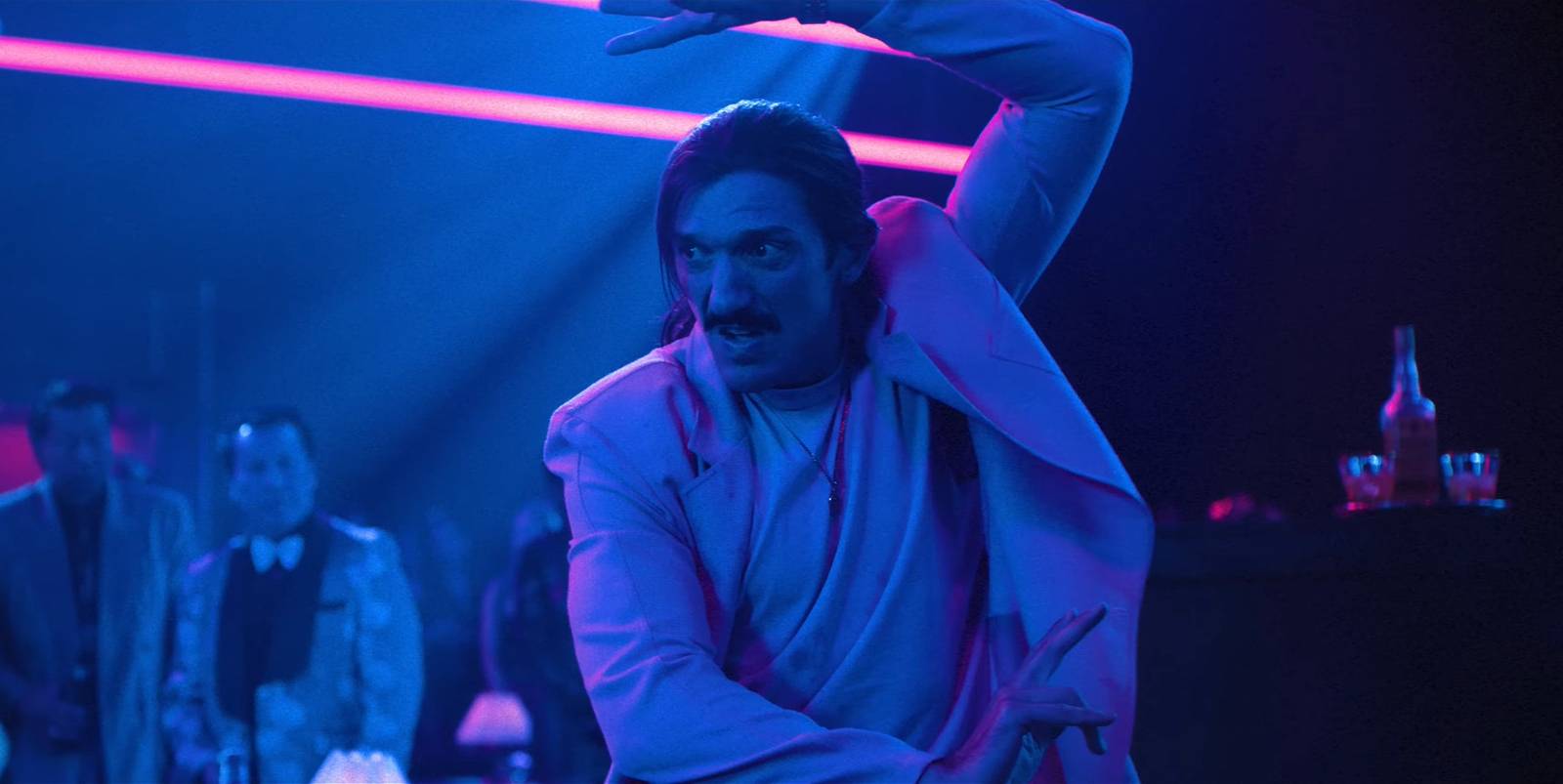
Let’s talk about some of the other signature characters. Which characters did you usually choose when you played the games as a kid? And what was it like seeing those characters in person every day on set as an adult?
I chose Ryu as a kid. I played Ken Masters sometimes, too. When I played “Marvel vs. Capcom,” I chose Ryu and Akuma. But it was almost always Ryu. I wouldn’t even choose other characters for fun. So it was incredible to see Andrew Koji show up on set as Ryu. Andrew took the role incredibly seriously. That made it even funnier. I knew Andrew’s work before the film, but I had no idea what he was like as a person. I had spoken briefly with Noah when he came to one of my stand-up shows, so I had some sense of who he was beyond the character. But when I first met Andrew, it really felt like I was meeting Ryu. I couldn’t tell whether he was doing method acting or whether he was simply like that in real life. (Laughs.) There was something Andrew often did between takes. He would stand on the beach and stare out at the ocean for a long time. I still don’t know whether he was truly immersing himself in the character, but he would stand there completely motionless, looking at the water for an incredibly long time. One thing is certain: Andrew Koji was completely immersed in Ryu.
How was Noah as Ken Masters? Was he completely immersed in the role, too?
Absolutely. Completely. His physique was no joke. There’s a scene in which Ken Masters tries to use a Hadoken, and I was watching Noah film it from the side because I had a scene right afterward. He was tensing every muscle in his abs to summon the Hadoken, and I was watching with my best friend from college, who is now my manager. We looked at each other and said, “Wow, this guy is the real deal!” Noah literally worked out all day on set. He’s someone whose commitment to becoming an action star is on another level. But if that’s what it takes to become an action star, I’ll just remain a comedy star. That’s an insane level of dedication. He worked out so much that his muscles would start cramping. He ate four meals a day, all steak and eggs. His body was unbelievably impressive.
What else should audiences look forward to in 〈Street Fighter〉?
Everyone immersed themselves in their roles to an almost unbelievable degree. But beyond that, they’re simply outstanding actors. Noah did an excellent job portraying Ken Masters. The film also shows him as vulnerable and uncertain. I like seeing someone with a physique as perfect as an action figure’s reveal that side of himself. He feels inadequate as he collides with the world. I don’t want to see an action hero who’s perfect. That’s boring. I want to see someone battered and bruised, someone who can be a jerk sometimes. One thing became clear to me after watching the film. The action is spectacular, the movie itself is fun, and the chemistry among the cast is excellent, but above all, the acting is terrific. You get completely drawn in. When you’re making a film built around important source material like Street Fighter, everyone takes it seriously and wants to get it right. The people on this production had also grown up playing Street Fighter, so they were passionate and excited.
As a longtime fan of the original game, what do you think director Kitao Sakurai brought to the film most successfully in adapting it for the screen?
Director Kitao Sakurai has a very distinctive style, and we talked about it a lot. As we filmed, I gradually got a sense of the film’s tone. First of all, the drama is genuine. It isn’t being used as a device to set up laughs; when a scene is serious, the film commits to that seriousness. Then, when the director suddenly swerves into comedy, as he does throughout the film, it lands much harder because it comes at a moment you never expect. When you’ve been watching a very serious scene and a crude joke suddenly pops up, it’s genuinely funny. You don’t see it coming at all. I really enjoy the director’s style. I always say that this is a movie you can enjoy so much that you’ll forget reality for a while. People who have played the games will feel, “Wow, they really respected the game when they made this.” The action is spectacular, and all the moves fans want to see are there. But the way those elements are woven into the film is deeply faithful to the original game and its established lore. They’ve also deliberately included details that only people who know the game inside and out will catch. Fans will feel as though they’ve stepped into the world they could only imagine while playing the game as children. Back then, we could only imagine how these characters would get along if they actually met, what kind of relationships they would form and where conflicts would arise. Now we get to see all of it firsthand. And for people who were never Street Fighter fans, this is simply a really fun movie. The filmmakers leading the production gave all of us the freedom to offer ideas and help one another bring not only our own characters but the other characters to life. We weren’t asking, “How can I make my character look the coolest?” We were thinking, “What do we need to create for Ken Masters and Ryu?” No one put personal ambition first. That’s why the film has rivalry and conflicting emotions, but it also has love. When all of that comes together, it makes an incredible combination.

![[Written Interview] 'Street Fighter' ⑤ Andrew Schulz on playing Hibiki Dan: “Hibiki Dan is charming because he’s all bluster but has no skill.”](https://cdn.www.cineplay.co.kr/w300/q75/article-images/2026-10-02/5fa62a5e-e327-4577-83c9-3194105e7de5.jpg)
![[Written Interview] 'Street Fighter' ④ Kalina Liang on playing Chun-Li: “Everything you see in the film is my real body.”](https://cdn.www.cineplay.co.kr/w300/q75/article-images/2026-10-02/1723b98f-4889-4b2b-bdc5-cff2a9eee6cc.jpg)




댓글 (0)
댓글 작성
댓글을 작성하려면 로그인이 필요합니다.
로그인하기