


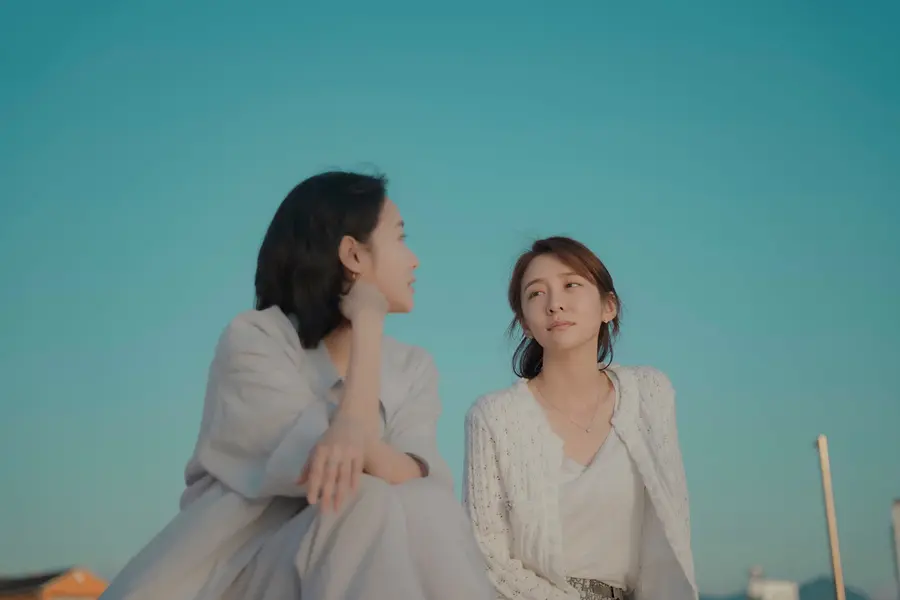
The final scene is quite impressive. Sang-yeon opens the valve without hesitation for his own death. At that moment, did Sang-yeon really have no regrets about life?
I think it was a moment he had been waiting for. As Sang-yeon said, "No one can die as happily as I do," he had always wanted to be freed from pain, so I don't think he hesitated. Actor Park Ji-hyun might have hesitated though. (laughs) I was very sad. When filming Go-eun's bust shot, I had to lie still without moving, but tears kept flowing. Go-eun said, "Sang-yeon, you did well. Sang-yeon, I love you." I didn't expect her to say "I love you." It wasn't in the script, and it didn't appear in the work.
Not only in the final scene, but Sang-yeon in his 20s and 30s doesn't cry much with others, but cries explosively when alone, with a red nose. As a character who cries alone, there must have been many unresolved emotions as an actor.
I cried a lot while reading the script. I wasn't looking at it objectively; I had to interpret the script from Sang-yeon's perspective, so I tried to think only from Sang-yeon's point of view. A scene that comes to mind is when Sang-yeon in his 20s lies to Eun-jung without hesitation. When Eun-jung asks, "Did you like senior Sang-hak?" he lies about liking a guitarist. Eun-jung's innocence at that moment was overwhelming. Sang-yeon lied, but Eun-jung apologized for doubting him. During filming, it wasn't captured on screen, but I cried a lot after Eun-jung left. I felt nauseous at myself for lying shamelessly to a friend who showed me great trust. But I think Sang-yeon might have felt the same. After saying harsh words, he cried where Eun-jung couldn't see. Like when he went to Eun-jung's mom and cried, "Please hug me," he was a friend who cried secretly behind the scenes.
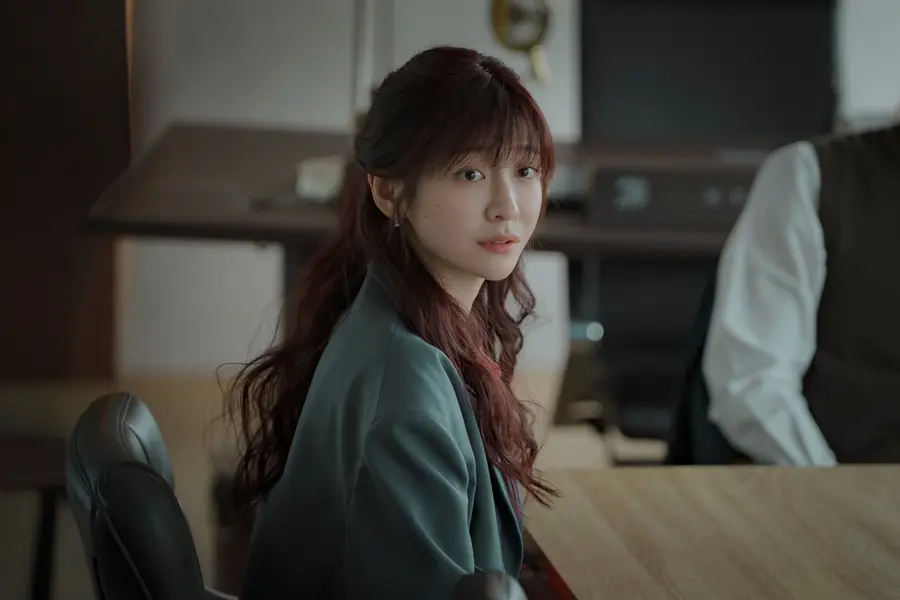
Visually, Sang-yeon in his 20s, 30s, and 40s looks different. In his 20s, he mainly wore achromatic clothes, while in his 30s, he appears with red hair. Was the use of red color by Sang-yeon in his 30s intentional?
I'm glad you noticed. In the message left by Kim Sang-hak to Sang-yeon in his 20s, there's a line, "Don't burn yourself out." So I wanted to express that even if everything else burned, I remained, hence the red feeling. Sang-yeon in his 20s has dark hair. I wanted to metaphorically express the feeling of gradually brightening from darkness.
I've heard that you used a lot of your own clothes and props for the shoot.
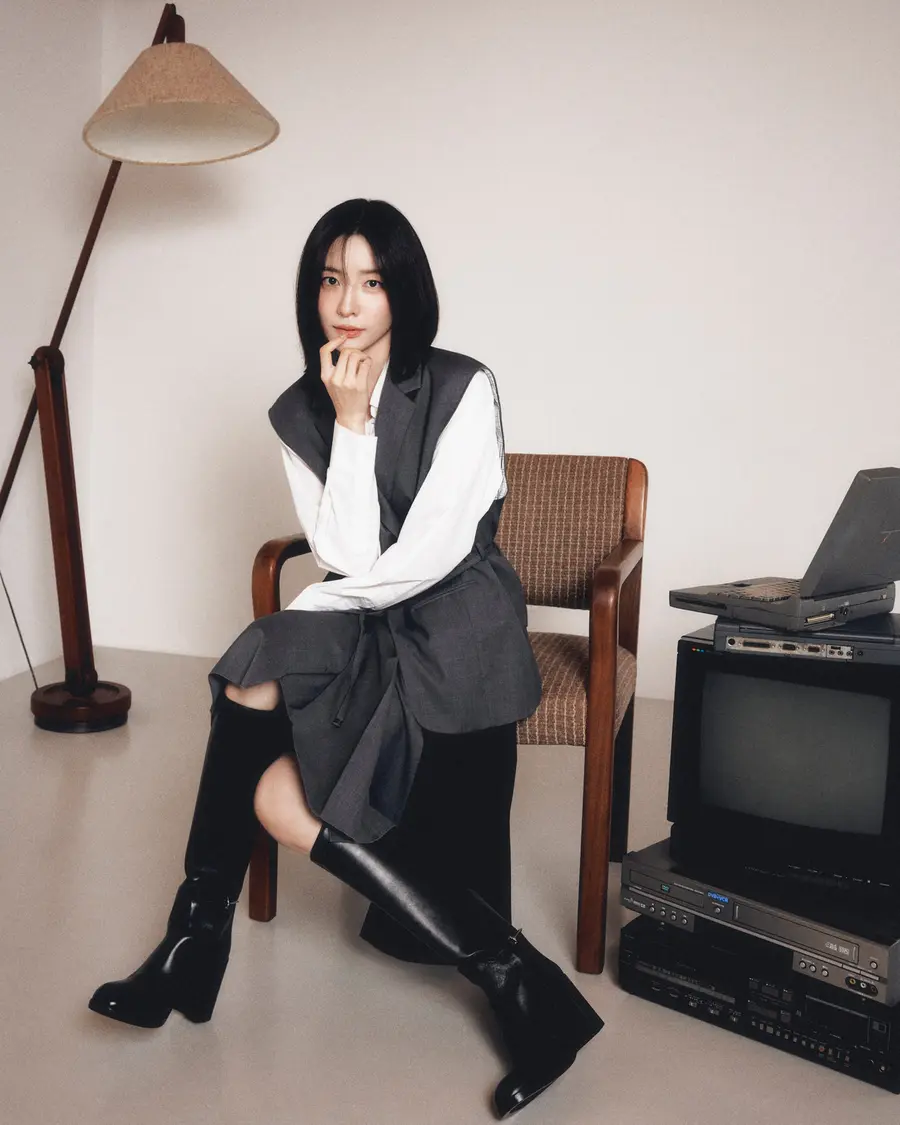
Most of the clothes and props for Sang-yeon in his 40s are mine. When I take on a character, shopping for clothes that fit the character is a hobby of mine. For Hyun-min in 〈The Youngest Son of a Conglomerate〉, I wore vintage clothes I bought. Sang-yeon cost a lot. (laughs) From accessories to sunglasses and bags.
Since 〈You and Everything Else〉 is a work about relationships, it seems your perspective on relationships might have changed while participating in this work. How do you currently think about relationships and understanding someone?
I think it's impossible to fully understand someone unless you become that person yourself. Whether it's a friend, family, or lover, do you have to fully understand someone to maintain a relationship? I don't think so. Even if you don't understand, just acknowledging and accepting that this person is like this and being by their side is what a relationship is, I think. Just recognizing that this person is like this, and I'm not like that, but still being able to stay by their side is a relationship that can last long. I used to think that a friendship meant "100% trust, 100% understanding, and 100% being the same as me," so I thought, "I have no friends." But when I think about it, I can't even understand myself, so is there anyone who knows themselves 100%? I change from today to tomorrow, from a few days ago to now, and even from a few hours or minutes ago to now, so how can I try to understand others? So I think just being there for someone and listening to them can maintain a good relationship.
Since 〈You and Everything Else〉 deals with assisted death, your view on it might have changed before and after participating in the work. How do you currently think about assisted death?
Since it's a work that deals with a sensitive subject and I'm the one involved, I thought that viewers should not feel uncomfortable or upset because of this work. So I felt I needed to study a lot, reading books and watching documentaries. But if I may share my thoughts, I haven't completely separated from the role in the drama, so Sang-yeon's perspective inevitably influences me. Humans can't choose to be born, but at least for those at the end of suffering, I think having the opportunity to choose their death, even if they couldn't choose their birth, is a free ending. However, while studying assisted death, I learned that there are really various types and many legal issues. So I'm still ignorant and can't say "it should be legalized" or "it shouldn't."
With a long holiday starting, it's a good time for those who haven't watched 〈You and Everything Else〉 to binge-watch. Since it's a 15-episode drama, some might hesitate to start. Lastly, what would you say to those who haven't watched 〈You and Everything Else〉 yet?
I think 〈You and Everything Else〉 is a work that touches on life, no matter whose life it is. It's long, but once you start, it's a work with a charm that you can't stop. I'm not saying this because it's my work, but I watched 〈You and Everything Else〉 four times before it officially opened, and countless times after it was released. Each time I watch it, it's new, and I feel different things, learn life lessons, and the dialogues are really good. Those who haven't watched it might regret it. I think your perspective on life might change a lot before and after watching 〈You and Everything Else〉. I'm confident that no one will regret watching it.
![[OTT Ratings] Cineplay reporter ratings for Netflix series 'Scandal'](https://cdn.www.cineplay.co.kr/w300/q75/article-images/2026-09-21/b3a9b606-46e0-40e8-9d5c-c054a0f03ba4.jpg)
![[Interview] Park Ji-hyun Talks About Sang-yeon's Choices, the Existence of Eun-joong, Attitudes Toward Death, and Season 2 ①](https://cdn.www.cineplay.co.kr/w160/q75/article-images/2025-10-01/a9296224-2441-4484-8b95-a319cc32d0b2.jpg)
댓글 (0)
댓글 작성
댓글을 작성하려면 로그인이 필요합니다.
로그인하기