



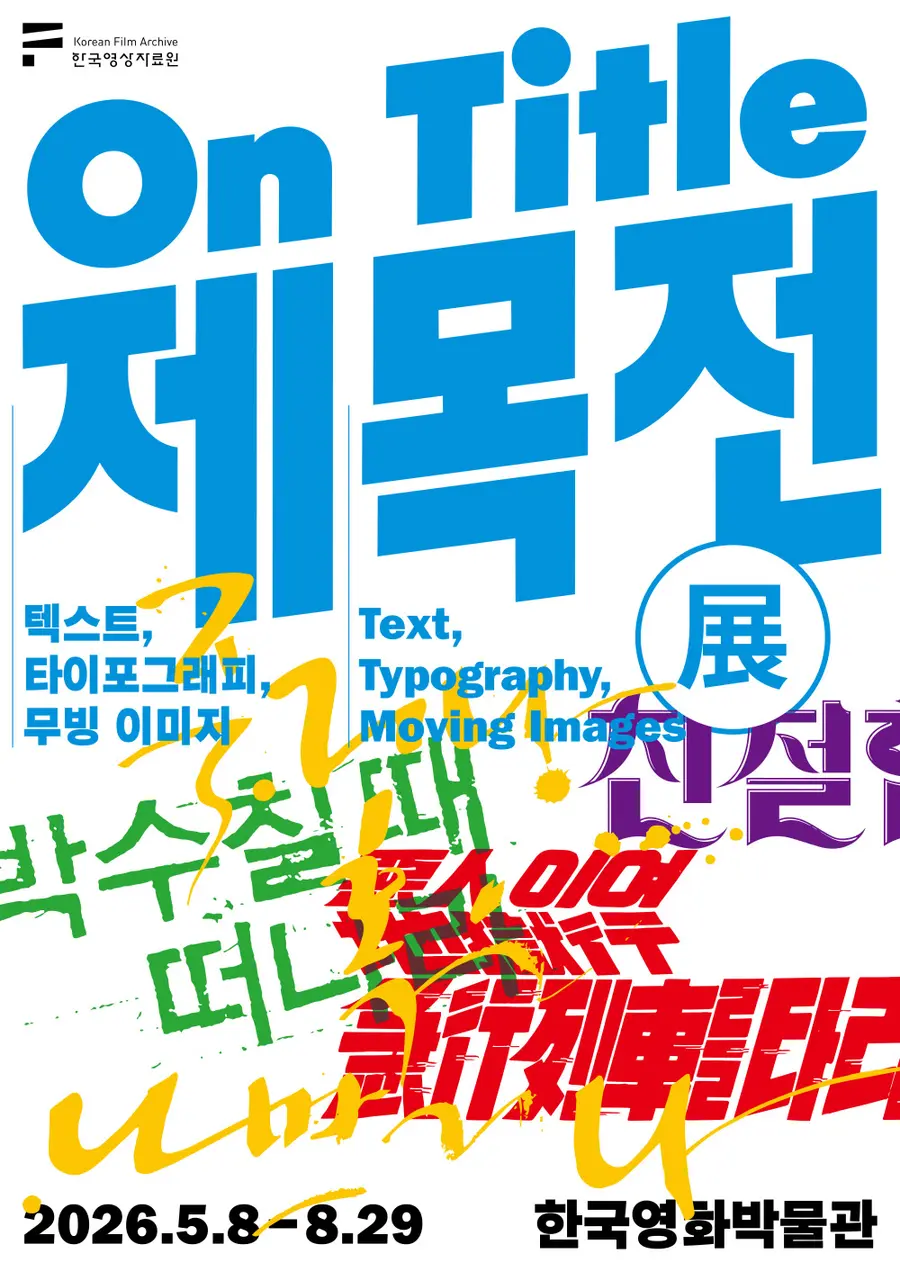
The Korea Film Archive (Director Mo Eun-young, hereafter “Korea Film Archive”) will host the new special exhibition 〈Title Exhibition (展) – Text, Typography, and Moving Images〉(hereafter “Title Exhibition (展)”) at the Korea Film Museum (located in Sangam-dong) starting Friday, the 8th.
This exhibition dismantles the more than 100-year history of Korean cinema into the smallest unit of all—“titles”—and then expands it into images and motion to show the process anew. While analyzing the titles of about 8,400 Korean films from 1919 to 2025, it also presents how, through animation, video, and graphic design, a title is reborn as a visual experience.
#1 “Love” Is the Most Frequently Used Word in Historic Korean Film Titles
What word appears most often in Korean film titles over more than a century of time? The answer is “Love.” 〈Title Exhibition (展)〉 collects and categorizes 8,436 Korean films released from 1919 through 2025, analyzes them through a variety of keywords, and presents a new perspective on Korean cinema.
In the “Top 100 Words in Korean Film Titles” section, words appearing in titles are ranked up to the top 100 based on frequency, showing what kinds of sentiments and narrative structures Korean films have developed within. “Love” was used in a total of 197 films to take first place. It was followed by “Woman” (172 films), “Night” (124 films), “Youth” (77 films), “King” (69 films), “Man” (67 films), “Fellow/Soldier” (67 films), “Flower” (63 films), “Road/Path” (61 films), and “People” (56 films).
Among them, “Love,” which won first place, shows how Korean cinema has advanced with relationship-centered narratives and melodrama at its core. Words surrounding emotions and relationships—such as “Separation,” “Tears,” “Lover,” and “Romance”—also appear with high frequency, revealing that the emotional tone of Korean films leans deeply on feelings and relationships between characters. This tendency has remained relatively consistent from the 1960s to recent times, forming an emotional current that runs through the eras.
□ Why Are There More Words Referring to Women in Korean Film Titles?
A title is not just a label—it is a symbol that reveals the sensibilities and viewpoints of a particular era. From mixed hanja-and-Korean written styles and expressions centered on loanwords to everyday colloquial phrasing, changes in titles reflect shifts in Korea’s cultural trends and popular sensibilities.
In this context, the exhibition sheds light on Korean film titles from a cultural and social perspective. In the representative section “If Your Name Were a Woman,” it compares and analyzes patterns in the use of words that refer to women and men. “Woman” ranked second in overall word frequency, and words referring to women comprised 47 types—about 63% more than the 29 types of words referring to men.
This also connects to the historical flow of the Korean film industry. Narrative structures that have emphasized women characters’ sacrifice and emotions centered on sinpa (new-school tearjerkers) and melodrama, along with the influence of erotic films in the 1970s and 1980s, led to the high frequency of female-related words in titles. Furthermore, if you include expressions that metaphorically refer to women—such as 〈Strawberry That Smelled of the Taste of SanDdalGi〉 (Kim Soo-hyeong, 1982), 〈Rose That Swallowed a Thorn〉 (Jung Jin-woo, 1979), and 〈A Parrot Cried in Its Body〉 (Jung Jin-woo, 1981)—its share expands even more. This tendency is also a clue showing that Korean cinema has long reproduced female characters within specific emotional and narrative frameworks.
□ From Text to Image, Then Back to Motion — Film Titles Reinterpreted by Contemporary Directors
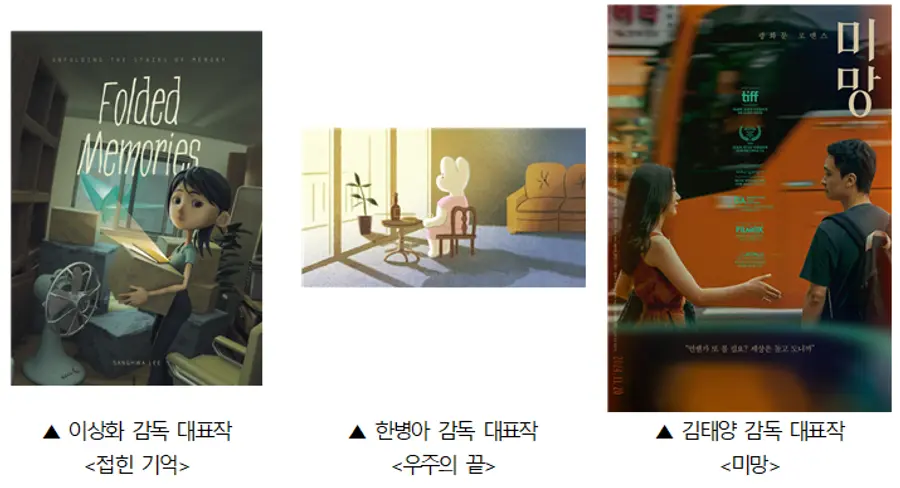
This exhibition expands film titles beyond mere text into “moving images.” The process in which letters change form, shift into scenes, and move with rhythm shows that a title can become a single independent visual language.
To do so, it presents video works in which contemporary animation directors and live-action feature film directors participate to reinterpret Korean film titles in new ways. Director Lee Sang-hwa, who has recently gained attention after being invited to the Maryland Film Festival in the United States and the Anima Arte festival in Brazil, presents an animation work based on Korean film titles and characters from the 2000s. Through morphing animation that quickly varies images from representative works such as 〈Protect the Earth!〉 (Jang Joon-hwan, 2003), 〈Oldboy〉 (Park Chan-wook, 2003), and 〈The Host〉 (Bong Joon-ho, 2006), it visualizes how titles and images combine organically.
Han Byung-a, director and chairperson of the Korea Independent Animation Association, as well as a winner of awards at Jeonju International Film Festival and IndieAniFest, presents a work reinterpreting film titles and images through an animator’s perspective, using as a motif the 1966 film 〈Let’s Meet at Walkerhill〉 (Han Hyeong-mo). In addition, Director Kim Tae-yang, who drew attention at domestic and international film festivals with the film 〈Mirage〉 (2024), participates with a video work that collages the title sequences of Korean classic films—unfolding, visually, the sense of time that a title carries and the layers of film history.
□ A Gathering of Works by Three Studios Leading Korean Film Poster Design
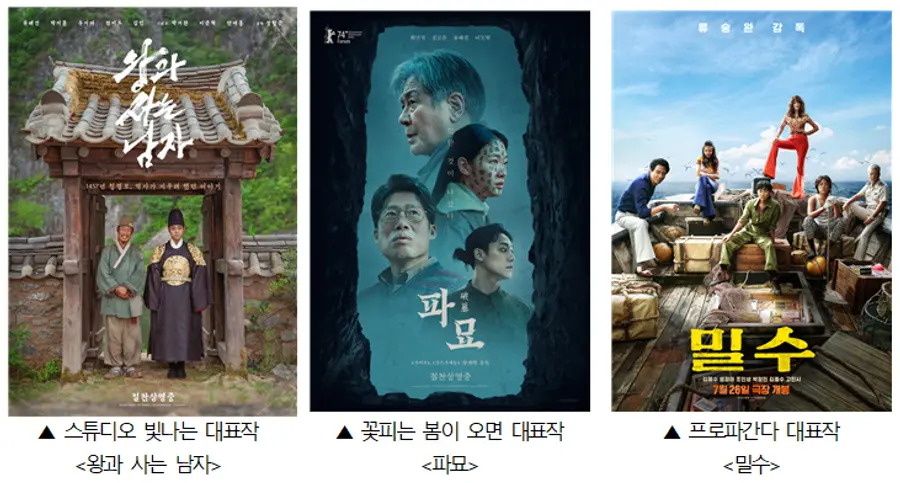
The aesthetics of Korean film titles come through most clearly in poster design. The typeface and design of the title that audiences encounter first before seeing the film serve as an important device that compresses and conveys the film’s mood visually.
In this exhibition, it highlights how titles are realized as images through the work of three key studios that have led Korean film poster design. “Studio Shining (Park Si-young)” showcases distinctive calligraphy works such as 〈The Goon Squad〉 (Yeon Sang-ho, 2026) and 〈Kim Min-young’s Report Card〉 (Lee Jae-eun, 2022), and has recently been drawing attention with posters including 〈The Man Who Lives with the King〉 (Jang Hang-jun, 2026).
“When Spring Comes and Flowers Bloom (Kim Hye-jin)” introduces works that have driven the flow of Korean film poster design—from 〈Either You Die or You’re Bad〉 (Ryu Seung-wan, 2000), to 〈Thirst〉 (Park Chan-wook, 2009), 〈Assassination〉 (Choi Dong-hoon, 2015), and 〈Digging for Fire〉 (Jang Jae-hyun, 2024).
“Propaganda (Choi Ji-woong, Park Dong-woo, Lee Dong-hyung)” shows how title design comes together through calligraphy from representative works and the process behind the work, including 〈New World〉 (Park Hoon-jung, 2013), 〈Little Forest Girl〉 (Jeon Go-woon, 2018), and 〈Smuggling〉 (Ryu Seung-wan, 2023).
This exhibition will be a chance for us to read Korean cinema again through film titles we’ve passed by carelessly, and to expand titles that once stayed as text into experiences of images and motion.
The exhibition can be viewed at the Korea Film Museum starting at 10:30 a.m. on Friday the 8th, and detailed information on how to use it can be found on the website (www.koreafilm.or.kr). Admission to the exhibition is free. (Inquiries: 02-3153-2039)


댓글 (0)
댓글 작성
댓글을 작성하려면 로그인이 필요합니다.
로그인하기