



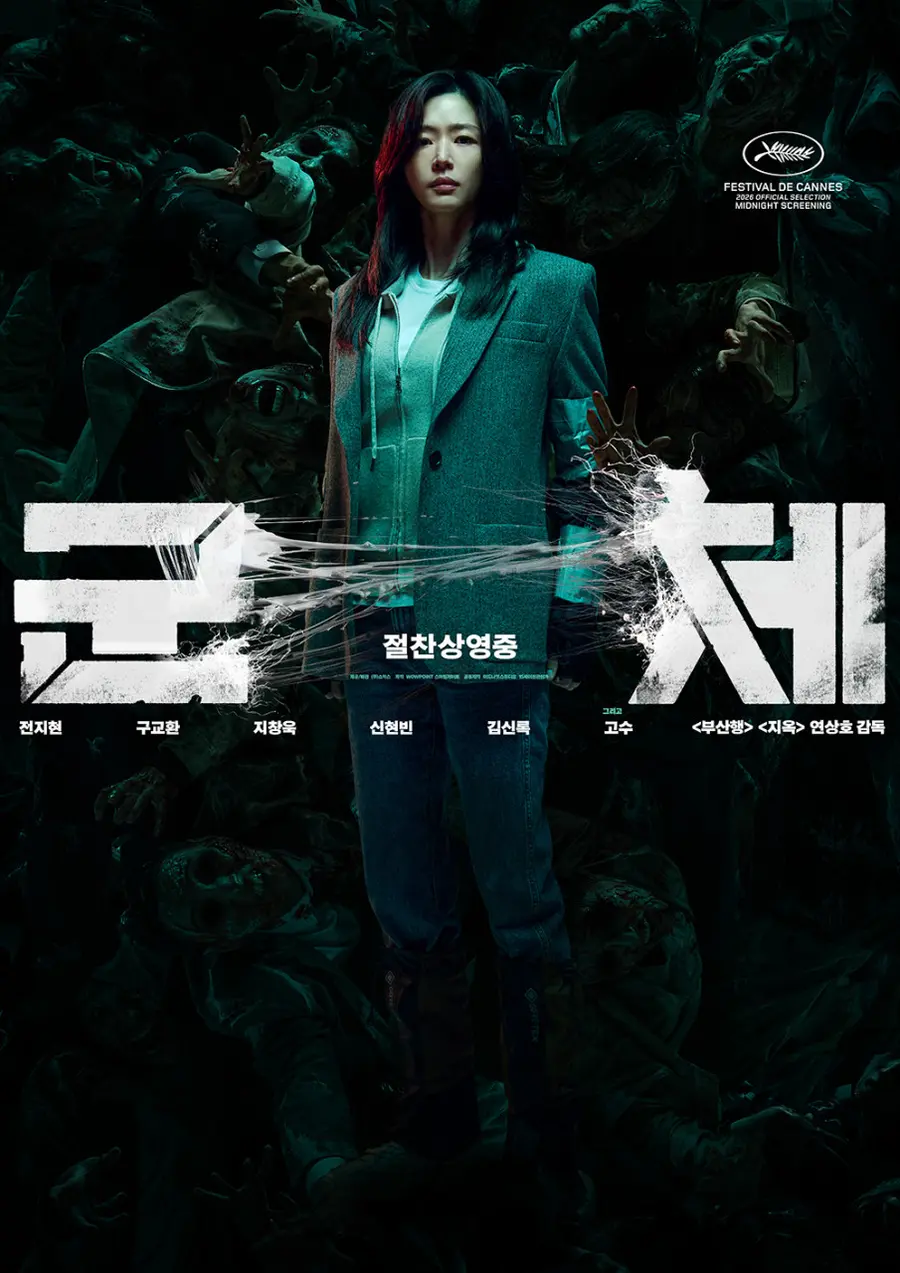
Returning after 11 years, she is, as director Yeon Sang-ho put it, “a film actor.” Actress Jeon Ji-hyun appears as Kwon Se-jung in 〈Colony〉, which opened on May 22, marking her first appearance before audiences since 〈Assassination〉 (2015). Jeon plays Kwon Se-jung, a biotechnology professor who fights to survive in a building cut off by a terrorist attack carried out by a genius biologist. In this zombie horror, which brings together a wide range of characters, she carries the film by accurately portraying a figure who is at times shaken and at times razor-sharp. On May 26, in Jongno District, Seoul, I met Jeon Ji-hyun to talk about 〈Colony〉. Saying, “I rested for the first time yesterday since coming back from Cannes,” she also stressed that “it’s important that the film does well,” underscoring how seriously she takes the film’s performance. Here are edited excerpts from our conversation about 〈Colony〉.
※ The following contains spoilers for the film 〈Colony〉.

A lot of people came over the weekend. Were there particular things you paid attention to that audiences picked up on?
〈Colony〉 is a familiar genre film, but it differs in that it tells a new story. I’m pleased audiences liked it and have talked about those elements. Because Kwon Se-jung anchors the story, I’m glad when people comment on that aspect.
Your stage greetings have been getting a strong response from fans.
The stage greetings have been great. (laughs) I don’t often get to meet or interact with the audience, so I enjoy connecting with them at these events. Our audiences here are exceptionally polite and well-mannered. From the theater stage you can see the crowd clearly, and the message cards are fun to read. There are a lot of message cards for Gu Kyo-hwan and Ji Chang-wook, so they might be hard to read, but I didn’t have many, so mine were more visible. (laughs)
Kwon Se-jung is a very determined character. How did you approach playing her, and were you careful about the many explanatory lines in the script?
Rather than making her feel like an extraordinary person, I wanted Kwon Se-jung’s choices to feel like choices the audience could make as well. I talked that over with the director; I wanted viewers to think along with her and understand her. I needed to understand the explanatory lines in order to deliver them, so I spoke a lot with Yeon Sang-ho, a K-zombie expert whom we jokingly called a 'zombie father.' (laughs) As an expert, he explained things to me first, and I aimed to understand them precisely so I could convey them accurately.
You’re known for your action work, but there weren’t many action scenes in this film.
That was a little disappointing. Because Kwon Se-jung is a biotechnology professor, it would have been hard to accept her as a flashy action figure. So even when I did action, I toned down flashy moves and filmed more restrained sequences.

Did you and the director talk about a sequel while you were together?
The director doesn’t seem keen on the idea of a sequel to 〈Colony〉. He’s a prolific filmmaker, so he talked a lot about his next projects, but nothing is decided. For me, it would be an honor to work with him again. He has so many ideas that he never seems to run dry. He’s exactly the kind of director the industry needs—he gives actors opportunities across a variety of genres and formats. His voice is also very distinct.
When I asked the director about making a full-fledged action film, he said you also wanted to do that.
What would he do without me? (laughs) I say this in every interview: working with him is an honor, and I want to do everything I can if given the chance.
The director said he courted you to join the film and even asked people around you to praise you.
Even if he hadn’t done that, I had watched all his previous work and wanted to be part of one of his projects as an actor. The moment his script arrived I wanted to do it, even before I finished reading. He was probably saying that jokingly.
What was Yeon Sang-ho like on set compared with the image you had of him as a fan?
Directors have a style, and I wondered if he might be particular. But he’s very bright and funny, so the set was a lot of fun. It was the best working environment: everyone arrived and left on time. The director’s vision for the film was so clear that, as an actor, it was comfortable to follow his lead. The set was great, performing was enjoyable, and you can never be disappointed by his results. 〈Colony〉 is no exception. That’s why many actors end up working with him repeatedly.
Audiences may be familiar with zombies, but how did concepts like swarm intelligence and a colony strike you when you read them on the page?
What I found interesting about 〈Colony〉 is how it differs from the traditional zombie. Classic zombies are individuals out of control, but the zombies in 〈Colony〉 have evolved into a network and move as a collective, which is fascinating. I also liked the director’s clever, cautionary message embedded in the film—how modern people increasingly hand over their thinking to AI.
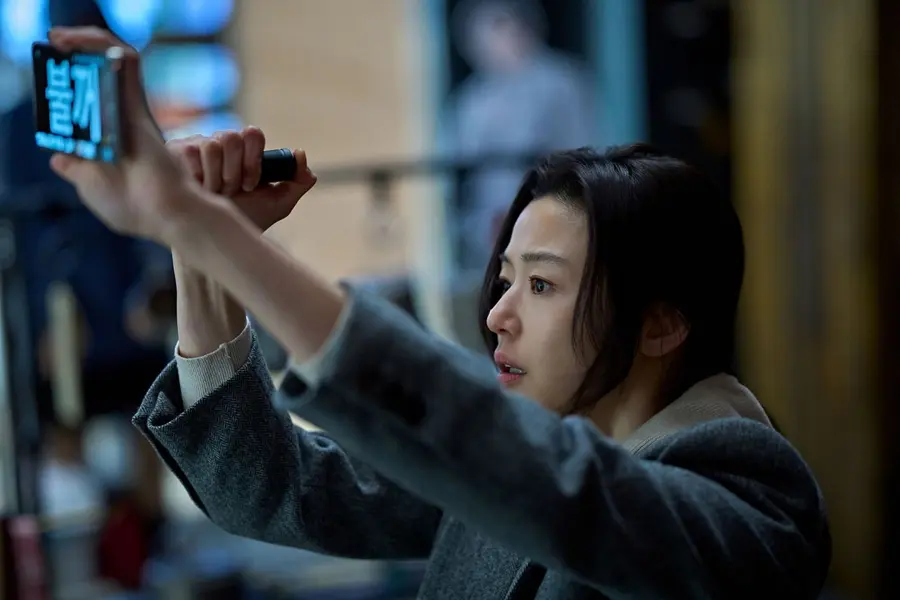
Kwon Se-jung is a very dry, restrained person. How did you plan to express that?
I didn’t want Kwon Se-jung to appear exceptional. I believe a chaotic situation reveals human nature, and Kwon Se-jung’s role is to hold the center and push forward what she believes. That carries the film’s message. Having the audience follow her was a major consideration in how I approached the role.
Kwon Se-jung represents dissent, the individual voice. She also embodies the director’s message. Which side do you feel closer to in real life?
I can’t stand seeing someone treated unfairly. I’m not patient about that either. At first I wondered if Kwon Se-jung might be overly righteous. The relationship involving Gong Seol-hee, played by Shin Hyun-bin, and the ex-wife/current-wife dynamic is unusual and interesting. At first I thought that uncomfortable setups like that might be unnecessary, but the way different people pursue a single goal from different spaces turned out to be something audiences enjoyed and talked about. Interpretations vary.
How was working with zombies on a genre shoot? It must have been physically demanding.
I had experience with zombies from 〈Kingdom: Ashin of the North〉. I had enjoyed 〈Kingdom〉 and was excited to join that world. On set I even took photos with the zombie actors. 〈Colony〉 employed many modern dancers, and because the work was so organized, the zombie performances on set were astonishing. There was a lot to learn about using the body and expressive technique. I was physically prepared for what a zombie project demands.
From an actor’s perspective, what did you find most interesting about the zombies in 〈Colony〉?
I think film ultimately offers new experiences. This film breaks from the usual zombie formula and adds an idea that cuts to the heart of the times we live in. Rather than complex analysis, I hope people come to the theater and feel this new energy directly.
![A scene from the film 'Colony' [provided by Showbox]](https://cdn.www.cineplay.co.kr/w900/q75/article-images/2026-05-17/4da29e44-32ad-4bef-9a43-28aec6f59932.jpg)
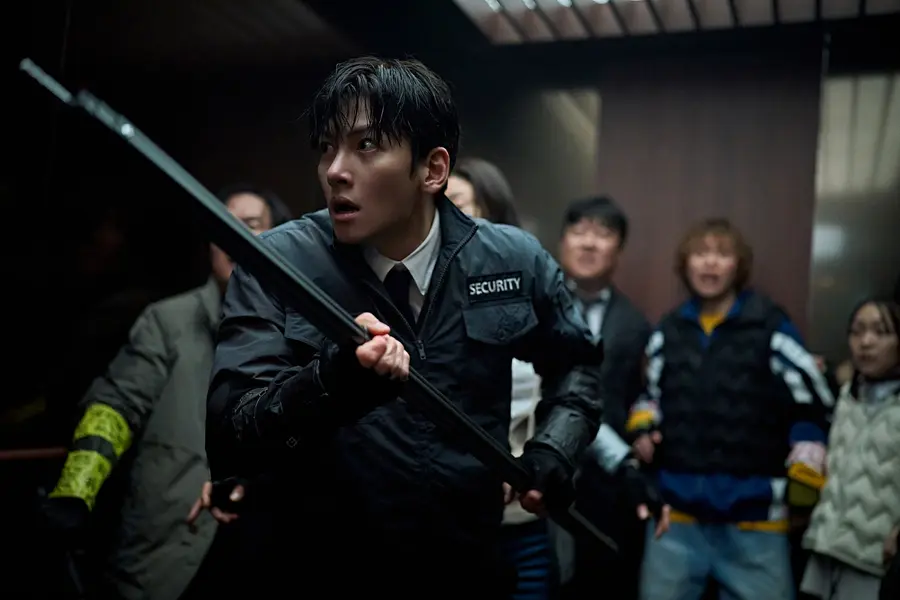
How was your chemistry with the in-demand actor Gu Kyo-hwan?
We were the two actors who stayed on set the longest. (laughs) That’s how we got close. Gu has a lot of sense; if you suggest something, he’ll immediately offer, “How about this?” in a snap. That made things fun and created a lot of synergy. Gu is entertaining—he puts in a lot of effort to make situations enjoyable, and I’m the type who likes that.
How was it working with Ji Chang-wook, who is currently filming the next project 〈Human X Gumiho〉 (working title) with you?
We didn’t have scenes opposite each other on the set of 〈Colony〉. We weren’t very close then — we were both busy, so there weren’t many chances to talk. Besides, he died early in the film… (laughter) Ji Chang-wook said he watched the film for the first time in Cannes and was surprised, saying, “Huh? I’m in it longer than I thought.” (laughs) We didn’t have many opportunities to talk then, so we weren’t close, but now we’re very close. After getting close to Chang-wook, watching the film at Cannes felt like watching someone else act. If we’d acted together then, it would have been different.

Any notable episodes from the Cannes Film Festival?
Cannes itself has a festival atmosphere—the city is like a dream shrine for filmmakers—so everyone was extremely excited. The weather was also lovely, and that mood and vibe were wonderful even without any particular episode. This is my first time being invited to Cannes with a Korean film. Previously I had gone as an ambassador or with overseas films. Experiencing Cannes with a Korean film made all my previous visits feel like they weren’t the real thing; this felt like the first time. It felt like a red carpet just for us, so we could savor it at leisure. We had plenty of time, which helped us relax and enjoy the moment. That led to playful poses with Gu Kyo-hwan, arms stretched wide. The director joked, “We mustn’t get too used to Cannes.” Attending was a thrill, and imagine how amazing it would be to be in competition. I also heard that Park Chan-wook made time to attend an event that usually only Thierry Frémaux, the festival’s executive director, would attend. Having Park Chan-wook there felt reassuring and made me proud as a Korean.
※ The interview with Jeon Ji-hyun about 〈Colony〉 Part 2 follows.

![[BIFF On Location] ‘Shaving’ Marks Show Kasamatsu’s First Korean Film Challenge: “We Create 100% Miracles on Set”](https://cdn.www.cineplay.co.kr/w300/q75/article-images/2026-10-09/70cadf5a-5820-4f28-bdea-52d94531634c.jpg)
![[At BIFF] ‘Dora’ brings Kim Do-yeon to tears during news conference; Jung Ju-ri’s 20-year project](https://cdn.www.cineplay.co.kr/w300/q75/article-images/2026-10-09/4a118116-5011-4858-a62b-2cedd0851b97.jpg)
![[First Press-Screening Reactions] 'Colony' Cineplay Critics' Ratings](https://cdn.www.cineplay.co.kr/w160/q75/article-images/2026-05-20/452c0988-e945-4a36-b7f9-1fc529600a3a.jpg)



댓글 (0)
댓글 작성
댓글을 작성하려면 로그인이 필요합니다.
로그인하기