


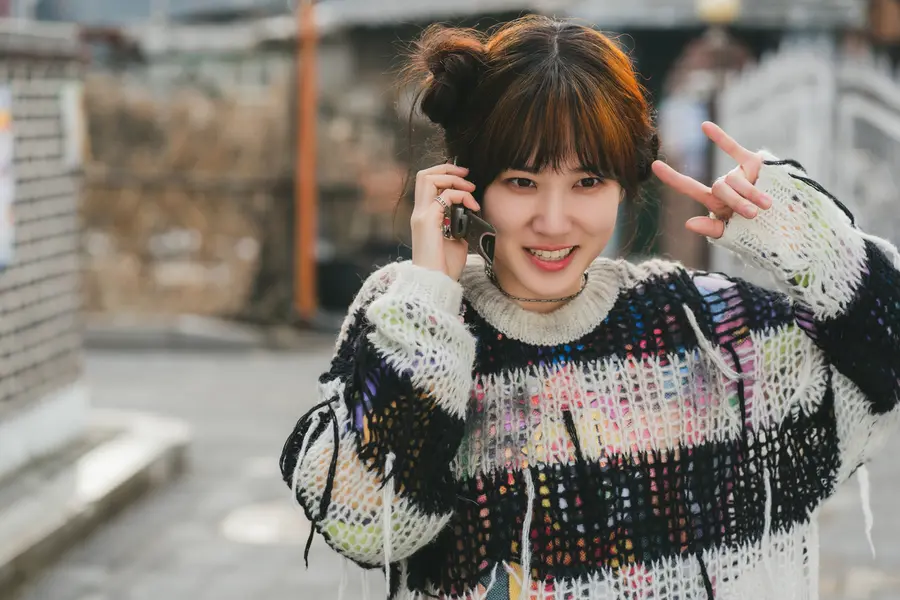
Park Eun-bin arrived for the interview dressed like Chaeni, the fiery heroine she plays in 〈The WONDERfools〉. In a yellow knit hood and an oversized shirt that summoned late-1990s style, she said she had worn the same outfit to the show's first script reading to recapture that initial resolve.
Park said she doesn’t let go of a character until the roundtable interview held after a project wraps. Flipping through a heavily annotated script covered in Post-it notes as she recalled the performance for the interview, she spoke with the sincerity and the renewed determination of someone marking the 30th anniversary of her debut.
The Netflix series 〈The WONDERfools〉 follows a group of neighborhood misfits who, in 1999 at the turn of the century when doomsday talk was fashionable, suddenly discover superpowers and struggle to protect the world from a villain in a comic superpowered adventure. It centers on people who had never achieved anything, had never claimed or won anything for themselves, or even known what they wanted, then suddenly find themselves with superpowers and a first real chance to take on the world—at the heart of that is Park Eun-bin's Eun Chaeni. Chaeni is headstrong and has been labeled Haeseong City's official "troublemaker." She plans a secret trip abroad—one item on her bucket list—behind her grandmother's back, and an unexpected incident grants her the power of teleportation.
Since its release on May 15 (Friday), 〈The WONDERfools〉 has drawn global attention and ranked No. 6 on Netflix's Global Top 10 Non-English Shows. On the afternoon of the 22nd, Park Eun-bin and Cineplay met at a location in Jongno-gu, Seoul, to talk about everything from behind-the-scenes stories of 〈The WONDERfools〉 to her thoughts on the 30th anniversary of her debut. Below is the full conversation.
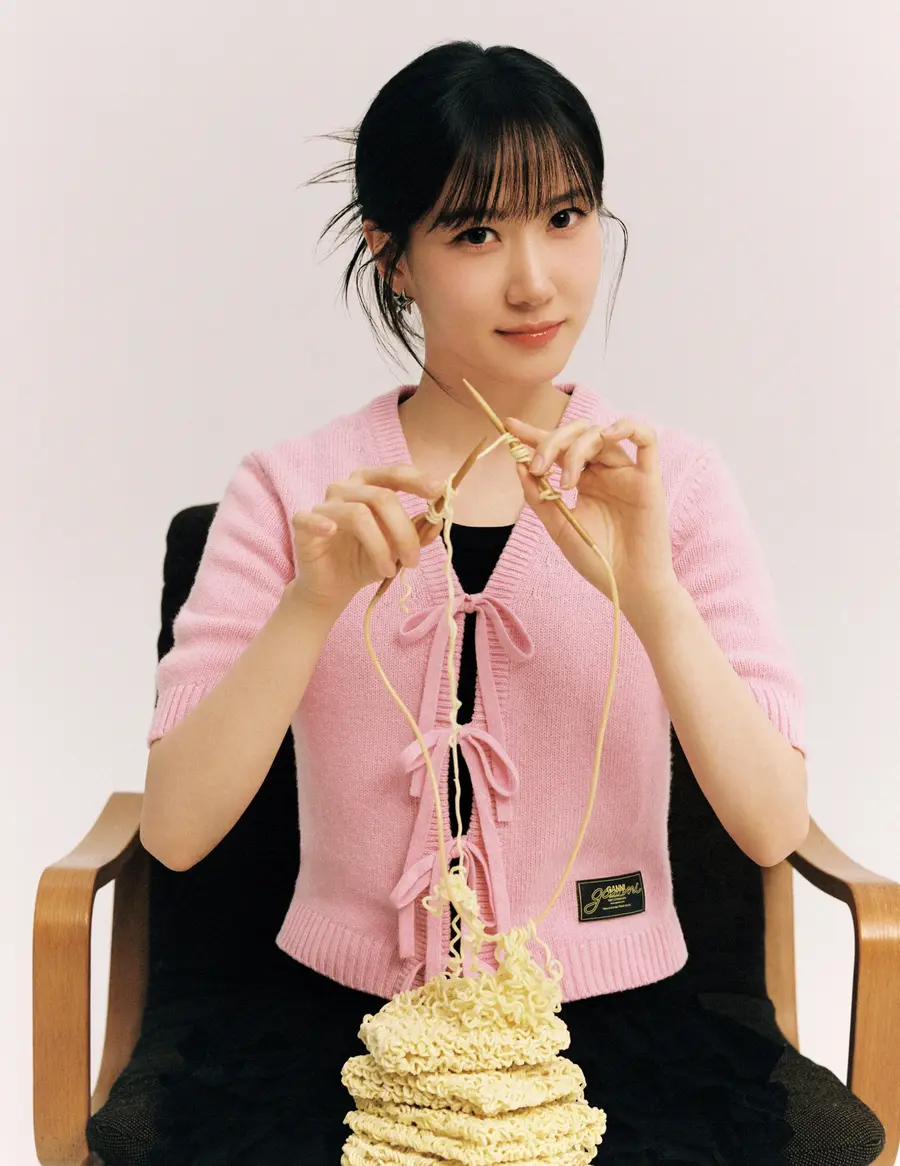
Your look today really feels like Chaeni.
"Today I wanted to show up a little Chaeni-like for the reporters. I figured maybe I could get some of Chaeni's energy that way, so I came prepared. This was what I wore at the first script reading. I want to bring back that initial resolve. I had never worn a hat like that before, so I thought, why not try a style I usually don't attempt?"
What did that "initial resolve" feel like?
"It felt like standing at the starting line of a long race. I actually haven't run a marathon, so I can't really speak to marathons (laughs). But I remember thinking, 'Now I have to run well,' before the long haul. Even though it's an eight-episode series, we all prepared mentally as if the shoot might feel longer than that, so I started with my determination set."
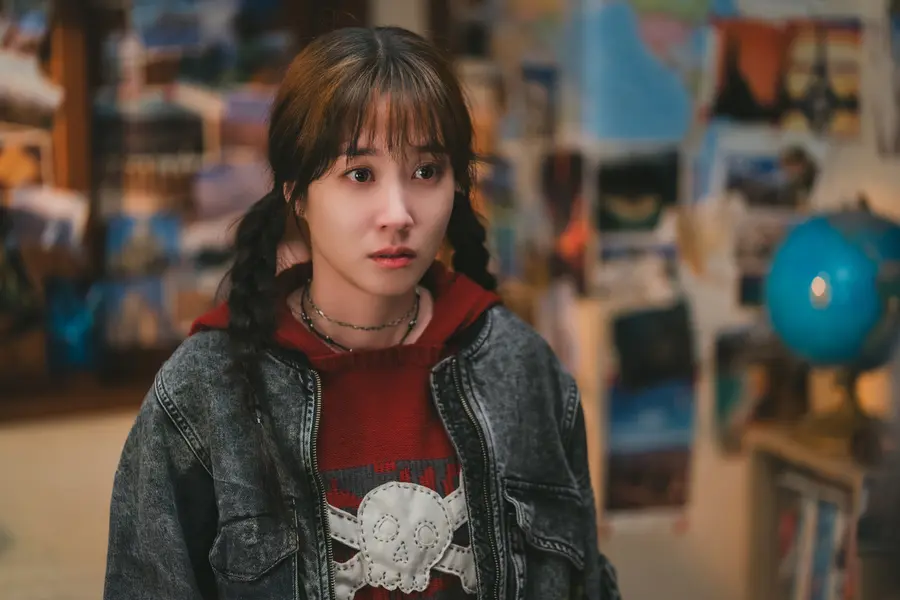
Because the show is set at the century's end, Chaeni's styling is distinctive. Did you contribute ideas?
"Each department looked for references at first. The drama team initially suggested things like headbands for me. But I thought a look that might get a smack on the back from the 'King Jeonbok' grandmother at 'Big Hand Restaurant' (Kim Hae-sook) would suit the 'troublemaker' image better. I wanted an appearance that might make neighbors tut—someone who could draw both affection and scorn. When I looked at Y2K-era photos, I felt a lot of orange tones, so I approached Chaeni as someone who likes orange. And since the fictional Haeseong City evokes comets and stars linguistically, and Chaeni becomes a kind of hero, I used stars, a motif I personally like. Chaeni also felt like someone who might have liked rock back then, so we used skull motifs a lot. I personally don't love skulls (laughs), but it was an ambitious idea to suggest an untouchable aura, and thankfully it came together so I could strut around in it."
The public tends to view you as the model-student type, while Chaeni is almost the opposite—dubbed a "hot mess" and even called Haeseong City's official "troublemaker." How did you build her interior life?
"In episode 1 you see Chaeni trudging along to Radiohead's 'Creep.' We filmed that in very cold conditions, and every background extra had dressed up so well to reflect 1999. I worried I might be overwhelmed by that energy, but when a neighborhood labels you its official 'troublemaker,' I felt I had to fully own the character. So I performed with that forward momentum—through her posture, tone and delivery. Maybe because I played Chaeni so directly, other cast members sometimes reacted to her greetings as if they didn't recognize me when I arrived on set (laughs). I acted with no deference and a lot of sulkiness, throwing myself at the world, but the moment they called cut I would be polite again."
Maintaining the comedy's tension over eight episodes must have been a challenge.
"If Eun Chaeni dips too low, the whole show could go darker, so I had to keep pushing her strong character forward. There is a portion in which the tone darkens because of the 'heart' of the 'Child of Eternity,' and I felt responsible for holding viewers' affection for these characters until we reached that point. I worried that playing it too casually would make it ordinary. This project shifts genres quickly—aiming for a touching moment, then flipping to comedy, then moving into action and even thriller beats. I believed that if the character's core truth stayed intact, it would provide enough consistency to hold through those shifts, so I worked to keep that tension. If viewers liked it, I'm glad; if it felt noisy, I apologize (laughs)."
I also felt that Chaeni's rough behavior was a defense against the fear of death. How did you interpret why Chaeni became a "hot mess"?
"I think Chaeni is full of sourness toward the world. Physical constraints related to her heart condition probably twisted her outlook. She has a personality that frets over thoughts like, 'If I hold back what I want to say today, I might be dead tomorrow.' That can make her off-putting to some, but it's her way of living earnestly—an outward and inward cry at the world. Even with a troubled heart, she channeled stress into short-term releases so as not to let it kill her; those impulses became the engine of how she lived."
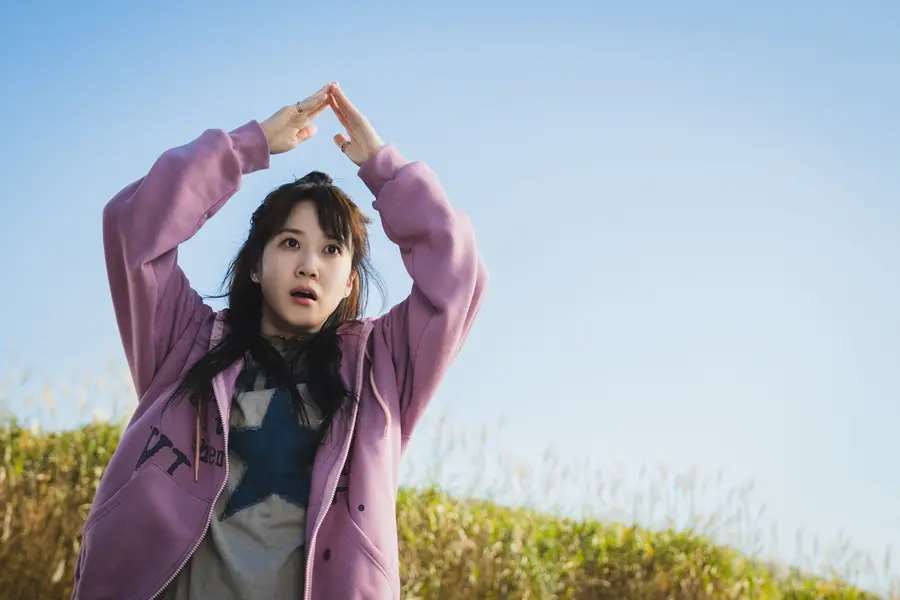
The series pairs a terminal illness setup with buoyant humor, creating a distinctive levity. Which scene where tragedy and comedy coexist sticks with you?
"The script jolted me with the moment that suddenly announces, 'I died on May 5.' Early on, Chaeni dies, and I remember thinking, 'What? Why did she die?'—which heightened my curiosity about the plot. But the lines themselves were hilarious: Robin (Im Seong-jae) saying, 'Chaeni, close your eyes. I'm scared,' and scenes where I'm playing a corpse but keep opening my eyes so Gae Jin-sang (Choi Dae-hoon) avoids eye contact. It's a darkly comic, almost bittersweet black-comedy moment in an otherwise inhumane corpse-abandonment sequence, and that was really fun. Admittedly, playing a corpse while keeping my eyes open for that shoot was hard—the set was dusty and we had no eye-care support on hand—so it wasn't easy. But I think I died convincingly (laughs)."
From wire work to superpower effects, the shoot must have been physically demanding. Any difficulties?
"I didn't imagine we'd use our bodies this much (laughs). All the characters were soaked in blood, sweat, and tears, so there were few days when anyone looked perfectly fine. Wearing a harness for wire work is uncomfortable all day, and being suspended by the crew's rigs and manpower made me realize how differently the body responds depending on position and force. I probably did every kind of wire action there is; depending on the position and the force applied, the body moves quite differently."
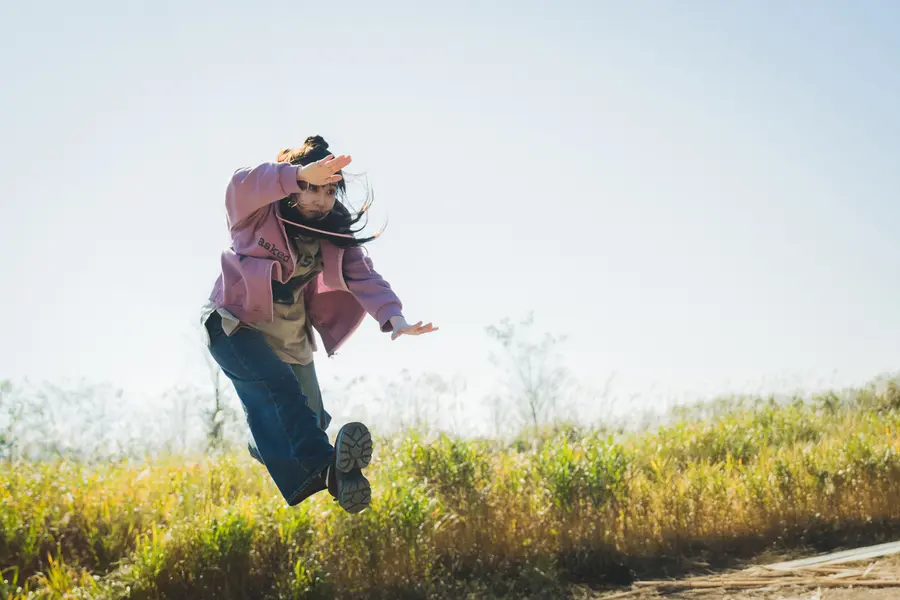
Chaeni's teleportation required careful editing. On set, actually performing the moves must have been tough.
"On set we would pop out of frame briefly and pop back in, which worked visually but took a lot of time and effort. Because sometimes the next scene would be filmed months later, maintaining continuity across seconds-long jumps required extra work. We shot it hard, but our goal was for viewers to experience it lightly, easily, and enjoyably, so we had fun making it."
You reunited with director Yoo In-sik after 〈Extraordinary Attorney Woo〉. I heard Director Yoo trusts your ability to break through unusual setups. What does he mean to you as an actor?
"After working with Director Yoo In-sik on 〈Extraordinary Attorney Woo〉, I felt in my bones that he is someone to deeply respect, and I believed that with him I could surrender some of my burdens as an actor and move forward with trust. Often our sensibilities felt similar. As a junior, I could bring personal questions to him as ones to ask a 'good elder.' He's humorous, has strong central leadership, and by embracing everyone he served as a beacon for me—a director I could lean on."
Until post-production, you don't know how the finished product will look. The set might have been chaotic. Did the cast have a shared sense of the overall tone?
"As an actor, it was a set unlike any I'd experienced before. We even used high-speed cameras like those used on the old 〈Sponge〉 program. But Director Yoo always explained things well. This project demanded that every department perform at its best: special effects, CG, stunt teams, and the actors' performances all had to sync. It was completed through everyone's labor and dedication. I remember looking at the finished work and thanking the director for crafting a hero."
▶ 〈The WONDERfools〉 actor Park Eun-bin interview continues in Part 2.

![[BIFF On Location] ‘Shaving’ Marks Show Kasamatsu’s First Korean Film Challenge: “We Create 100% Miracles on Set”](https://cdn.www.cineplay.co.kr/w300/q75/article-images/2026-10-09/70cadf5a-5820-4f28-bdea-52d94531634c.jpg)
![[At BIFF] ‘Dora’ brings Kim Do-yeon to tears during news conference; Jung Ju-ri’s 20-year project](https://cdn.www.cineplay.co.kr/w300/q75/article-images/2026-10-09/4a118116-5011-4858-a62b-2cedd0851b97.jpg)


![[OTT Ratings] Netflix Series 'The WONDERfools' Cineplay Reporters' Ratings](https://cdn.www.cineplay.co.kr/w160/q75/article-images/2026-05-18/10f573ff-05d2-4fa7-b75f-079696efcd48.jpg)
![[Photo &] Park Eun-bin Reunites With ‘Extraordinary Attorney Woo’ Director Yoo In-sik… ‘Wonderfuls’ Rebellious Problem Child Eun-chaeani, A Moment That Ties Survival to Survival With Instant Teleportation!](https://cdn.www.cineplay.co.kr/w160/q75/article-images/2026-05-22/be52b855-37b7-4e15-95c0-8e478e866372.jpg)
댓글 (0)
댓글 작성
댓글을 작성하려면 로그인이 필요합니다.
로그인하기