



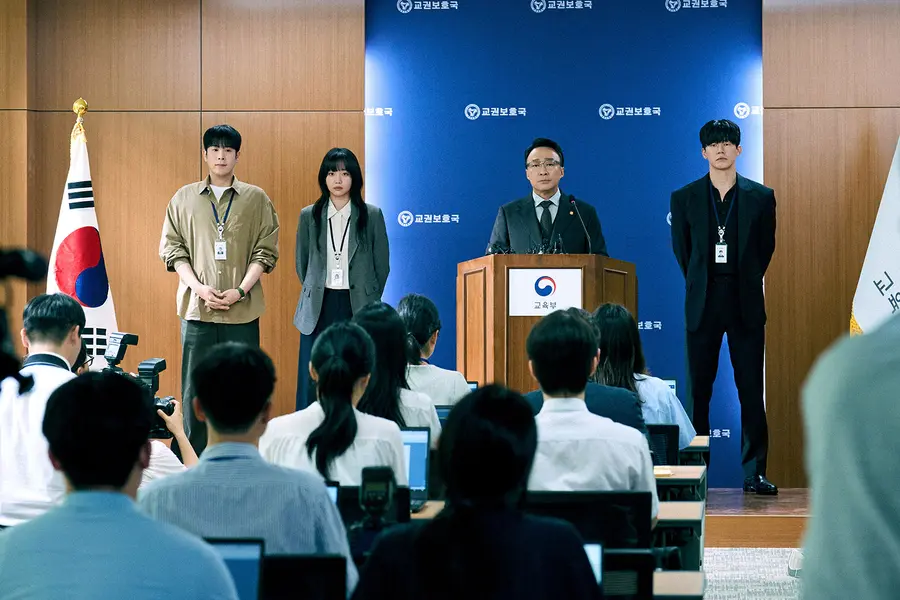
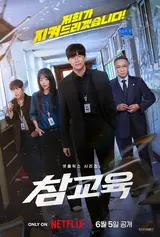
Once again, a high-impact K-content title has burst onto Netflix. The Netflix series 〈Reassignment Education〉, which depicts the relentless efforts of the authority group for protecting teachers’ rights as it takes the side of victims and puts schools back in order, kept its No. 1 spot among non-English TV shows in the global TOP 10 even in its second week after release. 〈Reassignment Education〉 logged 21,100,000 views (the value obtained by dividing the viewing time by the work’s total running time) and 225,800,000 viewing hours. It swept first place across 46 countries, including South Korea, Japan, and Singapore. It also landed on the TOP 10 list in a total of 91 countries, including the United States, the United Kingdom, India, France, Germany, Australia, Mexico, and Brazil.
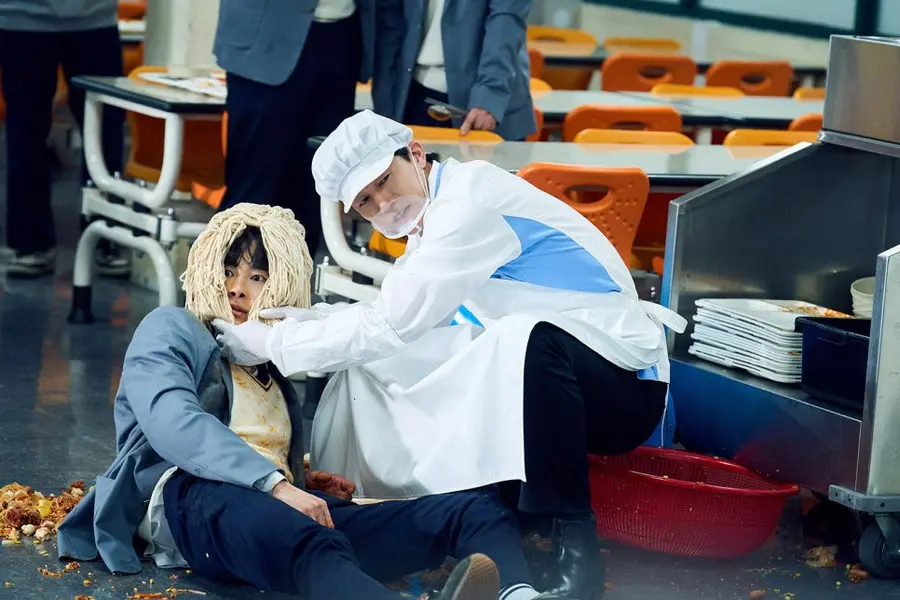
From Na Hwa-jin (Kim Mu-yeol), who saves students in crisis and delivers satisfying “reassignment education” to offending students, to Im Han-rim (Jin Ki-joo) and Bong Geun-dae (Pyo Ji-hoon), and all the way to Education Minister Choi Kang-seok (Lee Sung-min), who quietly carries responsibility to protect the teacher-rights protection bureau—these characters resolve incidents in their own ways across a wide range of places and situations, and that sparks an exhilarating catharsis. Viewers also can’t help but notice the supporting cast and special appearance actors, who bring strong presence and draw attention. First, villain Jo Gyu-cheol (Lee Bong-jun), who shows two faces at the center of the turmoil inside and outside the school, stoked viewers’ anger and left a deep impression. Also, the episode is richly packed with key figures such as teacher Choi Ga-yoon (Ha Young), Na Hwa-jin’s fiancée and also the daughter of Choi Kang-seok—an essential character whose story became the impetus for founding the teacher-rights protection bureau—along with teacher Jeong Seon-young (Lee Sang-hee), who had to endure difficult times amid a collapsing education field, and Hyun-min’s mother (Seo Yeong-hee), who has an excessive zeal for educating her son, among others.
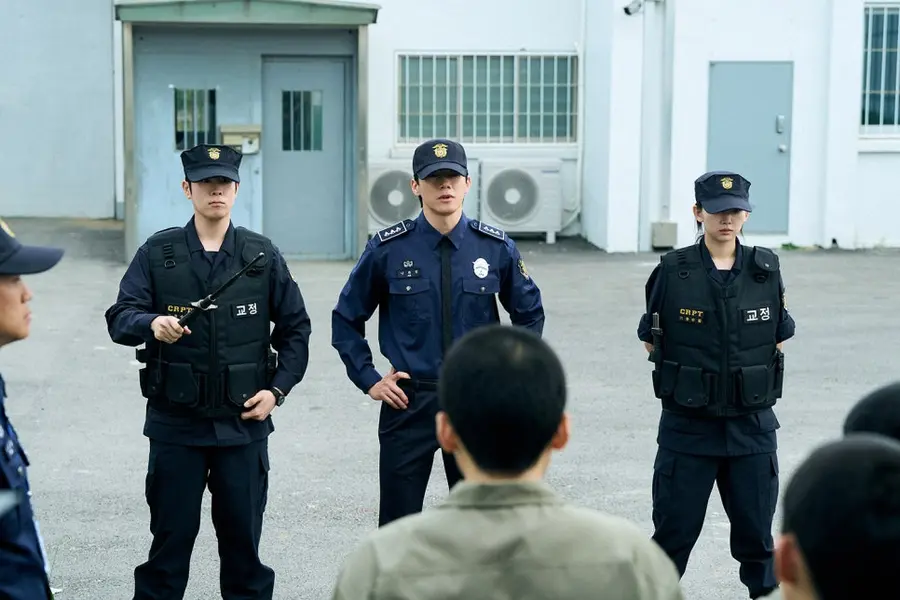
As much attention as it has drawn, so has controversy. Some praise it as “a satisfying antidote that makes you reflect on the reality of our education,” while criticism also exists alongside it—“a dangerous narrative intoxicated by premature, fake pleasure.” In any case, 〈Reassignment Education〉 clearly brings the sharp realities of education that sit behind its dramatic setup into the public sphere with relevance and heat, like never before. And here, Cine Play reporters still selected their favorite episodes one by one.
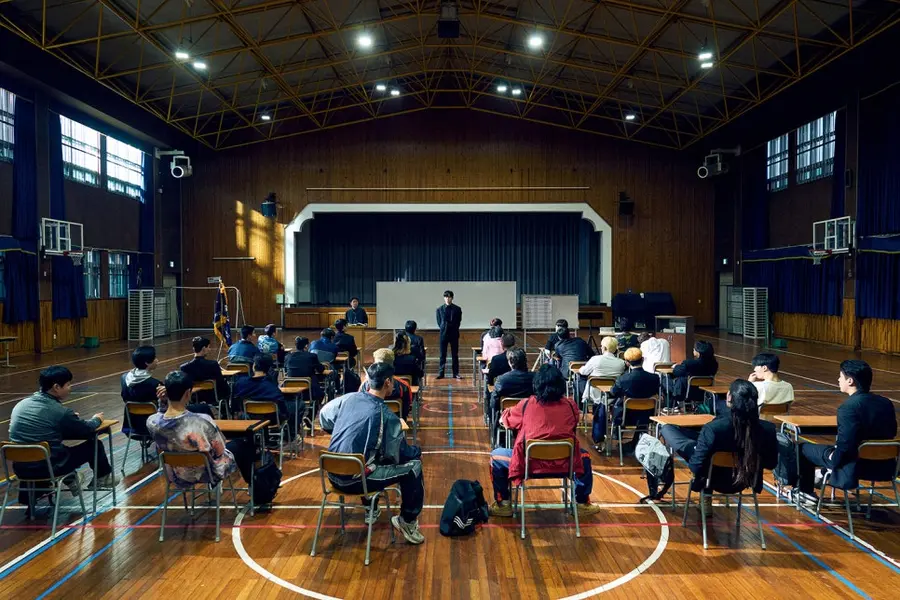
Reporter Seong-chan-eol’s favorite episode: Episode 2
“It’s not like it’s just all ‘Strength-stomp, one-trick only,’ which is a relief—but even so, it’s fun.”
〈Reassignment Education〉 seems to show its popularity in a way that’s ironic. Just like Netflix’s hit 〈Squid Game〉, once a violent subject matter earns mainstream popularity, from that moment on, it can’t avoid the sharp glare of criticism. In fact, you can’t even just ignore it. Because of those reactions, I avoided 〈Reassignment Education〉 from the very beginning. Judging by how it’s obviously set up, it must be the kind of story where kids get “educated” with violence and you end up getting that satisfying “antidote” feeling. Students should not hit teachers, but teachers also should not hit students. That’s why I didn’t plan to watch it.
But based on the points people raise about problems here and there, the issue with 〈Reassignment Education〉 doesn’t seem to be “Strength-stomp” (meaning pressing them down with force). The reason 〈Reassignment Education〉 is being criticized is, simply, that it resembles reality. So if it had pushed everything forward as pure fantasy, it might have taken some flak for it briefly—but if it had offered a satisfying “antidote” as fantasy, it would probably have passed as straightforward. Instead, 〈Reassignment Education〉 blended in realistic depictions of school education conditions, and that’s what created discomfort. As an omnibus-format series, 〈Reassignment Education〉 tackles multiple incidents. If you’ve been keeping up with the news a bit, you’ll probably find that after Episode 3, certain incidents naturally come to mind.
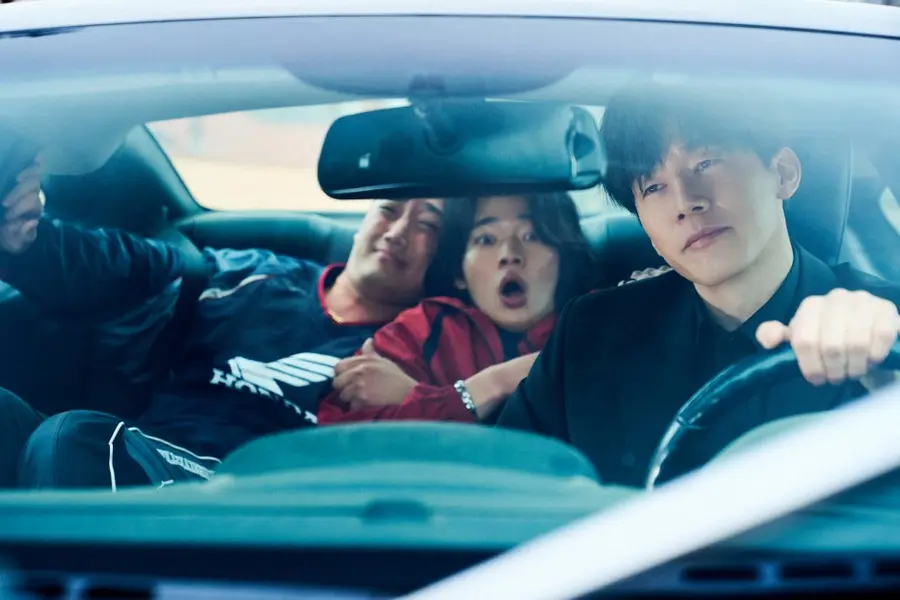
So, ironically, the episode I liked most is Episode 2. The episode set at Gureunhai Tech High School clearly has a surplus of the kind of energy you’d expect from a full-throttle action spree. Watching Na Hwa-jin “educate” kids who look up to MZ gangster culture and get thrilled by nothing but brawling and throwing fists—through “extra lessons” and overwhelming performances—feels almost cartoonish, leaving only that satisfying surge of emotion. Of course, it still depicts the tragic circumstances around Kim Hyeong-joo (Jeon Bong-seok), but at least it’s the part that gets resolved most neatly in the story, so the sense of lingering debt is smaller. Other episodes leave the plot in a way that feels messy, or leaves parts that can’t be fully resolved. In contrast, this Episode 2 gives off a sense that it’s somehow detached from reality, and that feeling actually helps immersion. If you want to encounter an episode you can watch without thinking too much, I recommend taking on Episode 2 of this 〈Reassignment Education〉.
Editor-in-chief Joo Seong-cheol’s favorite episode: Episode 5
Even though you could criticize it as a false report, if it can save the teacher
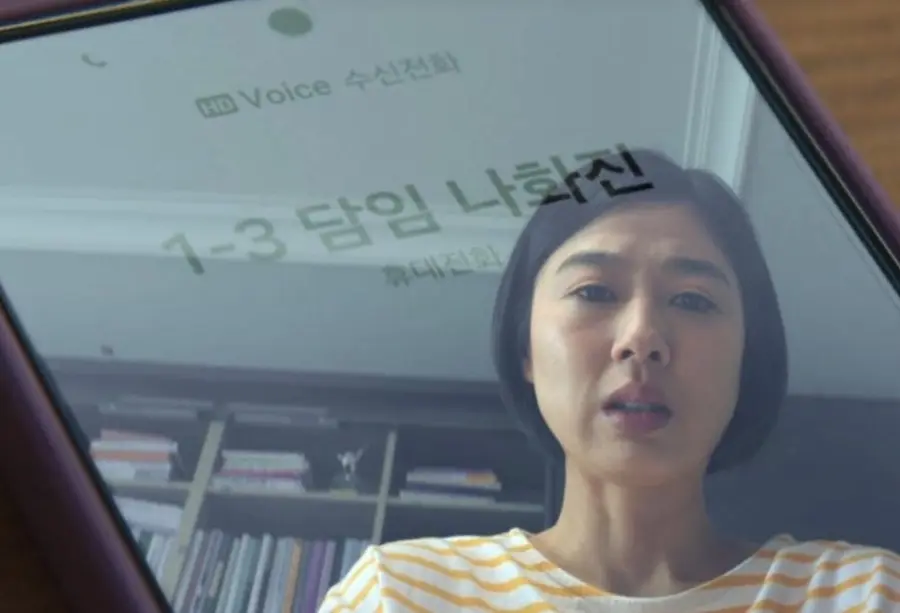
“Woo-jin is a precious child too, but so is the teacher—someone’s precious child.” Among all 10 episodes of 〈Reassignment Education〉, Episode 5 is the one people most commonly call the most “antidote”—the most satisfying payoff. It lays bare the despair of teacher Choi Ji-seon (Song Si-an), who feels there’s nowhere left to go and is driven toward an extreme choice. Above all, while other episodes resolve incidents mainly through “action,” Episode 5 centers on “mouth” action, which is fresh. It’s also an episode where the “real reassignment education” is carried out on a devilish parent through “mirroring,” returning what was done by making the person who received the harm experience the same thing back.
Woo-jin’s homeroom teacher, Choi Ji-seon, approaches the job with diligence and a sense of responsibility and always gives her best for the children. But the problem was Woo-jin’s mother (Park Ji-yeon). The moment the new semester began, she told Woo-jin, “Don’t speak stiffly when you talk to Woo-jin right away. Don’t let him solve problems by calling him out where other students can see. Don’t mark wrong answers on dictation worksheets with slash marks because he could be hurt. When conflicts arise with school friends, always take Woo-jin’s side. Don’t give orders or commands. And don’t force him to greet people.” Just writing down a few lines like that is already painful enough. The reason, in the end, was just one thing: Woo-jin’s “self-esteem” might fall. Then the trouble escalates after Woo-jin gets into a fight while playing with a friend. The other parent understands it as a kids’ fight and tries to move on, but Woo-jin’s mother reacts sharply, scolding the teacher—“Did you forget what you were told to do: always take Woo-jin’s side?” She gets the phone number, calls even outside work hours, learns the address, and shows up at the teacher’s home, too. Eventually, even Woo-jin’s father (Kwon Dong-ho) comes to the school and even tries to hit the teacher.
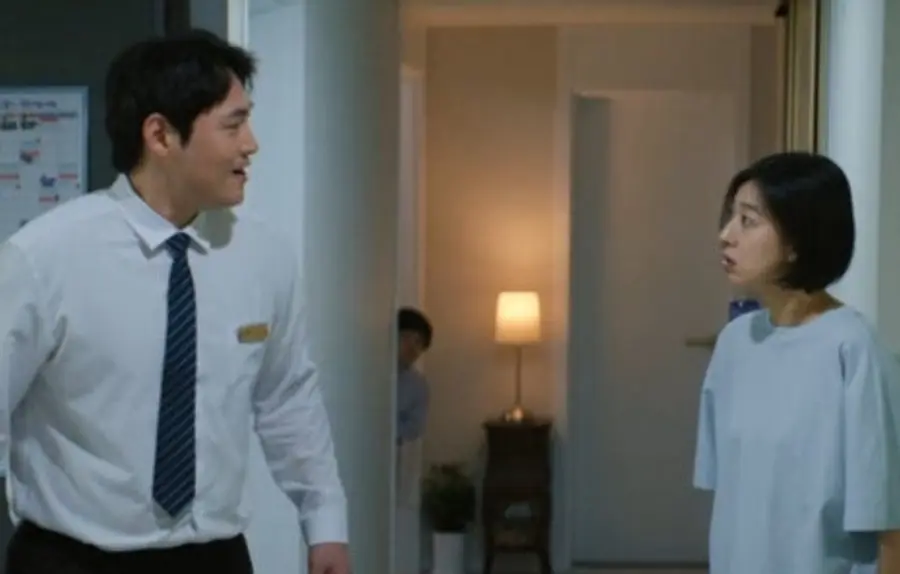

While watching Episode 5, many people recalled the case involving Seocho Elementary School in Seoul. In July 2023, a teacher at Seocho Elementary School died by suicide after excessive complaints from parents, and in February 2024, recognition of the death as a line-of-duty death was granted. The emotional violence by parents described above can be understood as real. In 〈Reassignment Education〉, Na Hwa-jin (Kim Mu-yeol) takes over as the new homeroom teacher and starts a deadly “mirror-mimicking” attack. Just like what Woo-jin’s mother did to the teacher, she keeps calling Woo-jin’s mother, telling her, “What should we do if Woo-jin is dozing off during class? Sleeping is a student’s freedom, too.” And she doesn’t hang up even when she says, “There’s a possibility that physical contact could be considered child abuse,” just like the earlier scene.
Now she goes to the bank where Woo-jin’s father works. She takes a number and waits. Then, once it’s her husband’s turn, she shouts loudly, “Is Woo-jin’s father here?” and orders the bank to clear the way. With all the bank customers watching, the man keeps dropping to his knees and the more he apologizes—“I heard you were very angry, sir. I really was wrong. I will make sure this never happens again”—the more it only increases Woo-jin’s father’s embarrassment and awkwardness. In the meantime, Hwa-jin breaks the wrist of Woo-jin’s father, who is trying to stop her, and warns him under her breath, “Stop the anger and live. If it happens again—if our husband gets angry one more time—then he dies.”
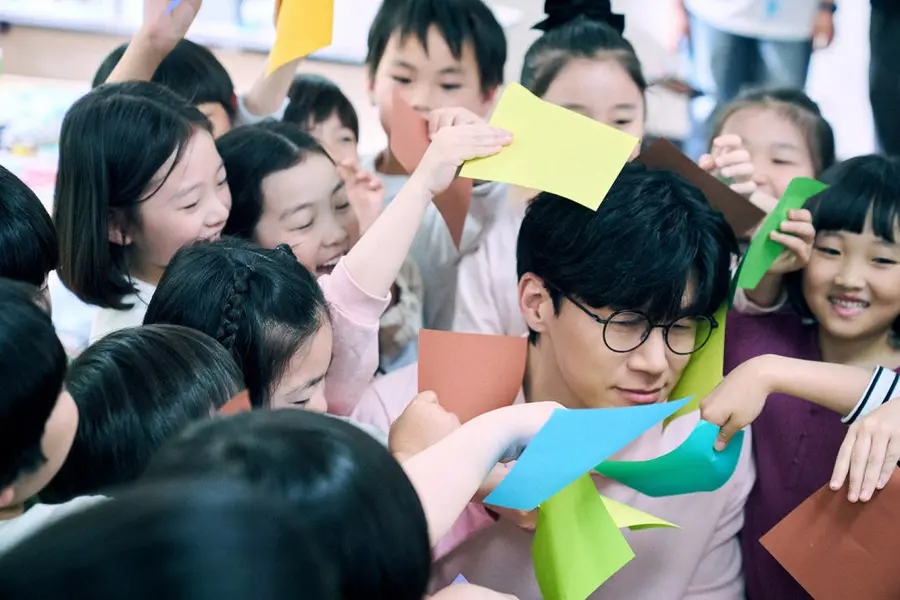
Of course, there are parts that could become controversial. Woo-jin’s mother tries to rally other parents to fight back, but in that meeting, the homeroom teacher Hwa-jin has already arrived early and is waging an opinion war in advance. She’s trying to file a false report for child abuse, claiming there are bruises on Woo-jin’s body. You could ask whether it’s appropriate to fabricate nonexistent crimes and make the devilish parents suffer even more. But viewers will want that sense of satisfaction, even if it’s by that means, of seeing Woo-jin’s mother and father ostracized and gossiped about among the other parents. So at least within the fiction of 〈Reassignment Education〉, the ending would ideally be that parents receive legal punishment, unlike the real Seocho Elementary School incident—and that teacher Choi Ji-seon survives and reconciles with Woo-jin. That’s what the show seems to aim for, and it’s what I believe the creators wanted.
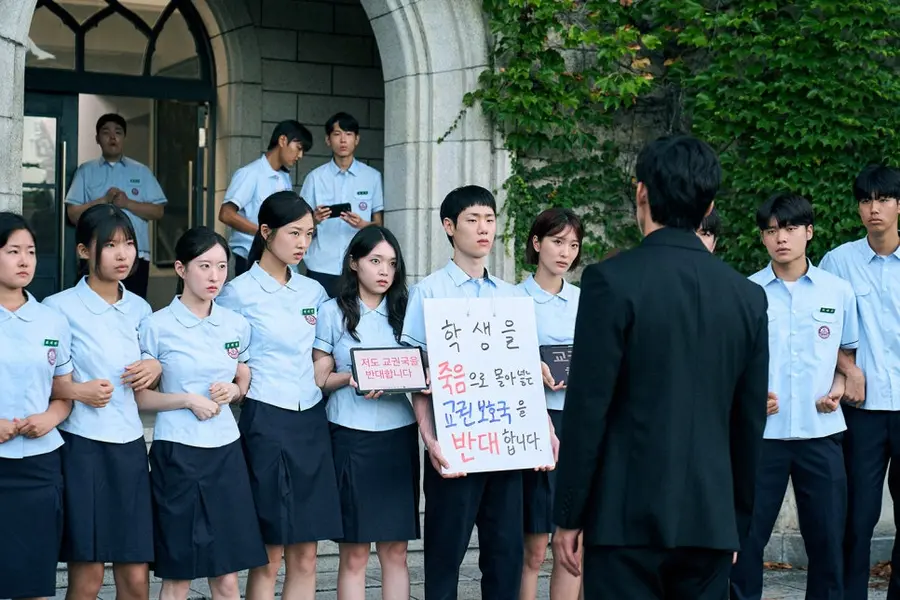
Reporter Kim Ji-yeon’s favorite episode: Episode 10
Despite it: “Private enforcement” narrative and attempts to draw a line
Violence, of course, is not “reassignment education.” That must be why the drama 〈Reassignment Education〉 has generated so many controversies. No matter how much it’s framed as fantasy, like a “munchkin” story, it chooses to counter the violence by bringing a narrative based on real incidents that happened in reality into the classroom with violence. So backlash was inevitable. This is also a controversy that the vigilante genre typically runs into.
However, in the drama 〈Reassignment Education〉, you can see signs that it has wrestled with how to differentiate itself from a flood of “private enforcement” narratives. Of course, it’s hard to say those efforts landed precisely on the viewers, but 〈Reassignment Education〉 seems to be deeply aware of the risks of a private enforcement narrative. For example, Choi Kang-seok’s (Lee Sung-min) line—“Once emotion enters the act, it becomes violence”—both pierces the contradictions that private enforcement contains and also serves as the most meaningful point where the drama suppresses the danger within its storyline. It’s as if the production team for 〈Reassignment Education〉 shares that view: just like how the film 〈Veteran 2〉 tried to say something through “Hae-chul,” the violence disguised as “justice” ultimately amounts to the exact same kind of violence.
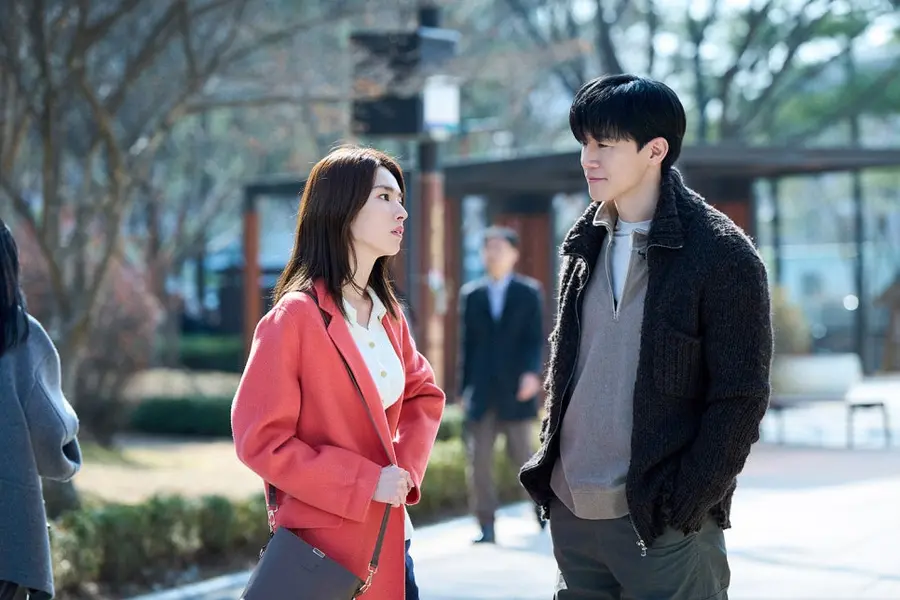
In Episode 9, Choi Kang-seok says, “Jo Gyu-cheol (Lee Bong-jun) has already been punished for his crime, and there’s no discretion left for the Teacher-Right Protection Office to block the student’s chance to study again. If you block it, then it’s revenge.” Then in Episode 10, when Na Hwa-jin (Kim Mu-yeol) faces off with Jo Gyu-cheol, Jo Gyu-cheol tells him, “If you hit him right now, it would really be private revenge.” Even though Na Hwa-jin ultimately swings his fist for dramatic fun, at least the people who made the drama tried to avoid the biggest dilemma the story might have fallen into by drawing a fierce line against private enforcement. When confronted with Jo Gyu-cheol’s words telling him to kill himself, Na Hwa-jin finally drops his fist and says, “Gyu-cheol, you can’t do that. It’s okay—we can try again. This is the final chance that teacher Choi Ga-yoon (Ha Young) gives you.” Whether the drama actually fell into a trap or cleverly evaded one is a judgment for each viewer, but at minimum, it has become clear that 〈Reassignment Education〉 recognizes three things: that violence is dangerous; that punishment can slip into revenge; and that the work’s fantasy cannot become reality.



![[OTT Ratings] Disney+ Series 'Made in Korea' Season 2: Cineplay Reporters' Ratings](https://cdn.www.cineplay.co.kr/w300/q75/article-images/2026-09-17/2a900ba9-d90d-467c-a46d-9cc71b361eca.jpg)



![[Photo &] Netflix No. 1 “Chamgyoyuk” director Hong Jong-chan interview: “Violence is fantasy—here’s hoping for an open public forum”](https://cdn.www.cineplay.co.kr/w160/q75/article-images/2026-06-12/d86ba154-c251-4e9c-bcdd-0d1c1dc1031f.jpg)
댓글 (0)
댓글 작성
댓글을 작성하려면 로그인이 필요합니다.
로그인하기