


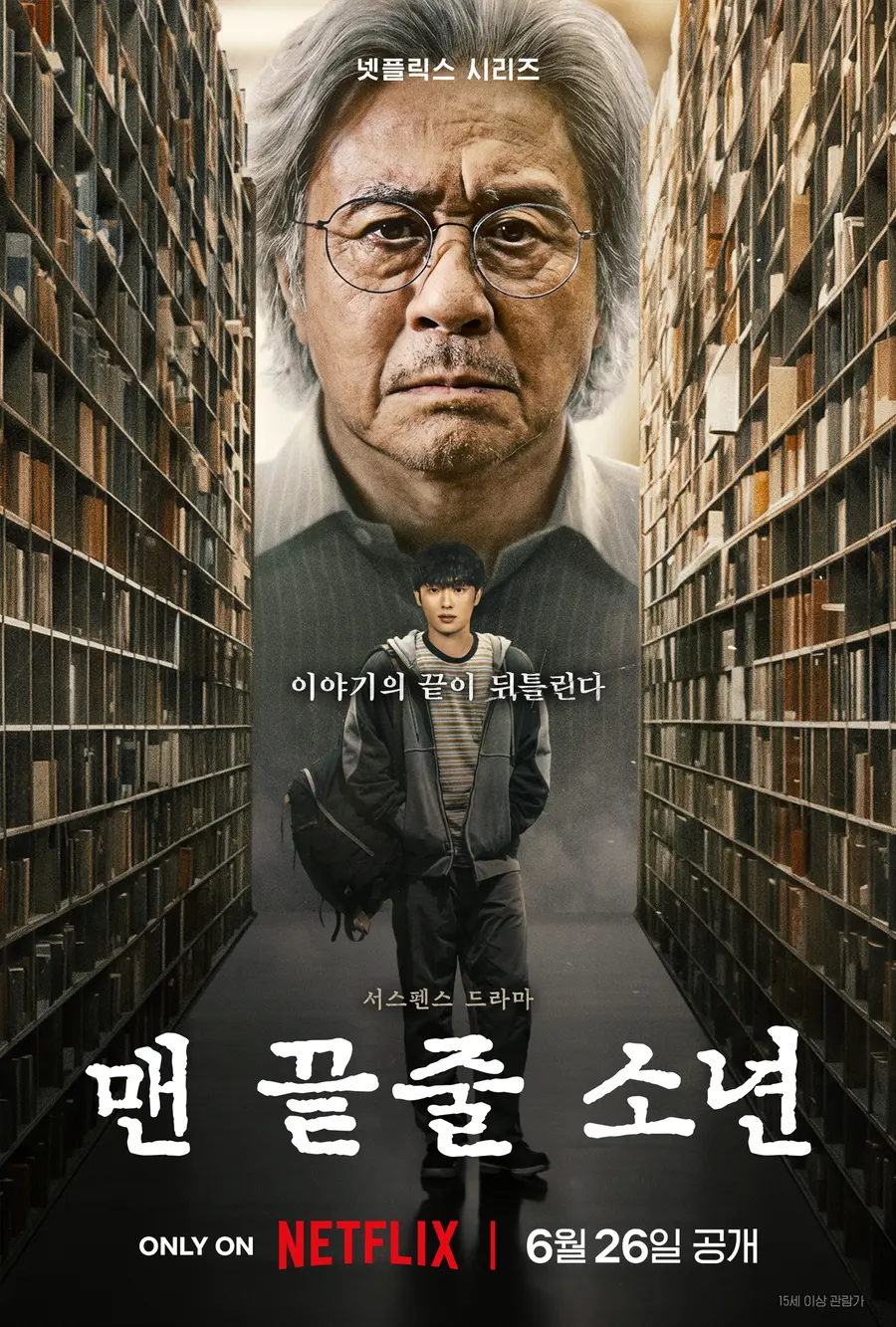
※Spoilers for 〈The Boy in the Last Row〉.
We live in the age of binge-watching. The days of waiting one or two episodes a week, predicting the next twist and musing about what comes next are gone. Netflix originals routinely end each episode with cliffhangers designed to make viewers hit the next-episode button. They do it so relentlessly that audiences find themselves unable to stop. Viewers become consumed with curiosity about what happens next and willingly trap themselves in the binge-watching cycle until they see the ending.
Released on June 26, 〈The Boy in the Last Row〉 is especially intriguing as a series born in the Netflix era: each episode follows the episode-structure playbook Netflix has honed, and the characters inside the show actively put that same logic to work.
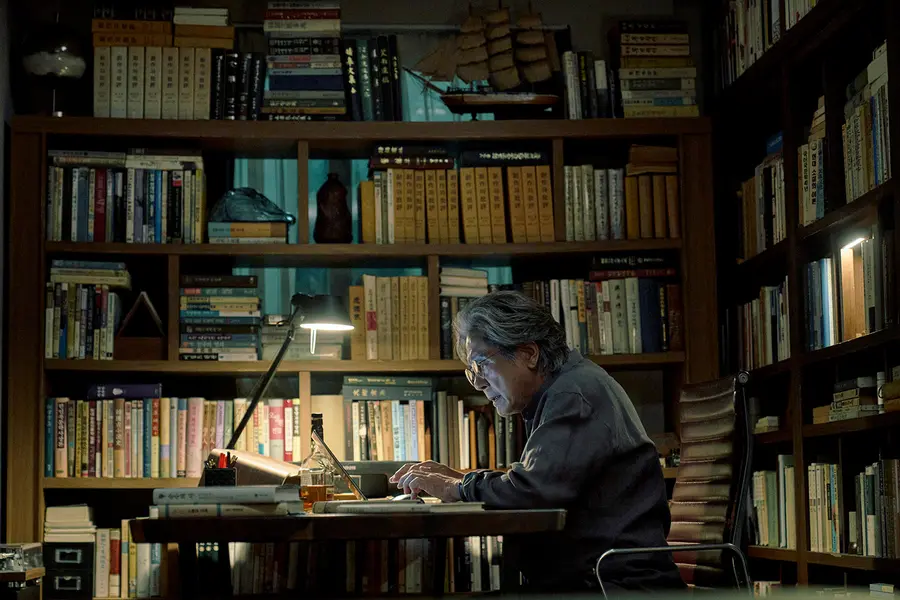
Netflix’s 〈The Boy in the Last Row〉 is a suspense drama about Heo Mun-oh (Choi Min-sik), a failed writer and a professor of Korean literature, who discovers the genius of Lee Kang (Choi Hyun-wook), a student in the last row, and grows obsessed with his writing. Heo, who has become a harsh critic of his students’ disappointing essays while teaching at the university, becomes fascinated by the pieces submitted by the last-row student, Lee Kang. He offers Lee private literature lessons, and as those lessons continue, Heo sinks deeper into obsession with Lee’s work.
Every assignment Lee Kang (Choi Hyun-wook) hands in is built around cliffhangers so compelling Heo cannot bear to stop reading. He caps them with the words "To be continued," pulling Heo deeper into his trap — exactly the kind of device Netflix has long used to keep viewers hooked.
What about the characters and incidents that, by the finale, are revealed to be creations of Heo’s imagination? The story he imagines is saturated with the kind of provocative material often described as 'makjang' — sensational, melodramatic ingredients. The protagonist cannot forget his first love despite being married; the wife has an affair with a man the same age as their son; a socially admired figure the protagonist envies is having an affair with the household helper. It reads like the formulas Netflix has often favored: formulaic, yet addictive in a way that makes it impossible to stop watching. That is why this series can be read as a meta-drama about Netflix dramas.

When Heo reads Lee’s work and imagines the home of Se-yun (Lee Jin-woo), that household is portrayed in an overly warm, bright light compared with reality. That idealization is a projection of Heo’s jealousy toward successful novelist Kim Soo-hoon (Heo Jun-ho) and his longing for his first love, Kim Soo-hoon’s wife, An Eun-joo (Kim Yoon-jin). Likewise, Heo’s imagined version of the housekeeper Min-hee (Han Ji-eun) is both materialistic and sexualized — evidence of the cramped, shallow, and dated imagination of a middle-aged intellectual.
Read as a meta black comedy, 〈The Boy in the Last Row〉 is at its most enjoyable. The show even uses the slang term for an 'interesting story,' highlighting how relentlessly society craves entertaining narratives. Intellectuals who debate the value of literature are not exempt. In 〈The Boy in the Last Row〉, a character saturated with defeat and an inferiority complex channels that lack into grotesque, over-the-top tales. It mirrors viewers’ own desire for relentlessly provocative and visceral narratives.
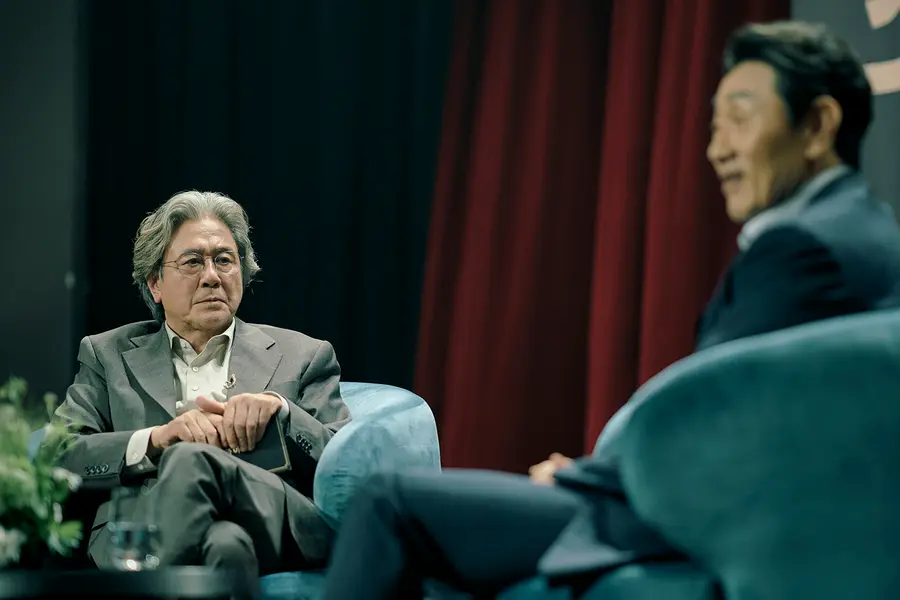
In the end, 〈The Boy in the Last Row〉 tells the revolting, chilling story of perfectly ordinary human beings. The portrait of an intellectual undone by his student’s gaslighting and by the inferiority complex lodged within him captures a universal and ugly side of human psychology. As Alfred Hitchcock suggested through Rear Window, audiences voyeuristically watch the act of voyeurism itself through the medium of drama — we voyeuristically observe those who voyeurize — even as the viewing experience makes us uncomfortable; we cannot stop. Like Heo, who cannot resist and writes the final lines of the novel himself, every one of us carries a bit of Heo Mun-oh inside.



![[OTT Ratings] Cineplay Reporters Review Netflix's 'Notes from the Last Row'](https://cdn.www.cineplay.co.kr/w160/q75/article-images/2026-06-29/b9f39822-feb8-4c9c-8454-bd9d172b1af8.jpg)


![[Interview] Rising star Choi Hyun-wook takes on a tiger-like co-star in 'Notes from the Last Row' ①](https://cdn.www.cineplay.co.kr/w160/q75/article-images/2026-07-03/50104a3f-b9b1-4d47-9d7a-b36470c979cd.jpg)
댓글 (0)
댓글 작성
댓글을 작성하려면 로그인이 필요합니다.
로그인하기