



Director Julia Ducournau, who won the Palme d'Or at the Cannes Film Festival with the film 〈Titane〉, returns with her new work 〈Alpha〉. Ducournau built a distinctive cinematic worldview by depicting forbidden desire with striking mise-en-scène in films such as 〈Raw〉 and 〈Titane〉. Her work often centers on vivid images of bodily transformation, sensory transference that makes the pain of others felt in one’s own body, and the unraveling of normalized identities. In 〈Alpha〉, she continues that worldview while introducing new shifts. The film leans more heavily into the tropes of tragic family drama and deploys a structure—crossing life and death, past and present, reality and fantasy—not seen in her earlier films, resulting in a noticeable evolution in her cinematic universe. Because of these fresh moves, 〈Alpha〉 has emerged as one of this year’s most contentious films. Immediately after its unveiling at the 78th Cannes Film Festival, 〈Alpha〉 provoked an extremely polarized critical response on Metacritic, recording a high score of 100 and a low of 20. Undoubtedly, 〈Alpha〉 will be this year’s most controversial film.
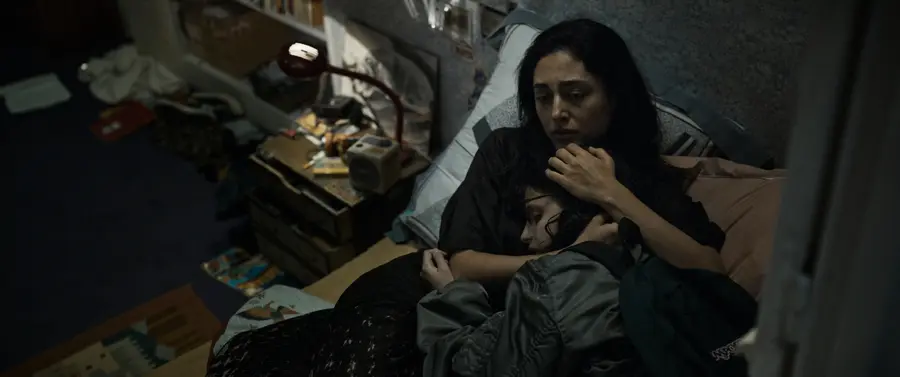

A blood-borne virus that turns human bodies rigid as plaster statues sweeps through the city. Alpha, a rebellious 13-year-old girl (Melissa Boros), comes home one night drunk. Alpha’s mother, a doctor (Golshifteh Farahani), finds a tattoo of the letter "A" on Alpha’s unsteady arm. Worried the tattooing instruments might have transmitted an infection, Alpha’s mother has her tested for the virus. While they wait two weeks for the test results, Alpha is already stigmatized at school as a virus-infected person and becomes a pariah among the children. Amid this turmoil, Alpha’s uncle Amin (Tahar Rahim) suddenly appears in her life. After that, the two women enter a fraught cohabitation with Amin, a man who was a drug addict in the past.
“Contamination by fear itself”

The virus in the film, spread through blood, evokes AIDS, which ravaged the 1980s. In one scene, Alpha’s mother cuts her own hand with a blade to draw blood. Immediately after, suspecting Alpha might be infected, she pricks Alpha’s hand with a needle, draws blood, and presses their hands together as if to share fate. The sequence reads as an explicit metaphor for AIDS. But the film focuses less on the disease itself than on reenacting the tragic history of social aversion that accompanied the AIDS panic of the era. With a wound from the tattoo still bleeding, Alpha bleeds at school and the children who witness it stigmatize her as a virus-infected person. Their avoidance and hostile stares toward a bleeding Alpha reflect the social misunderstanding and isolation suffered by AIDS patients of the time. Mockery of Alpha’s gay homeroom teacher by the students and people’s discriminatory looks at his plasterlike partner further reinforce that parallel. Observing the moral hysteria of the period, Susan Sontag wrote in her book 「AIDS and Its Metaphors」 (1989) that AIDS was “one of the illnesses most laden with meaning, along with leprosy and syphilis,” and she pointed out that society had overloaded the disease with meaning by treating illness as moral punishment. Julia Ducournau takes up Sontag’s argument. She has repeatedly stressed in interviews that 〈Alpha〉 is not a film about AIDS itself. Ducournau said, “The film’s central theme is ‘contamination by fear itself,’” adding that she focuses on how fear of others can infect an entire society and ultimately lead to the rejection of the other. 〈Alpha〉 is not a simple historical record of the AIDS panic of the 1980s; it reveals the pathological fear in people who, faced with an irresistible threat such as an epidemic, readily make strange and unfamiliar outsiders into scapegoats.
Time of trauma

As noted above, 〈Alpha〉 intentionally blurs the line between present and past, creating confusion. The film signals time periods only through subtle shifts in color. Past sequences are washed in sepia tones and red hues, while the present is rendered in a pale, cool tone. That cool palette externalizes the inner lives of characters still trapped in the past. For much of the film, viewers are left uncertain whether the two figures are the same person; only when past and present overlap in an event does the family tragedy finally reveal itself.
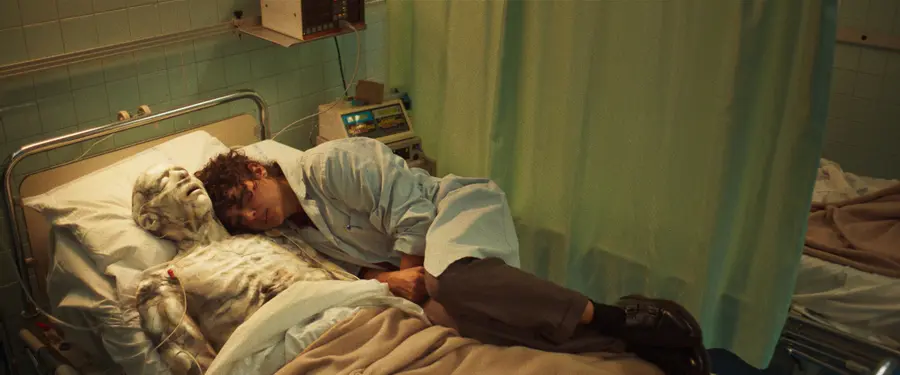

Alpha and her mother cannot escape memories of the past, when the virus took a family member; those memories continue to haunt them in the present. On the night Alpha comes home with a new tattoo on her arm, Alpha’s mother confesses she fears that the past pain of helplessly watching a family member become infected with the virus at close range may begin again. That fear conjures back the presence she had kept tied to sorrow. A five-year-old Alpha in the past also calls up childhood memories through fear and begins to see Amin. To express the inner life of characters consumed by trauma, Ducournau adopts a structure that blurs the boundary between past and present. In an interview she said, “Trauma’s time is never linear. The past returns as flashbacks and images that invade the mind, and the future constantly erodes the present with the fear that the same thing might happen again.” Their present is a perpetually perforated now, worn through by reenactments of the past and anxieties about the future.

In the present timeline of the film, Amin functions as an embodiment of Alpha and her mother’s unresolved grief and pain. In the past, Amin lived out his days waiting for death as a person immobilized by the plasterlike effects of the virus. In the present, he appears as a drug addict. That said, the decision to equate an irresistible epidemic with the personal trajectory of drug addiction and to treat them as tragedies on the same plane feels like a hasty leap. In the film, Amin’s drug dependence does not begin as a voluntary choice but as an effort to manage and forget the pain of the epidemic. By intentionally keeping that point ambiguous, the director exposes the cruel mechanism by which social judgment converts illness into an alleged personal moral failing. Yet this linkage departs from the realities of ordinary drug addiction and reads as an artificial construct within the narrative. The connection seems driven more by the writer’s subjectivity and ambition than by logical precision. Ducournau repeatedly draws these complex symbolic links in the film. Virus-infected people are pictured alongside sexual minorities, immigrants from Islamic cultural backgrounds (the film depicts Alpha’s family as coming from an Islamic cultural background), and other socially marginalized groups, fragmentarily portraying the condition of social minorities and stressing their isolation. The visual line connecting syringe marks on Amin’s arm signals this thematic concern. But despite the film’s stated impulse to connect with the other, it becomes trapped within its own dense system of meaning. That rigid system of meaning keeps Ducournau’s drama from landing emotionally. 〈Alpha〉 is a film full of its maker’s ambitions, even laying bare personal material, yet it leaves the impression of a misstep in Ducournau’s filmography.



![[Chu A-young's Music Box] How Don Hertzfeldt's 'It's Such a Beautiful Day' and Smetana's 'Vltava' Capture Life's Beauty](https://cdn.www.cineplay.co.kr/w160/q75/article-images/2026-07-30/8e4453b0-0238-49d6-9947-8e664799fe0f.png)

![[Choo A-young's Music Box] Ridley Scott's Message of Hope in 〈Dog Star: Last Hope〉 and Hozier's 'Like Real People Do'](https://cdn.www.cineplay.co.kr/w160/q75/article-images/2026-08-26/421a6be0-7c02-4e00-a36c-03a38877511a.jpg)

![[Choo A-young’s Music Box] After Anger, ‘Oasis: Don’t Look Back in Anger’ Sings Again](https://cdn.www.cineplay.co.kr/w160/q75/article-images/2026-09-10/93921b18-781e-4236-b1ef-360bc41540ee.jpg)
댓글 (0)
댓글 작성
댓글을 작성하려면 로그인이 필요합니다.
로그인하기