



To borrow the words of actor Lee Jun-hyuk, 〈The Art of Sarah〉 is truly the 'culmination of Shin Hae-sun's acting.' Following her portrayal of a multi-layered personality in 〈My Harry〉, Shin Hae-sun delves even deeper in 〈The Art of Sarah〉.
Released on February 13, the Netflix series 〈The Art of Sarah〉 tells the story of a woman named 'Sarah Kim,' who wanted to be a luxury brand even if it was fake, and a man named 'Moo-gyeong' (Lee Jun-hyuk) who tracks her desires. The character 'Sarah Kim,' played by Shin Hae-sun, is the head of the Asian branch of the luxury brand 'Bodua,' who confuses people and complicates investigations with her actions that oscillate between meticulously crafted lies and inscrutable truths.
While 〈The Art of Sarah〉 is undoubtedly a story about luxury goods, it is also a drama that poses multiple layers of questions about capitalism, reality versus illusion, love, goodwill, and sympathy. From Sarah Kim, the head of the luxury brand 'Bodua,' to Mok Ga-hee, who entered a department store with a single dream, to Dua, who plunged into the entertainment industry with debt, and Kim Eun-jae, who married a loan shark for identity laundering, it doesn't matter whether Sarah Kim was really Sarah Kim, Mok Ga-hee, Dua, or if she was Kim Mi-jung from the start. What is clear is that Sarah Kim did not worship materialism but rather exploited it.
Thus, 〈The Art of Sarah〉 appears to be a meta-drama that deceives even viewers who worship luxury. Sarah Kim, who declares, 'If Bodua is a scam, then all luxury goods are scams,' navigates various emotions freely, like a fish in water, embodying multiple personas. The space and contradictions created by Shin Hae-sun's portrayal of Sarah Kim made the drama even more intriguing.
Sarah Kim is a character whose aspirations are so great that she appears emotionally empty, twisted by a superiority complex that sees receiving help as shameful, yet she possesses the duality of offering her scarf to others. Shin Hae-sun does not attempt to define this contradiction with precise language or cut it off with dichotomy; instead, she leads the drama while posing strange questions to the audience.
Having clearly proven that 'Shin Hae-sun is a genre' through 〈The Art of Sarah〉, Shin Hae-sun met with Cineplay on the afternoon of the 20th in Jongno-gu, Seoul, to discuss the preparation process, behind-the-scenes stories, and her own interpretations of the work. Below is the full transcript of the interview.
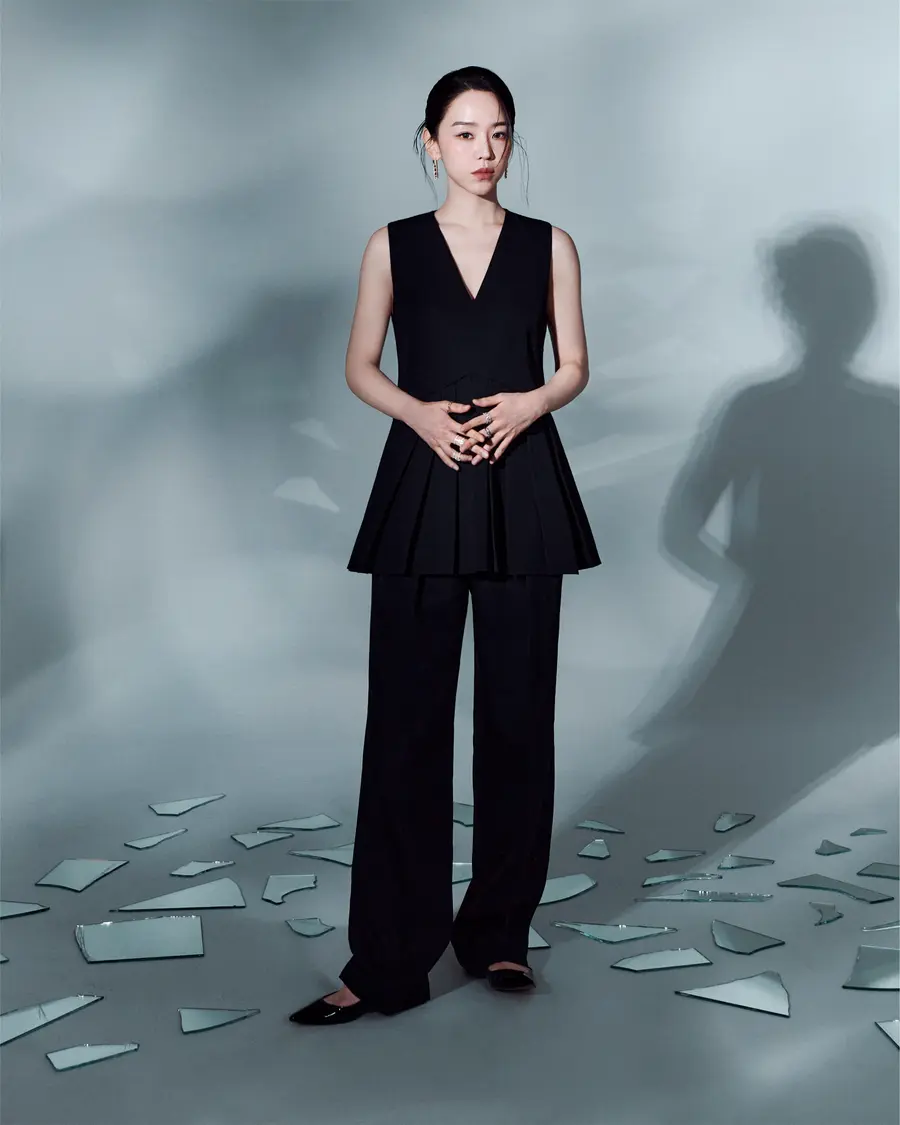
〈The Art of Sarah〉, and the reactions to Shin Hae-sun's performance are very enthusiastic. Do you feel it?
Actually, I have only done TV dramas, so I am used to the ratings as a metric. So, this is my first time with Netflix, and I wasn't quite sure about the atmosphere. However, I received a lot of messages from people around me. Even people I hadn't heard from in years reached out to say they enjoyed it, and some even said, 'Congratulations.'
As you mentioned, you challenged yourself with your first OTT project in 〈The Art of Sarah〉. How was the collaboration with Netflix?
I understand why everyone talks about Netflix. The good thing is that it is a platform that can be viewed globally. I am very grateful that people from other countries can easily access the work I participated in. Also, the filming set was very generous. The snack table was really luxurious. It was enough to fatten up the actors. (laughs) It was my first time experiencing such a diverse and luxurious snack spread. You could say it was enough that we didn't even need to eat meals.
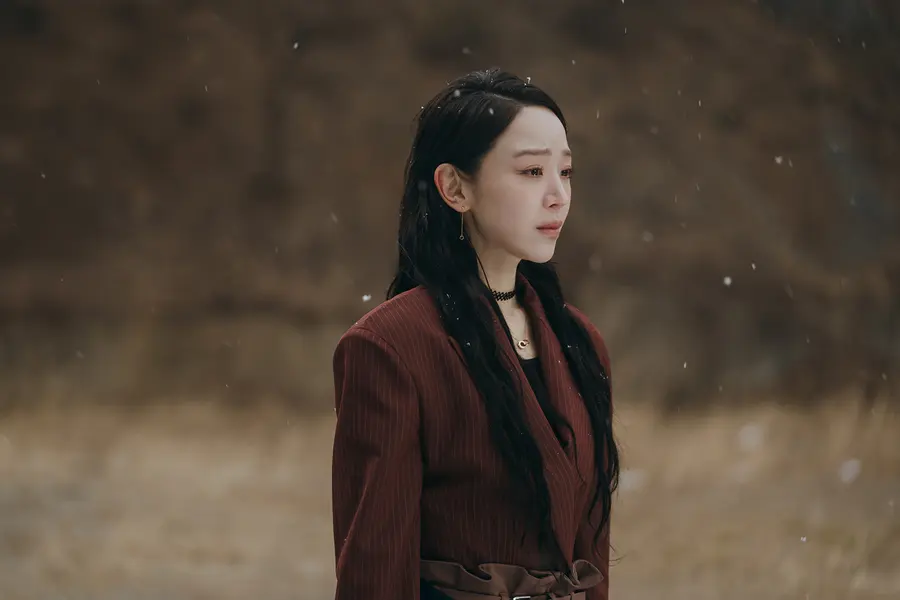
When you first received the script for 〈The Art of Sarah〉, you must have had a lot of thoughts since you had to portray multiple layers of personas.
Of course. Usually, when I read a script, I often think that I want to do the work because I am drawn to the character I will play. But this drama was different. The character Sarah Kim was very puzzling, and I thought, 'This will be difficult to act,' so I wasn't particularly drawn to the character. However, I chose this work because the incident was very intriguing. It starts with a dead woman, and I was curious about who this corpse really is and how the story would end. I only received the script up to episode 4, so I didn't know the ending. That's why I chose it because the script itself was interesting.
Sarah Kim is a character with multiple personas. It must have been challenging to differentiate your acting for each persona. How did you prepare for the role?
Finding the right tone was the biggest challenge. This character needs to have a tone that can persuade viewers as a main character, and while there are multiple personas, they should seem consistent yet subtly different. While I can't say Sarah Kim is a likable character, for the drama to flow, there needs to be some level of persuasion regarding her choices and character. The art team did an excellent job of capturing the overall tone and manner of the drama, so I thought I should align with that. Personally, I believe that the pitch and tone of a voice are one of the important factors when judging a person for the first time. So, I thought this role should be calm, and I tried to use a much calmer tone than my usual speech when portraying Sarah Kim.
What do you think is the core driving force of this character?
I see 〈The Art of Sarah〉 as a process of Sarah Kim finding her identity. In fact, she is a friend with aspirations that exceed the norm. However, because that aspiration is so great, it makes her feel emotionally empty. I wanted to convey the feeling that the closer she gets to her destination, the more emotionally vacant she appears. On the surface, she seems passionate, but I wanted to portray a strange emptiness in her gaze. I think the concept of 'Bodua' itself reflects what Sarah Kim, or rather this woman whose real name I don't know, projected onto it. But I think this woman really wanted to create something 'real.' Since everything about her is fake and she feels empty, her goal and aspiration seem to be about creating something genuine.
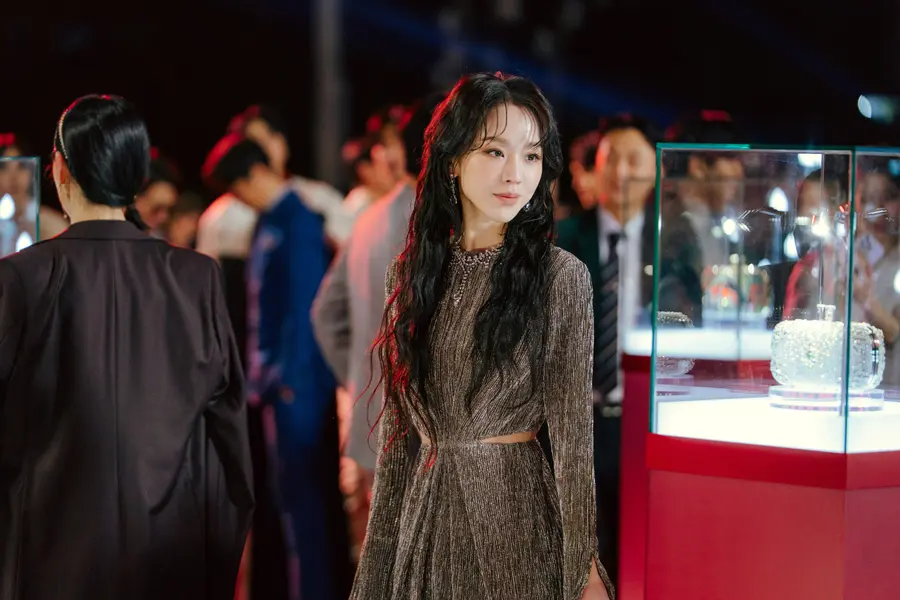
The party scene with Sarah Kim was impressive. As the phrase 'glamorous melancholy' suggests, Sarah Kim appears at the party with a glamorous exterior but has 'lifeless eyes.' In contrast, Mok Ga-hee had a very lively gaze when she first saw a luxury bag after joining the department store. How did you express that stark contrast?
That's exactly what I wanted to express. But if you ask how I did it, it's hard to explain it like a mathematical formula. (laughs) I think all actors feel something from within and act accordingly. It's not something you can plan; it comes out of the situation. I'm not sure how to explain it. (laughs)
Let me change the question. Mok Ga-hee, at 27, joins the luxury department store at an age that is quite old for a newcomer. What do you think was the driving force behind Mok Ga-hee's pursuit of her dream, represented by the bag?
The bag visually represents Mok Ga-hee's aspirations. As the copy in 〈The Art of Sarah〉 states, 'a fake that wanted to become real,' if this friend had been born into a wealthy family, she would have been someone who practiced nobless oblige without having to pretend. However, Mok Ga-hee has a twisted superiority complex. She dislikes receiving help and would rather be in a position to give help. It's important for her to be in a position where she can encompass everyone and 'give.' I felt that the bag represented that position. For instance, Mok Ga-hee had to pay back 50 million won in debt, and there was a time when all the employees pooled their money to help her. But when Mok Ga-hee received the employees' money, she probably felt worse rather than grateful. Being in a position where she has to receive help, and the audacity of them helping her, makes her feel anger; she is a character with a strange superiority complex and a twisted sense of elitism.
So, is the scene where Sarah Kim gives gloves and a scarf to a homeless person also derived from her superiority complex and elitism?
I interpreted it that way. I didn't see it as showing Sarah Kim's goodwill, but rather as a scene that demonstrates 'I am superior.' However, the difficulty in acting this was that it could also be genuine in her own way. She was a character with many contradictory aspects. It could be that she genuinely felt sorry for the homeless person and took off her scarf, but there are also mixed feelings of 'You're so pitiful, let me help you, I'm so superior,' making her a dual-natured character.
▶ 〈The Art of Sarah〉 actor Shin Hae-sun's interview continues in Part 2.

![[First reactions] 'Look Back' Cineplay reporters' star ratings](https://cdn.www.cineplay.co.kr/w300/q75/article-images/2026-09-29/86caa45d-4319-4803-92b7-38b58935b7d3.jpg)
![[On the Ground at BIFF] “Art Is Art”: Zhang Yimou Breaks Silence on Historical Controversy Over “Assassins”; Top Asian Film to Be Named on 15th](https://cdn.www.cineplay.co.kr/w300/q75/article-images/2026-10-07/c4d38025-dc2a-4cf0-919a-792227afc5f5.jpg)

![[OTT Rating] Netflix Series 'Lady Dua' Cineplay Reporter Rating](https://cdn.www.cineplay.co.kr/w160/q75/article-images/2026-02-19/24853f83-ccb1-49d6-ae3a-f283dcc7d08d.jpg)

댓글 (0)
댓글 작성
댓글을 작성하려면 로그인이 필요합니다.
로그인하기