



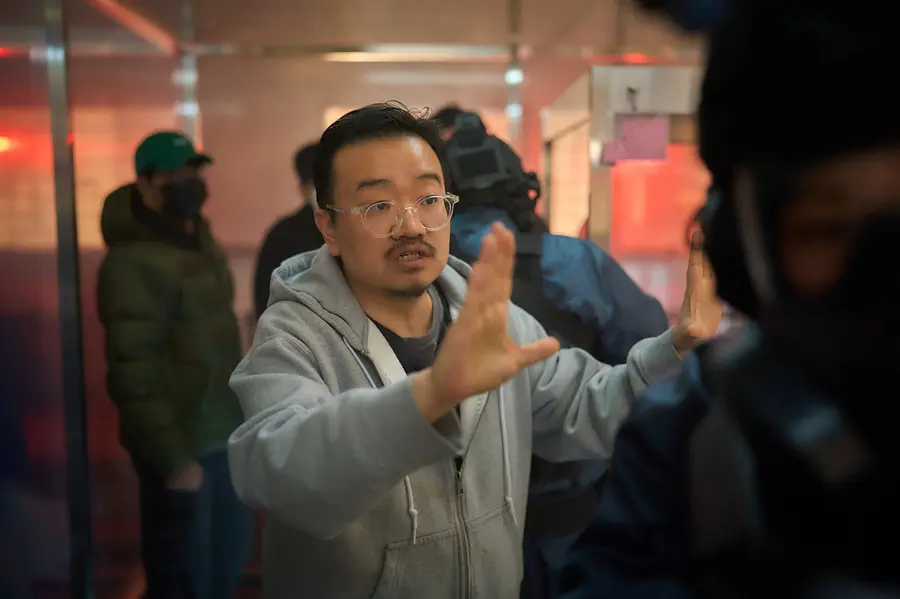
Yeon Sang-ho has done it again. Released on May 22, 〈Colony〉 passed 2 million viewers in its opening week. The overseas response has been as strong as the domestic reaction: advance international sales have already generated significant revenue, and in Malaysia the film ranked third among all Korean films at the box office just three days after opening. The world is responding to a new zombie film by Yeon Sang-ho, the director who solidified his reputation as the godfather of Korean zombie films with 〈Train to Busan〉. Though Yeon has released a new project nearly every year, this is his first large-scale commercial theatrical release since 2020’s 〈Peninsula〉, six years ago, according to the interview text. I met Yeon on May 26 at a location in Jongno-gu, Seoul, to talk about the film. Below, he discusses his mindset as a filmmaker.

You’ve returned to theaters with a large-scale project after a long break. How do you feel about the current situation compared with expectations before the release?
I made 〈Face〉 last year, but that was a small film by commercial standards. A lot has changed in the culture since then. I only have a sense of how things are going from what I’ve been told. Personally, I’d be satisfied if the film just breaks even. I watched it yesterday in a 4DX auditorium and it was lively. With 〈Face〉, audiences tended to be more absorbed, which I liked, but a big movie like 〈Colony〉 is good to see in that kind of rowdy environment.
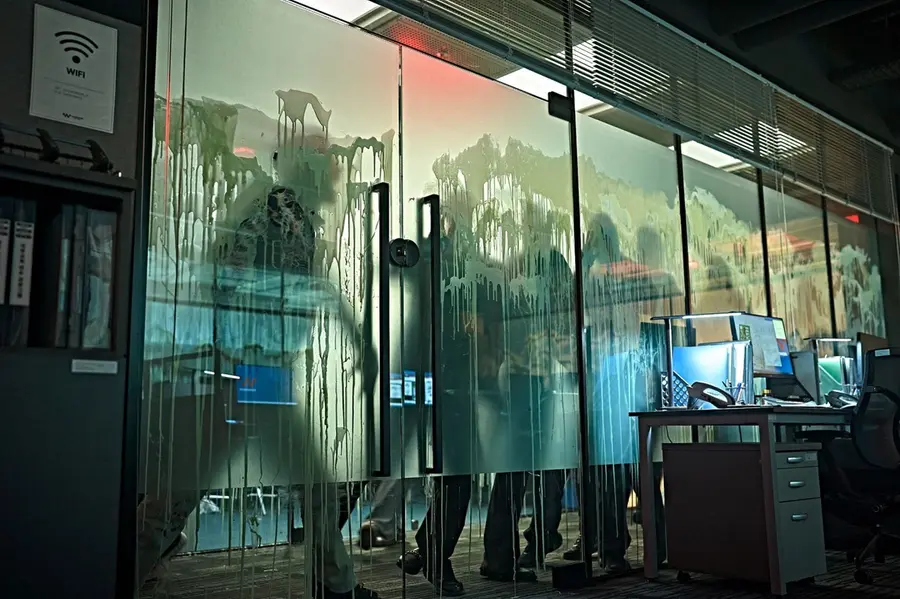
The zombies’ slimy visual effects were really striking.
We made them the way you make the toy “slime.” We produced it in large quantities and smeared it on. I thought it might not wash off well... We had a lot of trouble. Especially when we sprayed it on the floor, it got extremely slippery.
How did the international press react when the film premiered at Cannes?
Because it was the first time we presented this story, I wondered whether the ideas would translate. But critics picked up on themes like AI, collective intelligence, and social media, and they raised those points first. I felt they were seeing the film accurately.
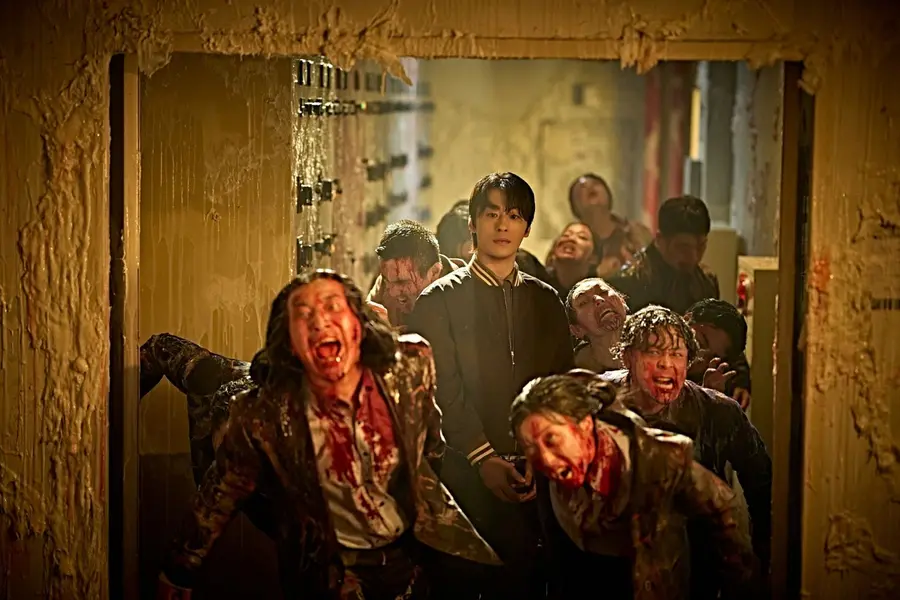
The zombies’ evolution is central to the story and creates the crisis. How far and in what way to evolve the zombies must have been an important decision.
From the concept of evolution, I needed the evolution of collective intelligence and its harms to be intuitively visible. I thought about what level would be appropriate. Although it starts as collective intelligence, by the middle and late sections it effectively becomes the will of an agitator, Seo Young-chul (Koo Kyo-hwan). That needed to be well expressed. The film ends at a relatively primitive stage. But the immersive performance based on the film offers varied endings: in some versions the zombies evolve further.
Compared with Yeon Sang-ho’s zombie films 〈Train to Busan〉 and 〈Peninsula〉, 〈Colony〉 is more restrained emotionally.
The original script was 168 pages. Converted to running time, that’s about three to three hours and 20 minutes. While discussing the project with Showbox, we debated the direction and what kind of audience we wanted to reach, and decided to go for a sense of speed. We aimed for an experiential, fast-paced film that focuses on formal beauty and an allegorical message. If you compare it to 〈Train to Busan〉, that film centered on the father-and-daughter relationship — a parent protecting a child — and that dynamic amplified the horror. With 〈Colony〉, I wanted to show zombies evolving into two groups: one side evolves, the other side regresses, and to use that contrast. I wanted to try that. These days escape-room games are very popular. I thought about why they’re popular — at the core is extreme game playability — so I built the film around that idea. So I studied films built around that kind of structure, like 〈Battle Royale〉.
So you must have cut a lot from the first draft.
We removed a lot. Those elements didn’t seem essential to the film’s concept. For example, the character the actor Kim Jae-rok plays, an elderly person in his 60s, has a backstory: his wife at home calls saying she wants jjajangmyeon, so he desperately tries to get out. There’s also a subplot about middle-schooler Seo Young-chul coming to meet Kwon Se-jung. Those things might have been meaningful if the story were a series, but in a two-hour film in a theater it’s hard to handle everything. Even without those scenes, I thought viewers could naturally imagine the two characters’ histories.
You described Seo Young-chul earlier as an agitator. If the zombies in 〈Colony〉 represent collective intelligence, that characterization has an odd edge to it.
The starting point was the logic of AI. Because AI centers on universalized thinking, I asked what would stand in opposition to that — and arrived at the idea of individuality. When I examined an organism acting as a collective, I found many interesting parallels. Because a colony functions as a single entity, an external weakness can kill it at once, so colonies constantly produce variants. I think that resembles human society. Nature shows why minority opinions matter even when generalized thinking dominates. I built the story along those lines.
The characters show unusual relationships: someone sacrifices themselves trying to save a school bully, and a man’s ex-wife and current wife cooperate, for example.
Those relationships were important to me. This film isn’t one that details every individual’s backstory, so it was more important to set up unique relationships that let audiences imagine the rest. The father-and-daughter relationship in 〈Train to Busan〉 is universal and easy for audiences to follow. 〈Colony〉 doesn’t have that anchor, so I wanted the film’s form to invite viewers to imagine the relationships afterward. I also needed the relationship between the bully and the victim to allow room for interpretation. I wanted audiences to be able to freely imagine those relationships.
There are several action sequences, but the monkey attack scene must have been the trickiest to film.
Most of the action was shot with live actors. The monkey sequence was entirely CGI. We prepared the previs work thoroughly before shooting. The actors must have struggled because they were acting against nothing. Still, we used techniques we developed on projects like 〈Parasyte: The Gray〉, and we made that scene in the same way. It was the scene where our working methods differed the most across 〈Colony〉 as a whole.
Given your experience, I’m curious whether you have special cost-saving techniques for production.
The budget for 〈Colony〉 was 17 billion won. I’ve done low-budget films like 〈Face〉, but I’ve never filmed with a lot of slack. To do this kind of work with that budget, you have to do a lot of prep. Our shooting schedule is short, and that’s the biggest factor tied to cost. If you don’t follow what you prepared in preproduction, costs inevitably rise. So we worked hard in preproduction to reduce the number of shooting days. That’s always the case when making a film: you plan tightly.
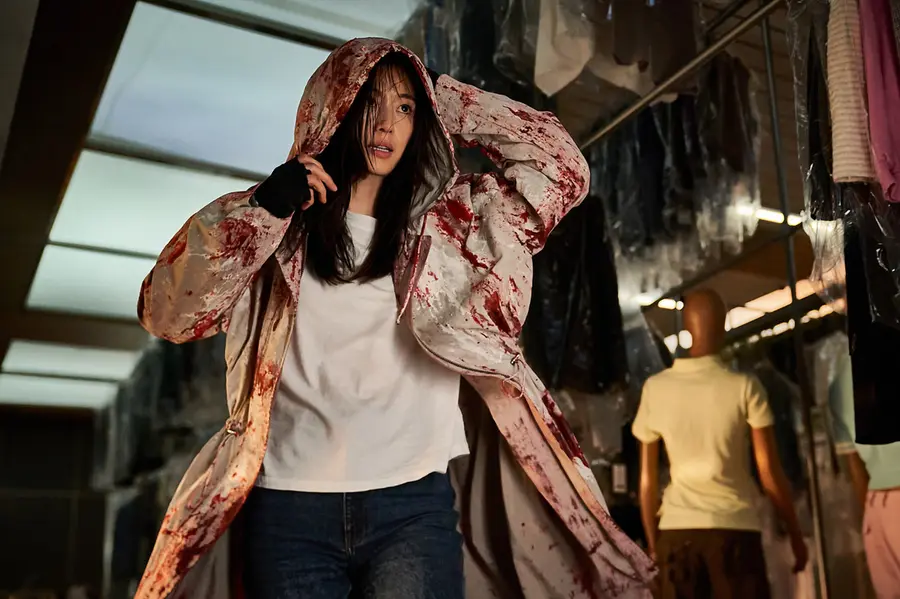
This is a film strongly carried by the presence of Jeon Ji-hyun. Yet some viewers have commented that Kwon Se-jung (Jeon Ji-hyun) looks almost too clean on screen.
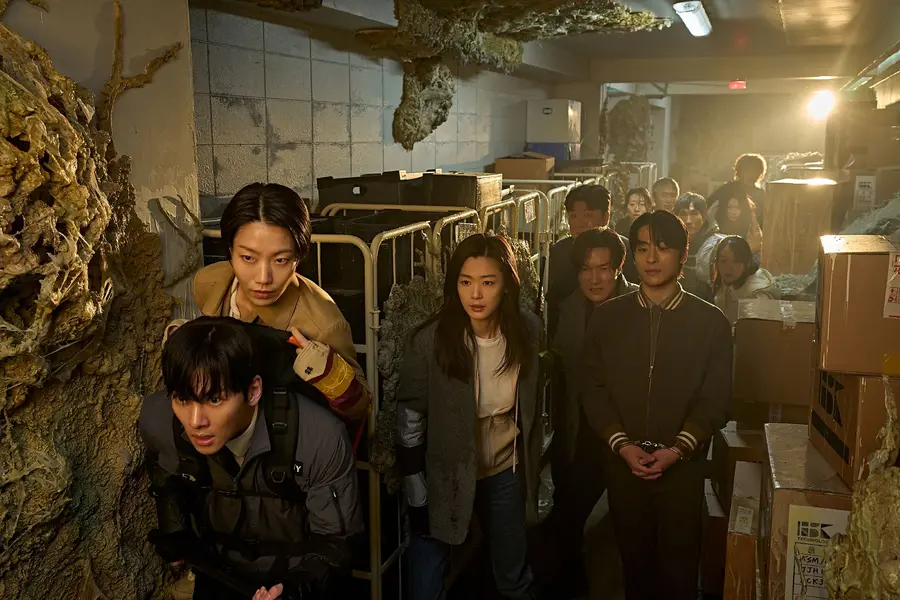
Jeon Ji-hyun didn’t do anything special for that— I watched her closely. Seo Young-chul’s face is clean too. If you look in the background, no one looks filthy. Actor Ji Chang-wook’s character gets splattered with blood, but Se-jung rarely does. In the latter part of the film Se-jung ends up wearing only a white shirt and jeans. I wondered whether the lead could look that plain, but after filming it didn’t feel that way. Her physical presence is overpowering. (everyone laughs) The makeup team adjusted looks to suit the story; we didn’t intentionally make her look cleaner. The image the public has of Jeon Ji-hyun is that she carries an aura even standing in a genre film, and that quality contributes significantly to the movie. Her character represents individuality and is depicted as an outcast in academia, so I worried viewers might think, “Would someone like that really be ostracized?” I believe a lead actor sets the tone of a film, and I think Jeon Ji-hyun largely set the tone for 〈Colony〉.

![[Box Office] 'Chiikawa the Movie' syndrome takes holiday No. 1 by just 215 viewers; 'Assassins' hits 3 million](https://cdn.www.cineplay.co.kr/w300/q75/article-images/2026-10-12/a9ee3a67-8186-44d1-a17a-88c842f6c0d8.jpg)
![[First Press-Screening Reactions] 'Colony' Cineplay Critics' Ratings](https://cdn.www.cineplay.co.kr/w160/q75/article-images/2026-05-20/452c0988-e945-4a36-b7f9-1fc529600a3a.jpg)




댓글 (0)
댓글 작성
댓글을 작성하려면 로그인이 필요합니다.
로그인하기