



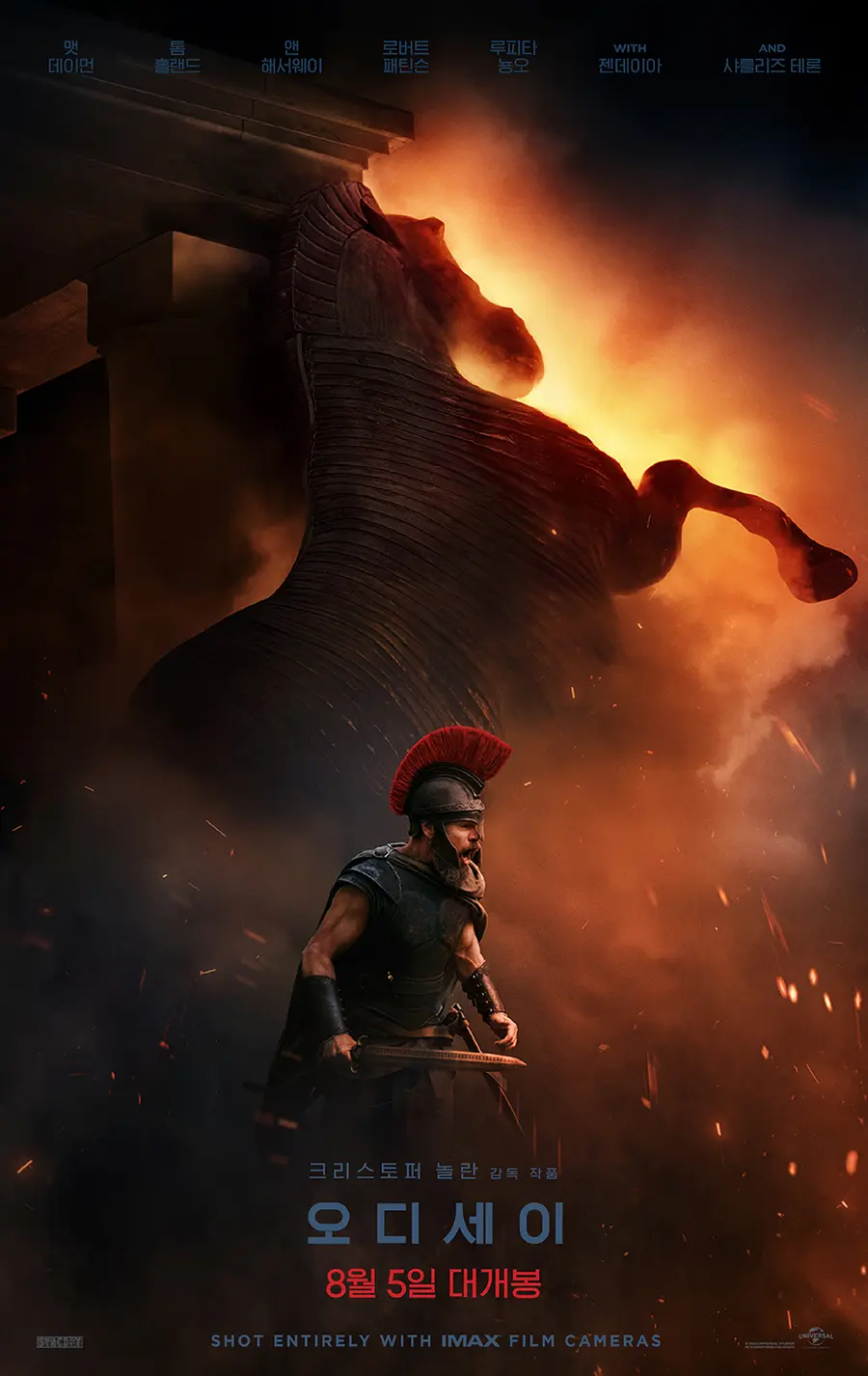
One phrase immediately came to mind: Christopher Nolan has pushed past his own limits in 〈Odyssey〉, his adaptation of Homer’s 「The Odyssey」, which opens on Aug. 5. 「The Odyssey」 tells the story of King Odysseus’s return to his homeland of Ithaca after the Trojan War, a foundational epic that still exerts enormous influence on literature. The fact that Nolan—the craftsman of analog filmmaking—has taken on a sprawling production set in the age of the Greeks made 〈Odyssey〉 a subject of conversation. After succeeding both commercially and critically in countries where it opened earlier, including North America, the film has only heightened anticipation in South Korea. With the director and principal cast scheduled to visit South Korea, 〈Odyssey〉 held a press screening on July 23. Below are first impressions from a film that has drawn applause not just from critics but also from general audiences.
Not a Hero’s Myth, but a Great and Fragile Human Being
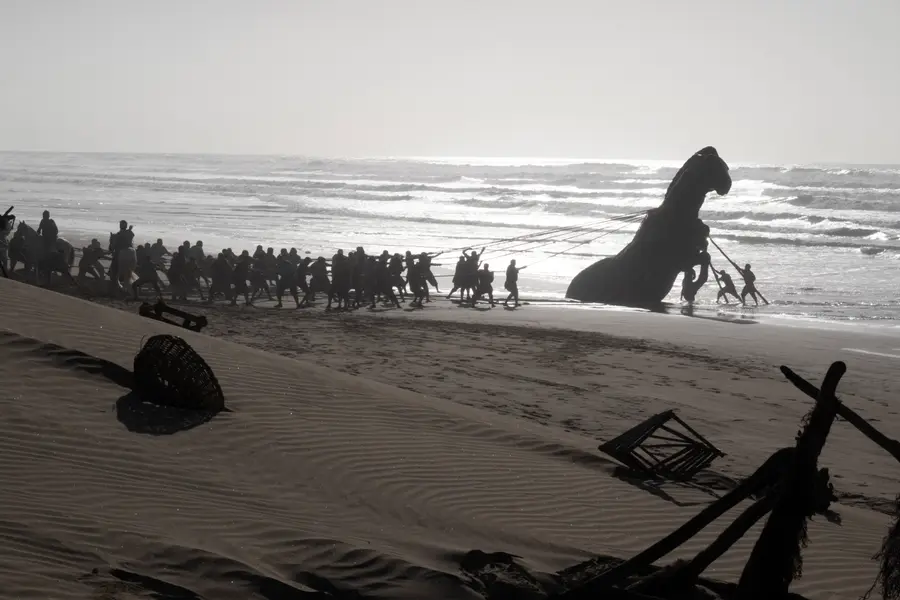
〈Odyssey〉 (and the source text 「The Odyssey」) is often summarized as “Odysseus’s homecoming,” but the film resists such a simple reduction. One strand of the film follows the people in Ithaca, where Odysseus still has not returned. Ten years after the Trojan War, Odysseus—the strategist who turned the tide with the Trojan Horse—has become the stuff of heroic song, yet Odysseus himself has not come home. Suitors flock to the vacant throne, and under what the film calls “Zeus’s law” (treat others as you would like to be treated) they cannot simply be driven away. The queen and the prince firmly believe in Odysseus’s return, but they cannot leave the throne empty forever. By contrast, Odysseus himself, the hero who sealed the war’s end, repeatedly runs into life-or-death crises wherever he goes. A place with heroic tales but no hero; a hero confronting violent, mortal danger rather than legendary deeds. Those two narrative lines drive 〈Odyssey〉.
Having experimented with structure and form around film and time across his last three pictures, Nolan opts here for a relatively straightforward structure. That choice likely aims to convey the story’s core to viewers who come in without prior knowledge. At the same time, he fills the film with strands of thought. Following the spine of the original—a myth about a human journey—the movie casually throws gods and mortals, life and death, war and menace, and an era’s decline into the narrative, so that even viewers unfamiliar with the source can sense the epic’s rich scope. Rather than framing Odysseus purely as a mythic hero, 〈Odyssey〉 presents him as a man living in an age shaped by myth. The film suggests Nolan is asking how great humanity can be—and how small at the same time.
A mythic world that never feels out of place, a cast with undeniable presence

With Nolan’s recent experiments in structure and form taking a step back, the film’s mood and imagery move to the forefront. Focused on making the unreal feel real, 〈Odyssey〉 fully realizes the fear—greater even than awe—that erupts the moment mythic beings appear onscreen. Nolan’s trademark commitment to realistic depiction remains intact. Even though this is a story that belongs to “myth,” every mythic depiction in the frame sits naturally within the high resolution of IMAX 70mm film without feeling out of place. The imagery is so convincing it can prompt astonished questions of “how did they shoot that?”—sometimes pulling you out of immersion. At the same time, Hollywood know-how and financial resources capable of combining this level of location work, special effects, and cinematography are apparent in every frame. The best way to witness the journey’s grandeur and intensity is in the IMAX GT auditorium projected on IMAX 70mm at a 1.43:1 ratio; the next-best choice is a theater with excellent sound, where you can feel the remarkable synergy of Ludwig Göransson’s score and the sound team.
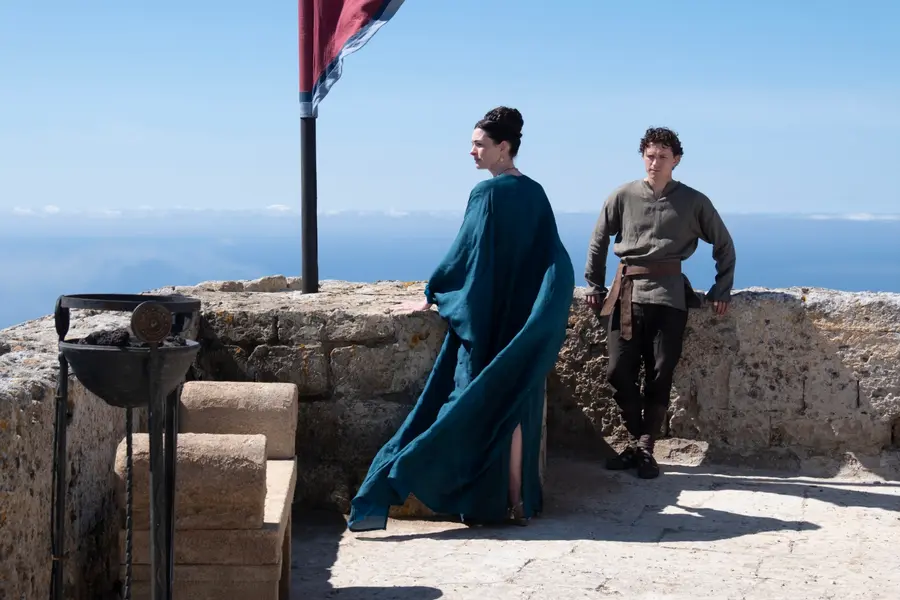
The film’s much-discussed star-studded cast also proves justified. Surprisingly, some of those actors appear in smaller amounts than expected, yet even so, the actors so fully embody each character’s circumstances that their performances overpower the audience. Anne Hathaway’s presence as Queen Penelope and Robert Pattinson’s as the ambitious Antinous explain why Nolan trusts those actors. Above all, Matt Damon, who carries the film as Odysseus, makes the strongest impression. Even though the film offers little overtly heroic imagery, by the end he makes the legends surrounding the character feel entirely believable.
Christopher Nolan’s Portrait of Human Faithfulness
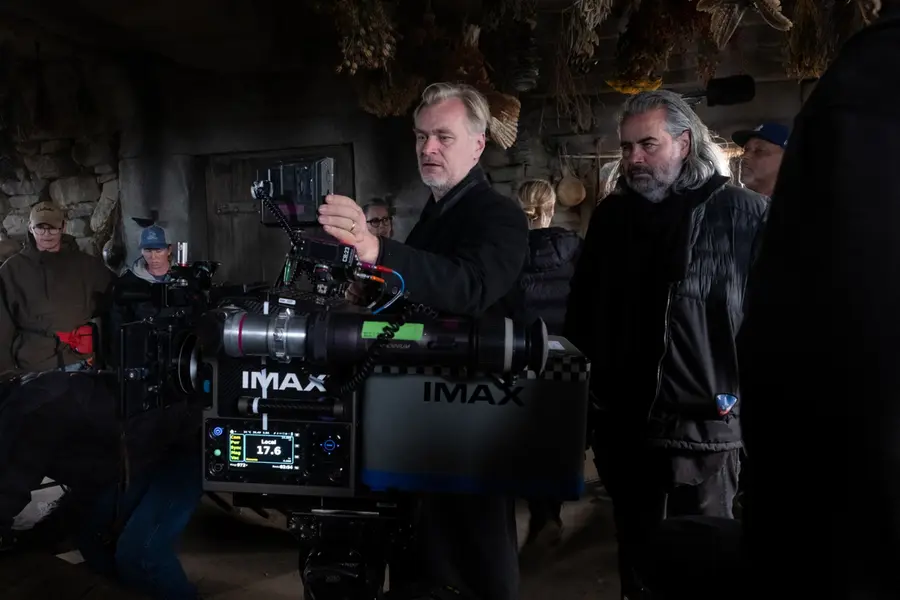
One thing often overlooked when discussing 〈Odyssey〉 is why Nolan followed 〈Oppenheimer〉 with this project. Odysseus is one of the quintessential “human” heroes in Greek myth. 〈Odyssey〉 reconstructs the figure hidden behind heroic tales and strips away the illusions created by war’s mythology. In an era marked by constant signs of war, the film ultimately becomes a story about the fear and pain felt by an intellectual. 〈Odyssey〉 stands on its own, but paired with the story of Julius Robert Oppenheimer—who helped bring a world war to an end but later suffered under false accusations and guilt—it makes for an even more intriguing companion piece.
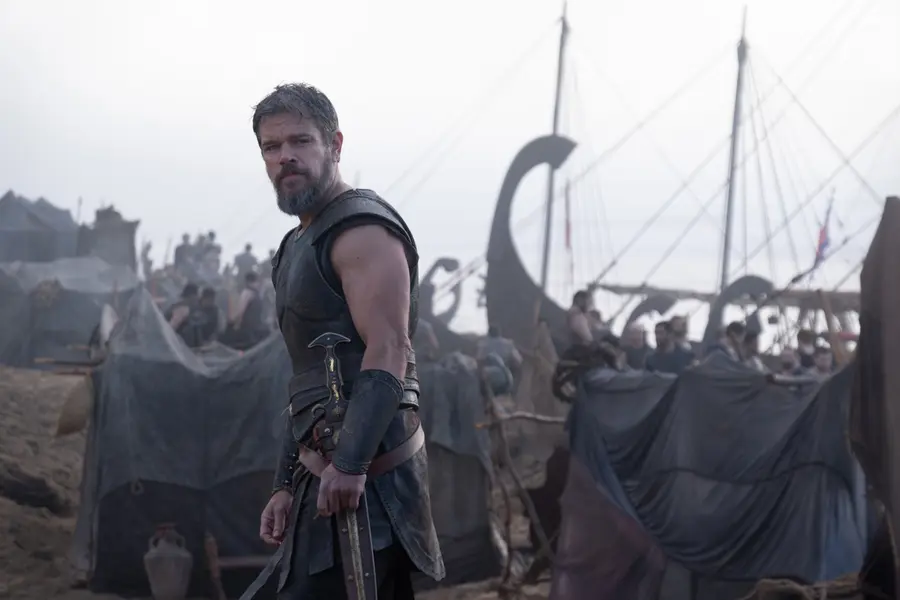
Although the film has drawn widespread praise, it still feels long. Above all, at times the editing feels rough as the film tries to trim its long pacing to fit the IMAX 70mm limitation that prevents projection beyond three hours, and the slightly different tonal quality of some action and reaction shots in IMAX resolution can be subtly jarring. Depending on the viewer, the film’s somewhat explicit message delivery may not always suit a grand epic. Even so, none of this blunts 〈Odyssey〉’s momentum. True to its name, the film uses the full extent of the screen to portray a homeward journey. Seen in theaters, 〈Odyssey〉 offers a striking portrait of human faithfulness through Odysseus—the mythic hero who was also a king and a man.


![[Interview] A Love Letter to Life, Humanity and Korea: ‘Journey There’ Star Justin H. Min, Part 2](https://cdn.www.cineplay.co.kr/w300/q75/article-images/2026-10-22/f97b0baf-32b0-4b5c-983b-df3166e84990.jpg)




![[Photo &] Christopher Nolan’s New Film, “Odyssey,” Shot Entirely in IMAX for the First Time Ever—Releases on Aug. 5](https://cdn.www.cineplay.co.kr/w160/q75/article-images/2026-07-24/873d94e4-89dc-4fb8-803c-f6e144aaccfa.jpg)
댓글 (0)
댓글 작성
댓글을 작성하려면 로그인이 필요합니다.
로그인하기