


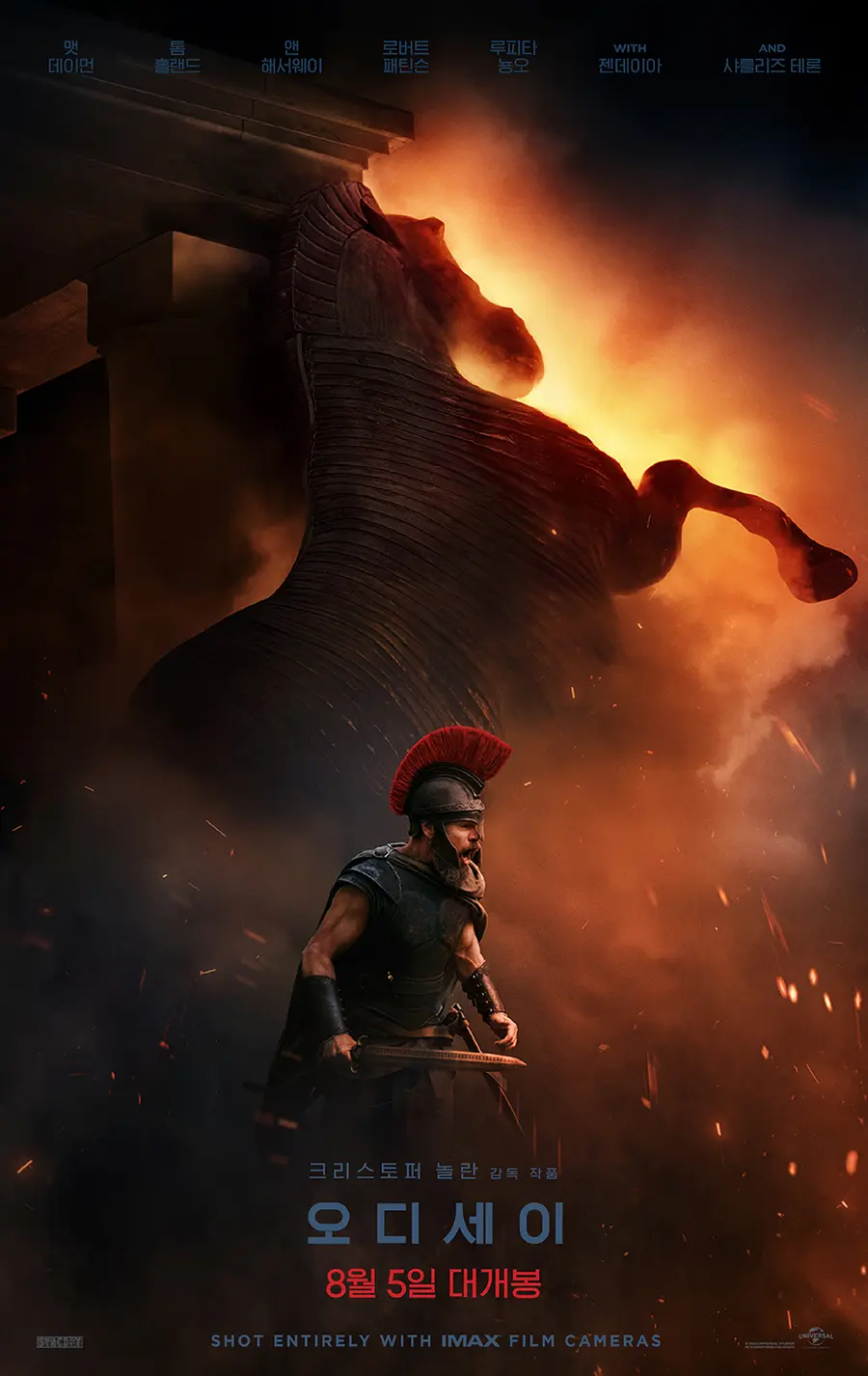
Christopher Nolan’s long-gestating passion project finally reached theaters in South Korea on Aug. 5, with 〈Odyssey〉 reimagining Homer’s 「Odyssey」 as a modern blockbuster. 「Odyssey」—written around the 8th century BCE—is widely regarded as a pinnacle of ancient Greek literature and is often described as the work that launched Western literary tradition. Over nearly three millennia it has profoundly influenced literature, theater and film. In 〈Odyssey〉, Nolan offers a fresh interpretation of the cultural foundation represented by 「Odyssey」, treating universal themes—human will, homecoming and the conflicts between gods and humans—on a grand scale with philosophical intent. With 〈Odyssey〉 drawing strong reviews from critics and audiences worldwide, we summarize the film’s behind-the-scenes history based on materials released by Universal Pictures.
# Nolan’s 20-year dream project
〈Odyssey〉 is a project Nolan has nurtured for more than 20 years. Explaining why he decided to adapt it, he said, “「Odyssey」 is a work that has had enormous influence on world history and culture, but it has never been adapted as a modern blockbuster.” The film reunites Nolan with Matt Damon and Anne Hathaway for the third time. Damon joins Nolan after 〈Interstellar〉 and 〈Oppenheimer〉; Hathaway reunites with Nolan after 〈The Dark Knight Rises〉 and 〈Interstellar〉. The film’s nonlinear structure—memories and parallel narratives woven together—recalls 〈Oppenheimer〉; episodes set in extreme environments evoke 〈Inception〉; and large-scale battle and infiltration sequences call to mind 〈Dunkirk〉 and 〈Tenet〉. Those are hallmarks that run through Nolan’s filmography and here converge in a single work.
# First full-length feature shot entirely on IMAX film despite noise challenges
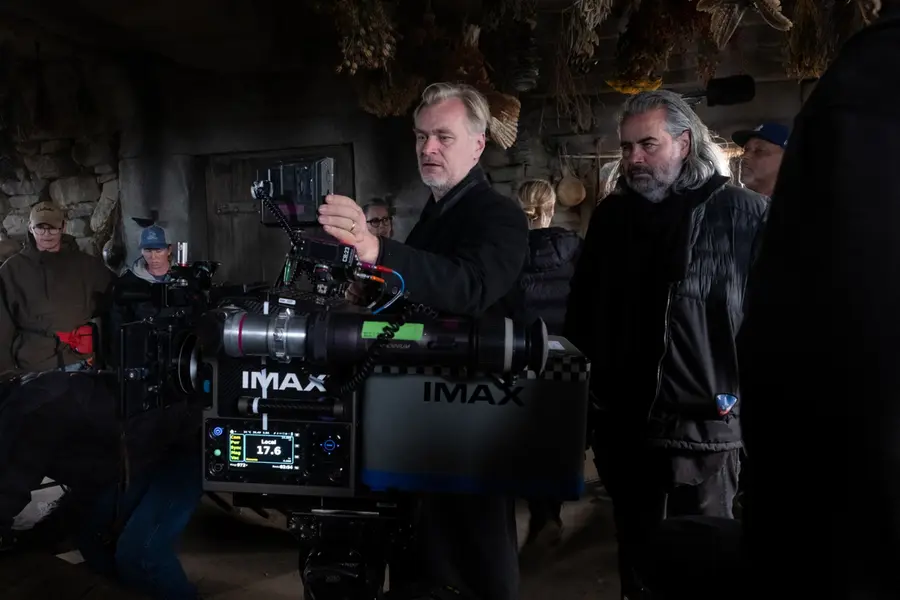
〈Odyssey〉 is the first feature in film history to be shot entirely in the IMAX film format. Nolan, who was captivated as a child by the IMAX dome at the Museum of Science and Industry in Chicago, has expanded IMAX photography across films such as 〈The Prestige〉, 〈The Dark Knight〉 and 〈Oppenheimer〉, and with this film he realized that long-held vision. The challenge was the IMAX film camera’s massive size and its noise. Matt Damon described that noise as “like running a blender right in front of your face.” Nolan therefore teamed up with IMAX to develop a next-generation camera that combines vibration-damping technology and sophisticated soundproofing while preserving the distinctive texture of 65mm film. The result was the IMAX “Kigley” camera, built using carbon-fiber components also used in F1 race cars. Over the 91-day shoot, the production used 2,100,000 feet of film—about 640 km. Cinematographer Hoyte van Hoytema described the film’s visuals as an “intimate epic,” saying he hoped audiences would experience with a man what it feels like to do anything necessary to return to his wife and son.
# No green screen: real locations around the world
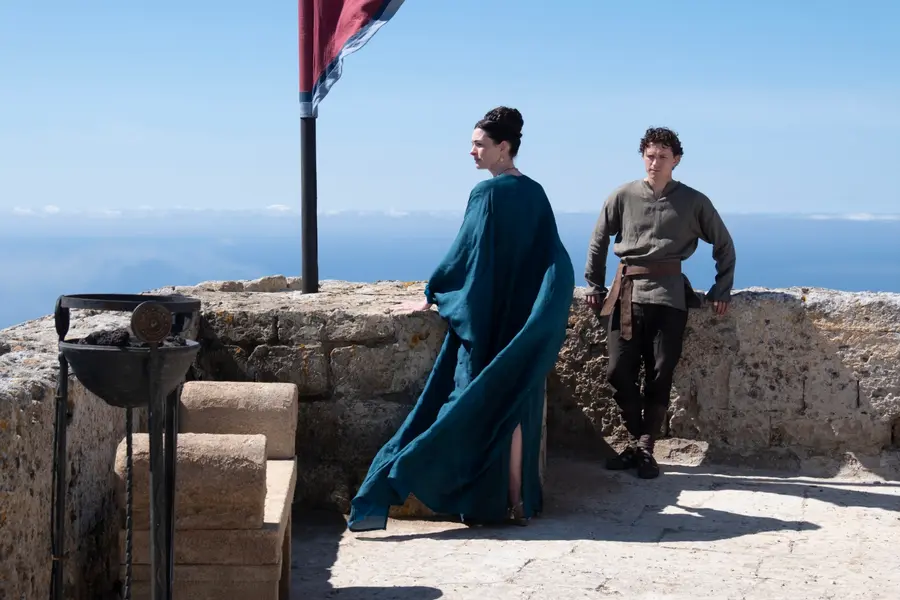
Nolan, known for favoring practical filmmaking over digital effects, spent months scouting and researching locations to bring the world of the original to the screen. The result: dramatic natural sites across Greece, Italy, Iceland, Scotland and the United States were transformed into mythic places—from the beaches of Troy to the cave of the Cyclops, from the underworld of Hades to the islands where Calypso and Circe dwell. “I can’t think of anyone else but Nolan who would make a film of this scale without green screen,” Damon said. Production designer Ruth De Jong, who was an Academy Award nominee for production design on 〈Oppenheimer〉, said, “There wasn’t a single easy location. But if we hadn’t actually gone there to shoot, 〈Odyssey〉 could not have been completed.” Nolan himself summarized his guiding principle succinctly: “The most important thing is to use the real world.”
# Built a 10.7m life-size Trojan Horse and a seaworthy ship
Nolan’s conviction that real space delivers cinematic power was decisively shaped by his experience on 〈Oppenheimer〉. There he and cinematographer Hoyte van Hoytema worked with IMAX and Kodak to develop black-and-white film for 15/65mm IMAX cameras, setting a new technical standard for cinema. That experience gave Nolan the confidence that, by marshaling his production methods and technology, he could bring Homer’s immortal epic to a wholly new level.
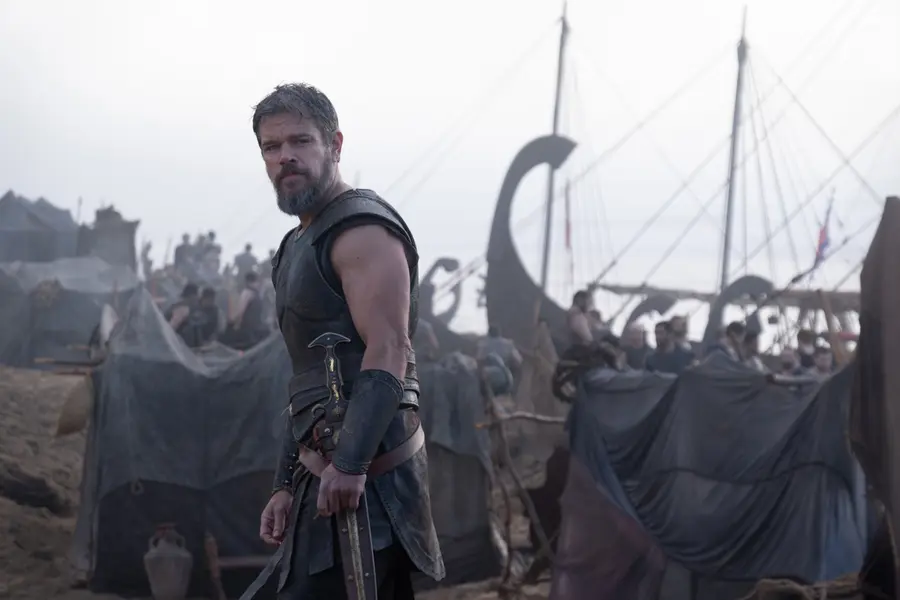
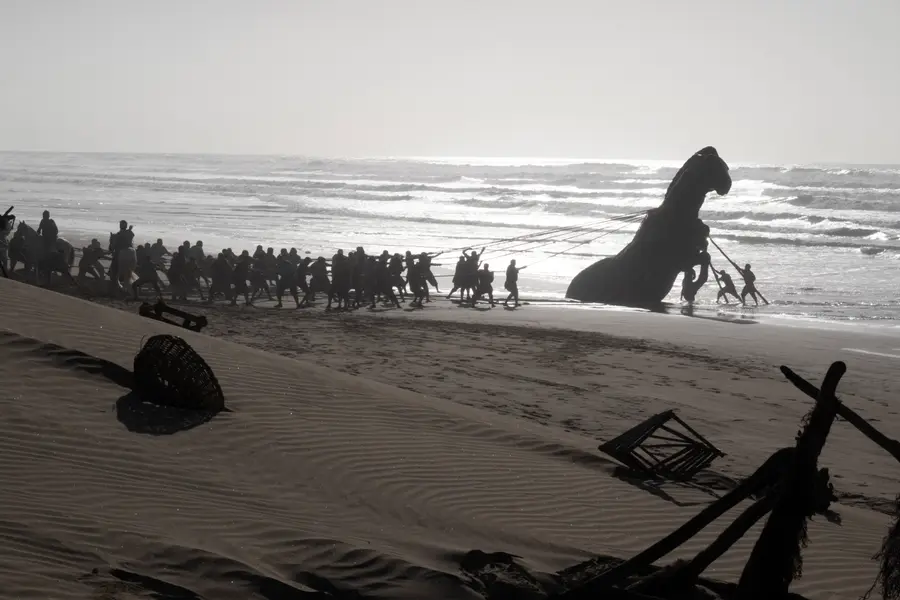
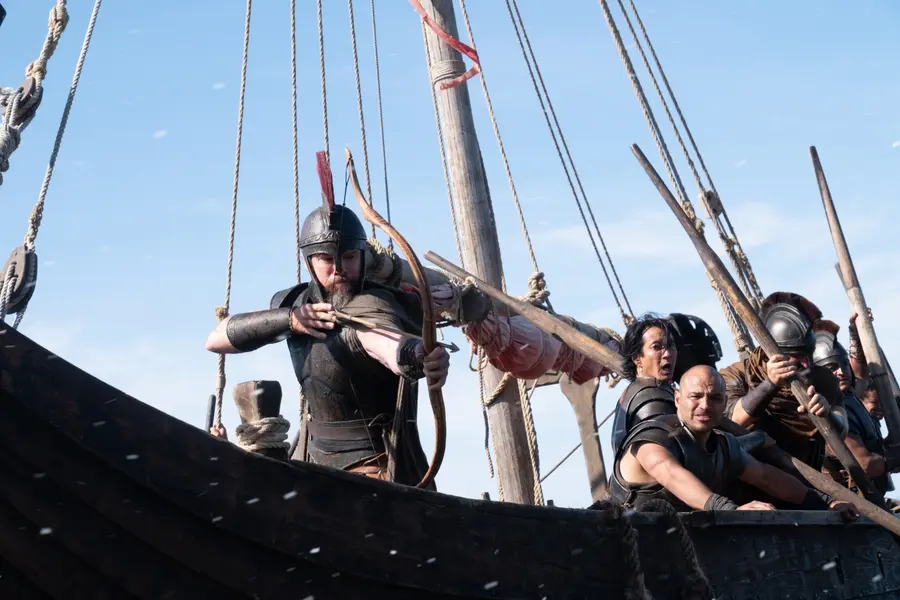
The result is a production that is counted among the biggest projects in Nolan’s filmography: the making of 〈Odyssey〉. Insisting on in-camera spectacle, the crew built a massive Trojan Horse that stands 10.7 meters tall—not a CGI prop but a real, practical structure. That horse is not merely a set piece; it is a symbol of the spectacle Nolan has pursued—something that truly exists in the space. They also constructed the ship for Odysseus and his crew as a seaworthy vessel, allowing actors to perform amid real waves and wind rather than against green screens. Sea monsters, including the one-eyed Cyclops, were realized by combining practical effects (in-camera effects) with minimal CGI, producing an overwhelming sense of presence that digital work alone could not achieve.
# Special LED lighting “Pyrahedron” developed for the fall of Troy sequence
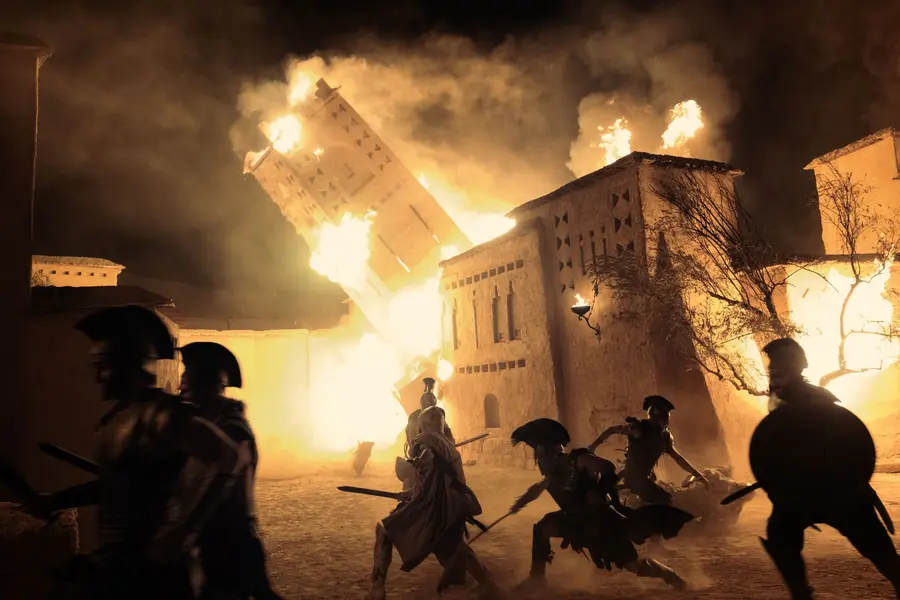
For the fall of Troy sequence, the production had to capture massive sets and thousands of extras while preserving the period texture of a world lit only by torches. To achieve that, the crew developed a new special LED device called the “Pyrahedron” and used thousands of units to create natural-looking torchlight. Nolan said he found the answer in production methods from the silent-film era: “The elements that once drew audiences to theaters—overwhelmingly large sets, astonishing locations, thousands of extras—remain effective today.”
# Ludwig Göransson’s original score crafted from ancient instruments and 35 bronze gongs
Ludwig Göransson, who previously worked with Nolan on 〈Tenet〉 and 〈Oppenheimer〉, returned as composer. Nolan asked him to avoid relying on an orchestra because, he noted, the concept of an “orchestra” did not exist at the time. Göransson conducted deep research into ancient instruments that might have been used in the 5th or 6th centuries—such as the aulos and the lyre—and he experimented extensively with 35 bronze gongs inspired by warning devices that would likely have been used during sieges of Troy. The resulting three-note motif became the core theme representing Odysseus. Sharing about 42 minutes of demos continuously during production, Göransson completed roughly four hours of score by the time filming concluded.







댓글 (0)
댓글 작성
댓글을 작성하려면 로그인이 필요합니다.
로그인하기