



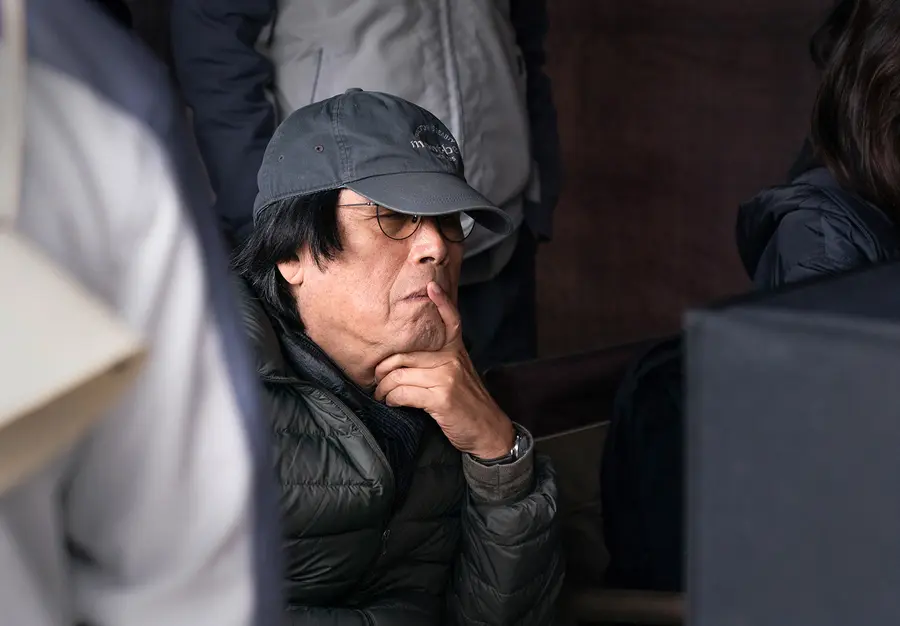
Over roughly 30 years, Korean master filmmaker Lee Chang-dong has made just seven films, yet his imprint on Korean cinema remains immense. Lee Chang-dong returned after eight years with 〈Possible Love〉, a drama about what happens when a laid-off worker couple and a wealthy documentary-director couple meet during the making of a documentary. The film won the 'Silver Lion' Jury Grand Prize at the 83rd Venice International Film Festival in 2026. It opened in theaters on Sept. 23 and will be released exclusively on Netflix on Nov. 6 following its early theatrical run. The collaboration between Lee and Netflix drew wide attention. I attended the press screening on Sept. 21 and offer these impressions. Because the film is not an easy watch and to avoid overstepping the complex feelings it evokes, I’ve organized a few brief keywords.
Workers
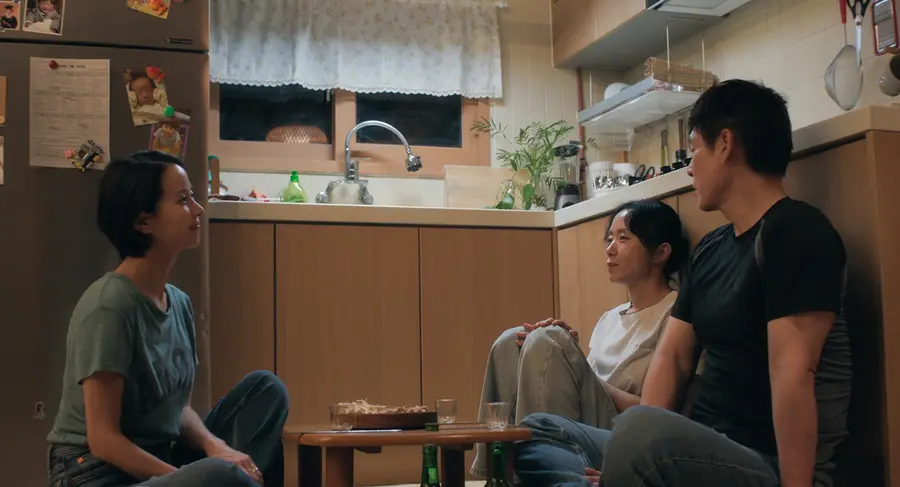
〈Possible Love〉 opens in a way that is at once comic and bitter. Dressed in black, Mi-ok (Jeon Do-yeon), Ho-seok (Seol Kyung-gu) and their son Cheol (Jeong Seop) ride in a car. A resident passing by while doing a rhythmic clapping exercise asks, “Are you headed somewhere nice?” Ho-seok snorts without thinking, repeating, “Somewhere nice?” The place they arrive at is the funeral of a colleague who had joined Ho-seok in striking against the company’s layoffs. From its first moments, 〈Possible Love〉 plunges directly into the issue of dismissed workers.
Ho-seok can’t bring himself to step inside at first, but he soon goes in and meets his former colleagues. Although he has been offered long-term psychotherapy and even went to the center with the intention of treatment, he repeatedly turns away. He once put a marble table in the yard so he could grill meat with the younger men from work, but after the strike he has visibly become someone else. Centered on Ho-seok, 〈Possible Love〉 uses Lee Chang-dong’s characteristic, meticulous observation to etch the faces of dismissed workers throughout the film.
The camera
Does the camera capture truth? Since the advent of photography and film, that question has demanded an answer. In 〈Possible Love〉, Ye-ji (Cho Yeo-jeong) aims to record the story of the laid-off workers. She meets Mi-ok by chance, grows close to her, and begins to film Mi-ok and Ho-seok. Documentaries are often thought of as a genre that captures life as it is, but when they function as journalism they inevitably introduce some degree of artifice through interviews and archival material.
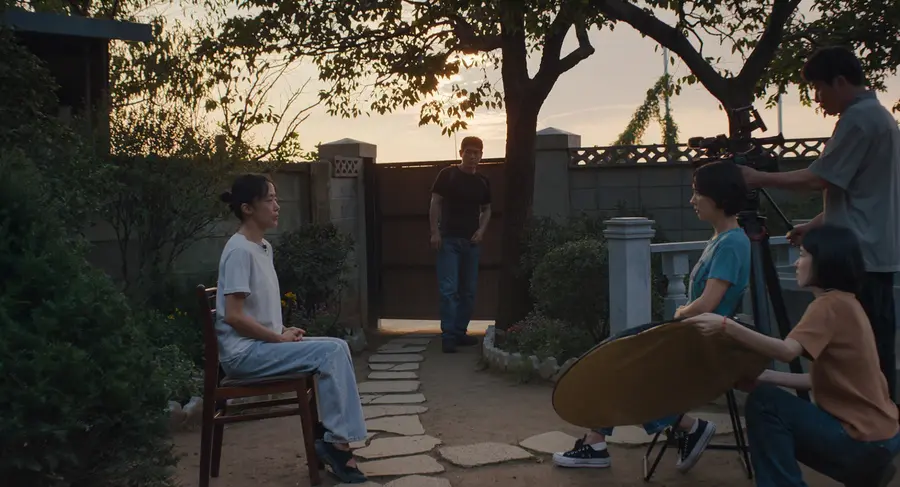
〈Possible Love〉 repeatedly highlights subtle points about what the camera captures. When Mi-ok mentions an old memory during a conversation with Ye-ji, Ye-ji suddenly insists on setting up the camera and asks Mi-ok to tell the story again. It is the same story, but Mi-ok’s expressions and the nuances in how she recounts it are slightly different. In front of the camera, Mi-ok often offers an awkward smile. That smile reads less as an unfiltered expression of what she feels than as a defensive attempt to hide it. The invisible tension that appears when speaking with a stranger is captured on screen by Ye-ji’s camera and by the film’s own cinematography. 〈Possible Love〉 doesn’t lecture on the truthfulness of the camera or the aesthetics of art versus fact, but these camera-driven moments invite individual reflection from the audience.
Trauma

Even from the opening and early scenes, viewers will quickly sense it: 〈Possible Love〉 is saturated with the scars of workers who endured mass layoffs and strikes—that is, trauma. Ho-seok was discarded by the company he worked for his entire life, but what wounded him most was what happened during the strike. The film gradually renders more clearly the events only hinted at in dialogue, and in one sequence Ho-seok finally lets everything out. While Mi-ok and Ye-ji drive the film forward, Ho-seok’s trauma underlies everything. 〈Possible Love〉 quietly asks how people who have endured such intense memories and emotional collapse can process or resolve those memories. At the same time, it makes clear that these wounds are not fully healed. Ho-seok eases some of the burden that has consumed him for years, yet in a drunken moment he behaves strangely—perhaps because he briefly confronts the real-life gap he could not face while trapped in trauma. Rather than resolve years of erosion in a single dramatic gesture, 〈Possible Love〉 poignantly depicts people who must continue living with their scars.
Love
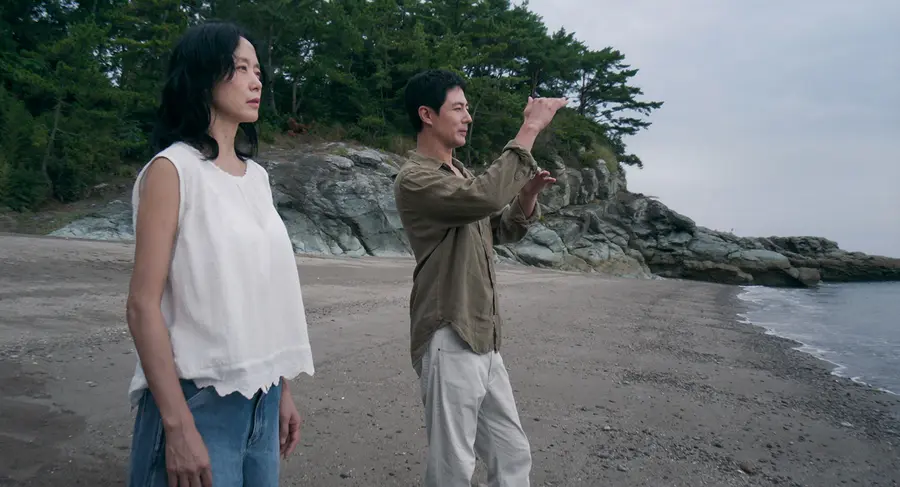
Love. In a story about two couples, the word naturally evokes romantic love. As the film’s dialogue acknowledges, however, the love in 〈Possible Love〉 is not limited to that. The film does tell the love stories of Mi-ok and Ho-seok and of Sang-woo (Jo In-sung) and Ye-ji (Cho Yeo-jeong), and there are subtle moments suggesting Mi-ok is slightly drawn to Sang-woo, everyone’s sweetheart. But the film also embraces a broader, more dictionary-like sense of love. What exactly does "love" mean here, and whether it is in fact "possible," is a question I encourage each viewer to answer by seeing the film for themselves.





![[First Reaction] 'Possible Love': CINEPLAY Reporters' Ratings](https://cdn.www.cineplay.co.kr/w160/q75/article-images/2026-09-21/4e8e5a87-9661-4669-9afe-ba1df097176c.jpg)
댓글 (0)
댓글 작성
댓글을 작성하려면 로그인이 필요합니다.
로그인하기