



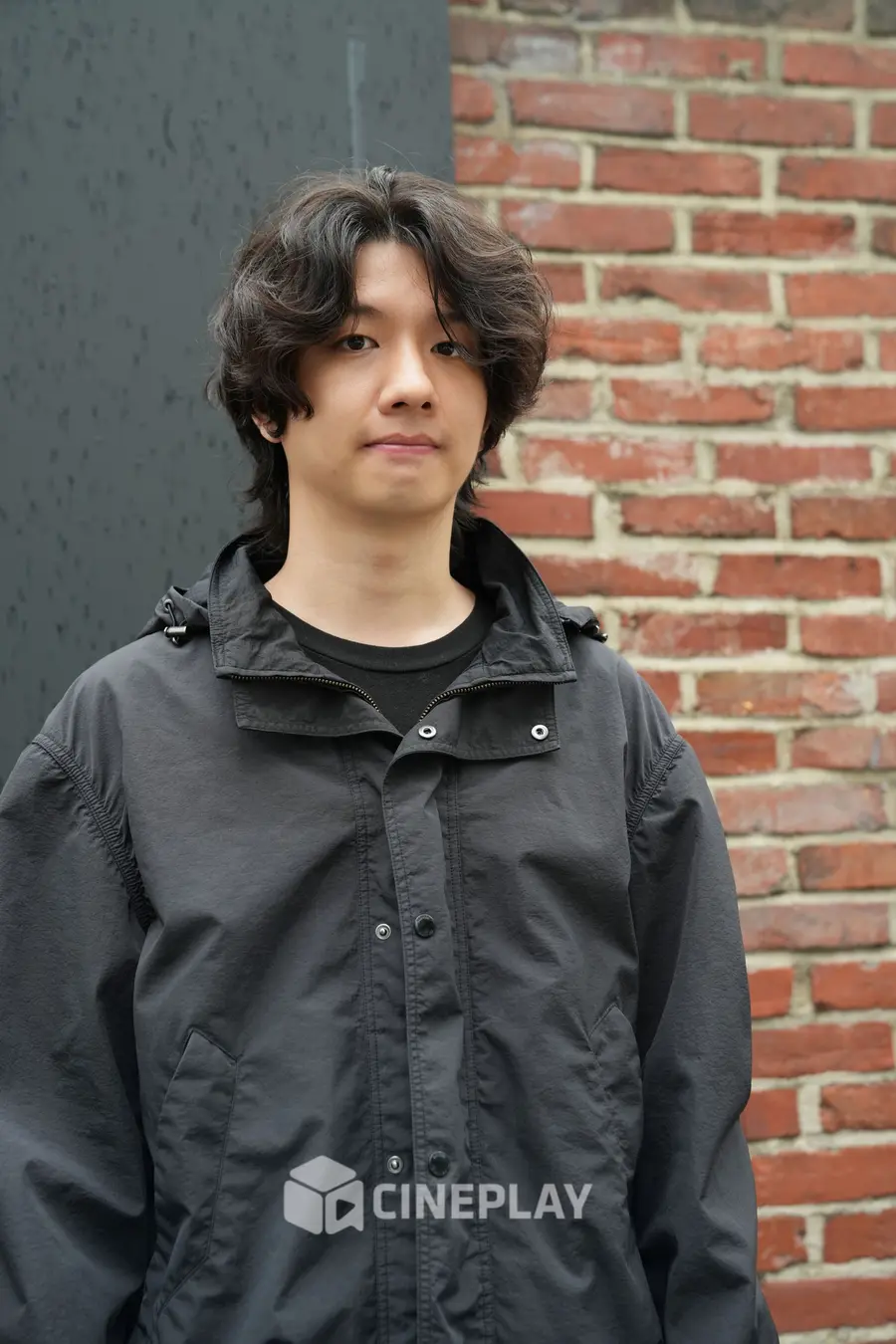
In a snowy market, a child wearing a red scarf has no name. One morning, the Jangseung falls over, and people ignore it. The child tries to lift the Jangseung, and its mouth seems to move slightly. "Who are you?" Thus begins the interaction between the child and the Jangseung, and before long, 'words' return to a village where 'words' have disappeared. The film 〈When It Snows, the Jangseung Speaks〉 follows the gaze of a child who has lost language, expressing that the essence of existence lies in 'names' and 'calls.' If the award-winning work 〈Akdal〉 is a piece that relentlessly pushes the action and spectacle that AI films can show, 〈When It Snows, the Jangseung Speaks〉 beautifully demonstrates the aesthetics of lyricism that can be pursued in AI films. We met Director Kang Eung-bin, who maximized the advantages of a playwright to infuse rich 'words' and emotions into AI film before 'technology.' Meanwhile, this year's award-winning works can be enjoyed on KT Genie TV's YouTube channel 'Genius Cut' and Genie TV VOD.
What prompted you to submit to the KT AI Video Contest?
While preparing for a feature film, opportunities did not arise as I had hoped. Then I thought I should study AI video. As I delved into it, I realized that AI video had many constraints before even coming up with any material or theme. It was difficult to maintain continuity in the faces of AI actors, and their voices sounded awkward. Rather than simple constraints, there were significant limitations in unfolding the story. While pondering this, I thought about focusing on this year being the 80th anniversary of liberation, and I made an effort to concentrate on that. It was a day when I went to work as a substitute at my mother's store, and since there were hardly any customers, I spent the day brainstorming ideas. (laughs)
Many of the works submitted to this year's contest utilized Eleven Labs' voice conversion service. However, you recorded the narration yourself without using it.
Since there was a lot of text, the emotions I wanted to convey did not come through well with AI voice. So, I asked actress Lee Seol-ha for help to bring out the flavor of the narration as much as possible.

As the narration is heard from off-screen, it follows the gaze of a child who has lost language. It seems to be an excellent character setting to alleviate the unnaturalness of AI voice.
The intention was indeed to handle the narration with human voice and to erase language from the character. However, the biggest mistake was not considering Google's policy and choosing a child protagonist. It often malfunctioned in most prompts, even when output repeatedly. For example, scenes involving hitting or violence would immediately result in errors. A crucial scene where the child enters the water was problematic because it was interpreted as an accident, so after about 100 attempts, it only output once or twice. Ultimately, I set the scene to have the child swimming, which was a scene obtained after repeated attempts.
Were there any other scenes you struggled with during the process?
Another variable was the Jangseung. The AI had not been trained on the design of Korean Jangseung, so it outputted as statues from Inca or Indian civilizations, or as eagles, or even resembling Japanese Oni or Chinese generals, which was frustrating. Since it was a very important scene where the child and the Jangseung meet in the water, I worked hard until it was right.

The protagonist of your previously worked short film 〈Cheol-in〉 (2023) is also a woman named 'Areum' who is stranded on a deserted island. In that sense, it resembles 〈When It Snows, the Jangseung Speaks〉 as it is a story led by a female protagonist.
〈Cheol-in〉 was my first short film with a single protagonist. After that, the second work had two characters, and the third had three, so I was contemplating whether to go with four this time. (laughs) However, since this is also my first attempt at an AI film, I started again with one character. Above all, I am still in the process of learning about AI films, so I did not have the confidence to smoothly edit cuts when featuring multiple characters. This work started from acknowledging my current skills and shortcomings in various ways.
What do you think the future of AI films will be?
Various arts such as novels, plays, and visual arts still coexist. The same goes for the realm known as video art. Just as film became a minority and digital became the mainstream, I believe the proportion of AI films will also increase. While it may not completely replace the current field or studio at the digital level, I think that in a few years, almost all filmmakers will be using AI tools. Of course, I believe it should not become more than a tool as it is now. I strongly resonate with the words of actor Jo Woo-jin, who participated as a panelist at the KT AI P.A.N. Film Festival conference, saying, "Art starts from humans and must go to humans." If art is called language, what to write and say with that language is still thoroughly the responsibility of humans.

What are your thoughts after completing this work and receiving the Best Short Film award?
While continuously preparing for feature films, I was feeling upset and somewhat exhausted after being rejected from various production support projects. I approached AI films with curiosity about how far it could go, along with a desire to study. However, for those using AI programs or services, the financial burden of having to keep paying is significant, so I couldn't just experience it for fun out of curiosity. In any case, I thought I should do what I want and what I can do well. Since I am also a major in playwriting, I write attempts. So rather than writing a tightly woven story with a clear structure, I worked with the mindset of writing poetry, and it turned out better than I expected. I think of the AI video as a result obtained while studying rather than something I have fully learned and acquired, so I feel lucky. Now, I am pondering whether I have talent in AI video, and whether I should learn and grow more from here. Anyway, for now, I am deeply contemplating what to leave behind without any specific plans, emptying my mind and going with the flow.

Which directors have you liked in the past?
I like Ryusuke Hamaguchi the most and also Hirokazu Kore-eda. It feels a bit odd to mention only Japanese directors while making anti-Japanese themed works, but (laughs) I enjoy thinking and expanding around 'playwriting' myself, so I am fascinated by direction based on solid playwriting. I think that will be an unchanging part of whatever work I do in the future.


![[KT AI P.A.N. Interview ②]](https://cdn.www.cineplay.co.kr/w160/q75/article-images/2025-09-24/c954c027-2f51-4992-8c00-1c5d3c722683.jpg)
![[KT AI P.A.N. Interview ③] A Brave AI Movie Capturing Dance, Song, and Joseon... Special IP Best Award 'Joseon's Idol' Team ArtTech](https://cdn.www.cineplay.co.kr/w160/q75/article-images/2025-09-25/b738a60a-505f-4a11-9e87-895fc3c12551.jpg)
![[KT AI P.A.N. Interview ④] Sensory Style Extracted from the Logline, KT Group Media IP Division Excellence 'There Are No Good Women. Good Woman, Busemi' Burned Rabbit Fur](https://cdn.www.cineplay.co.kr/w160/q75/article-images/2025-09-25/1e43138e-285c-47bc-9659-3b51f41e3a87.jpg)
![[KT AI P.A.N. Interview ⑤] Finding Survival Strategies in the AI Era, KT Group Media IP Division's Best 'Disaster Girl Music Video (Global)' Jisan X Jason](https://cdn.www.cineplay.co.kr/w160/q75/article-images/2025-09-25/c43cc492-e266-4804-9141-58f7925be4e0.jpg)
![[KT AI P.A.N. Interview ⑥] Short Film Category Jury Special Award 'The Orange' CLUB RONAIC](https://cdn.www.cineplay.co.kr/w160/q75/article-images/2025-09-26/78dc50fc-3e2f-4d39-b617-47dc5e6c46a0.jpg)
댓글 (0)
댓글 작성
댓글을 작성하려면 로그인이 필요합니다.
로그인하기