


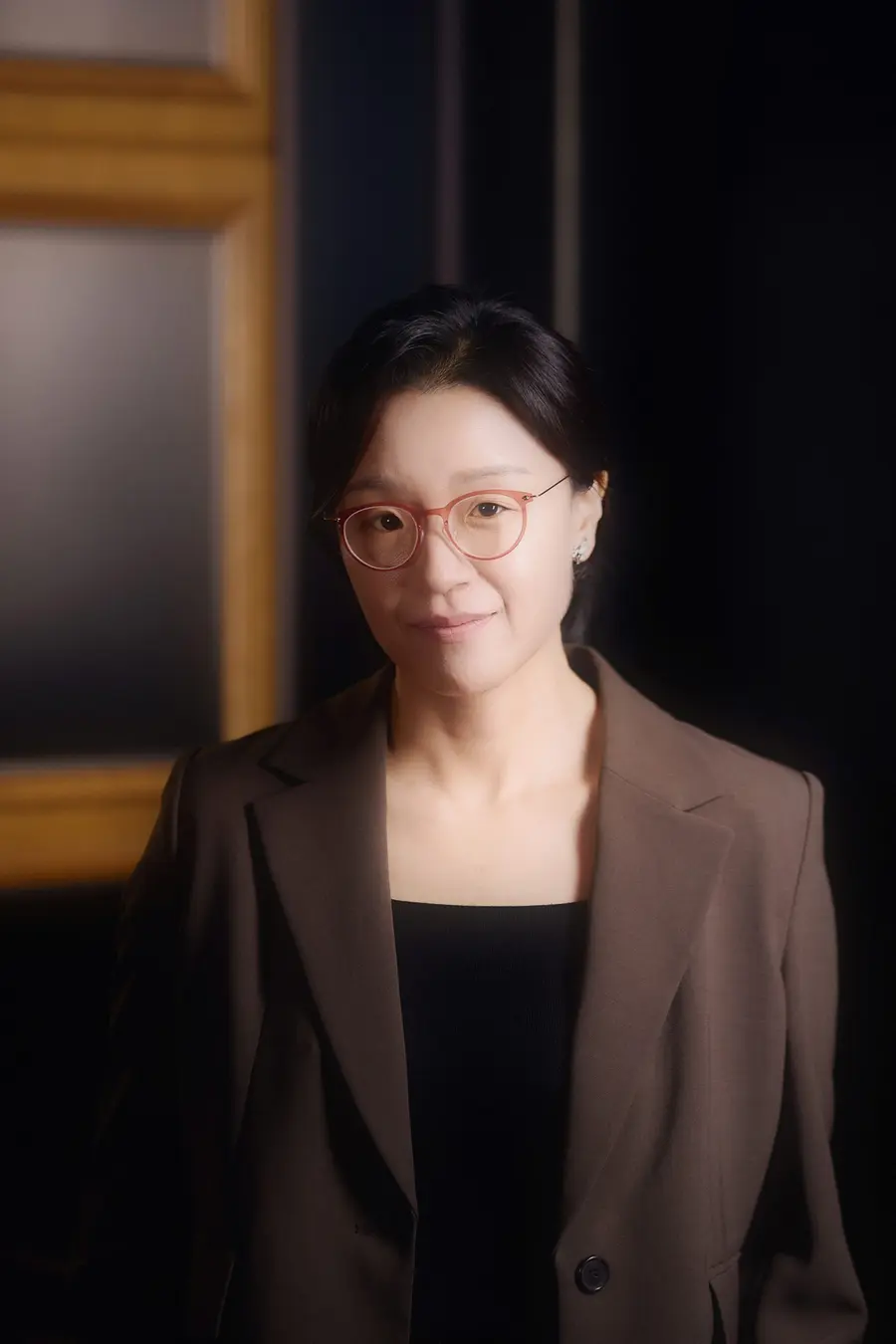
Yoon Ga-eun's new film 〈The World of Love〉 returns after six years. It feels familiar like an old friend, yet often confronts us with strange moments. Yoon Ga-eun draws us in with a familiar story that captures the small universe of children with a delicate gaze, just like her previous works 〈Our Body〉 (2016) and 〈Our Home〉 (2019), while simultaneously making new attempts not seen in her earlier films. By overlapping various mysteries and building tension, she deconstructs the basic narrative structure and brings in sensory elements from various media outside of film. In this way, 〈The World of Love〉 is a product of the author's consciousness and concerns that breathe in sync with a changing world, harmonizing with her existing worldview. Perhaps in time, 〈The World of Love〉 will be referred to as a turning point in the Yoon Ga-eun universe. I met with Yoon Ga-eun to discuss her intimate concerns and the process of building the 'world of love'.
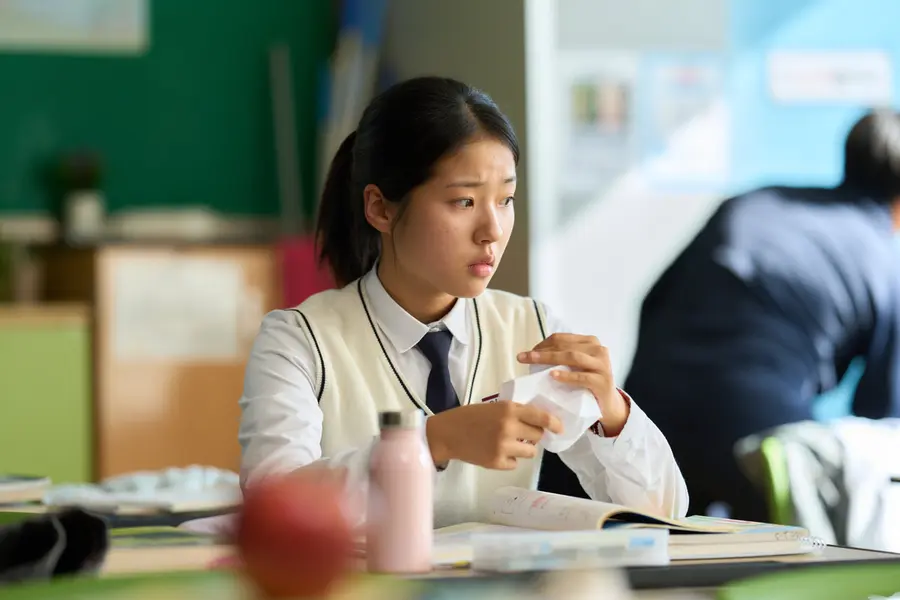
〈The World of Love〉 is your new work after six years. The production period was quite long; was there a special reason for that?
There were projects I was preparing that fell through, which extended the gap. I kept going through the process of preparing and then having things fall apart, and I thought I might revisit the stories of teenage girls experiencing sexuality, love, and romance for the first time. It was something I had wanted to write about for a long time, so I felt I could find my direction again. During that time of contemplation, the most real stories I had been trying to avoid naturally came in. Originally, I had intended to push those things away while writing, but ultimately I made the decision to confront them, and I think that’s why it took a long time to deconstruct and reassemble the story.
You mentioned wanting to talk about teenage girls' sexuality and love, but I saw in a previous interview that this idea is over ten years old. So what do you think is the biggest difference between the initial story and the one that was eventually created? You mentioned reflecting more on violent content.
In fact, that point you mentioned seems to be the biggest change. The previous version also had similar character expressions. It was composed of characters who experience the emotions of love intuitively and simply, confronting those feelings with their bodies and honestly reflecting on their hearts. That character experiences the entire process of a love beginning and ending. However, I wanted both myself and the audience to observe that experience not as a rehearsal for children but as the genuine experience of a human confronting that period as it is.
As I delved into this story, I particularly wanted to talk about the anxiety of facing love for the first time regarding sexual experiences. I thought this could be a common experience for all girls who have gone through that period. I have loved teen films for a long time and wanted to create a Korean version of a teen film. However, I wanted to depict a very realistic romance that incorporates the anxieties of children facing that period, stripped of fantasy. While other themes came in, it became a bit heavier, but I think it’s a story about children experiencing and rediscovering love and sexuality in their real lives.
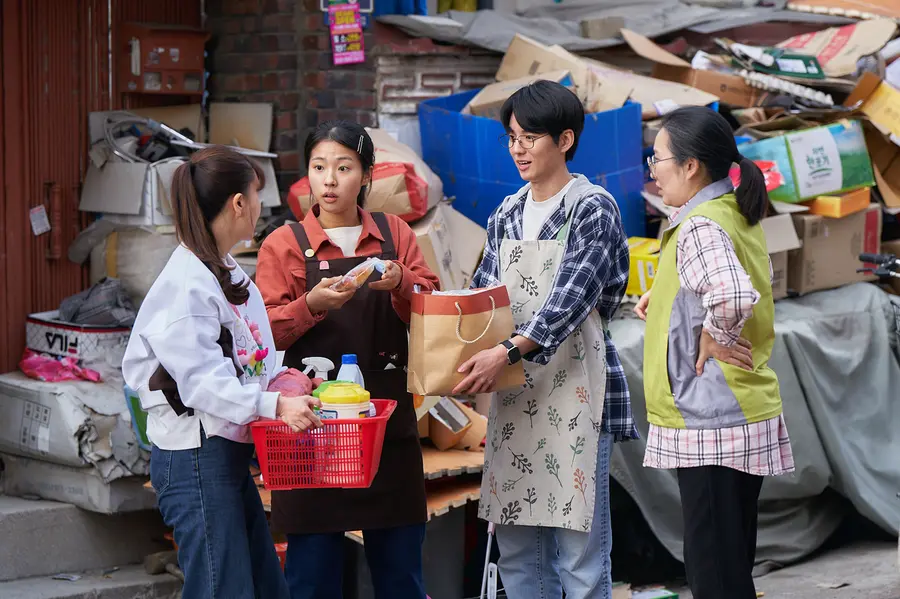
I want to ask about the film's opening. It starts in darkness with only the sounds of children, and the next scene abruptly transitions to a kiss between the main character and Chan-woo (Kim Ye-chang). I'm curious about your intention in placing this scene at the beginning of the film.
In this film, how to introduce the character of the main character is very important. In the process of contemplating that, I thought it would be good to reveal what the main character is currently struggling with. The main character is a friend who is passionately in love and wants to have sexual experiences with her boyfriend, but since it’s her first time, she feels awkward. It could also be that it doesn’t go well due to some of her experiences. Anyway, I wanted to introduce this character in a way that allows us to observe her struggles. At the same time, the early part of the film needs to flow with everyday things, so I thought about how to make it more appealing to the audience from the start, and that’s how this scene came about.
The film is structured with various mysteries intertwined, such as the reason the main character does not sign, why her father lives separately, and who sent the note, creating tension. I'm curious about your reasoning for structuring the film this way.
Before it took its current form, the structure was more clearly defined with a setup, development, and resolution. However, when I ultimately decided on the current theme, I didn’t know what to do. As I rewrote it, I thought to deconstruct the story. I decided not to worry about the setup, development, and resolution, but rather to think about life more closely, even if it seems boring and predictable, focusing on the main character's daily life and thinking about scenes first rather than structuring it.
In that process, the character's daily life comes out first, and I wanted to make the audience see that character and her daily life differently later on. So, I wanted to create a feeling of gradually entering into that person from the outside. And I brought in some tension and mystery to show the character's daily life in the early part of the film without making it boring.
One of the main mysteries in the film is the note, which plays a significant role in creating tension in the latter half. I would like to hear your intentions regarding the function of the note.
Writing the content of the note was the most challenging process. The note intentionally blames the main character. It could also be a stereotype about characters like her in our society. At the same time, I thought it could feel like the inner voice of the main character. One day, while working on the storyboard with our cinematographer, he said, "But this note could be something the main character has been asking herself, right?" After hearing that, I also thought about how the writing on the note could be interpreted in that direction.
I imagine you sought advice and did a lot of research regarding sexual violence and related trauma. Please tell us about that process.
I read and studied everything I could find, including related documentaries, reports, books, papers, case studies, and personal accounts. Eventually, I found myself reading medical books about trauma research that I didn’t really understand. (laughs) So, I recognized my limitations from that point. The more I studied, the broader the spectrum of trauma became. The pain stemming from it manifests in very different ways depending on the environment in which each person grew up. The depth of pain is something we cannot dare to compare. It was a moment of endlessly confronting these things.
So, when I thought about whether I could handle this, I felt scared. What could a film represent about such things? I thought I should just let go of that point. However, I thought that perhaps I could depict one case, one face among countless cases. I focused solely on revealing that one character.
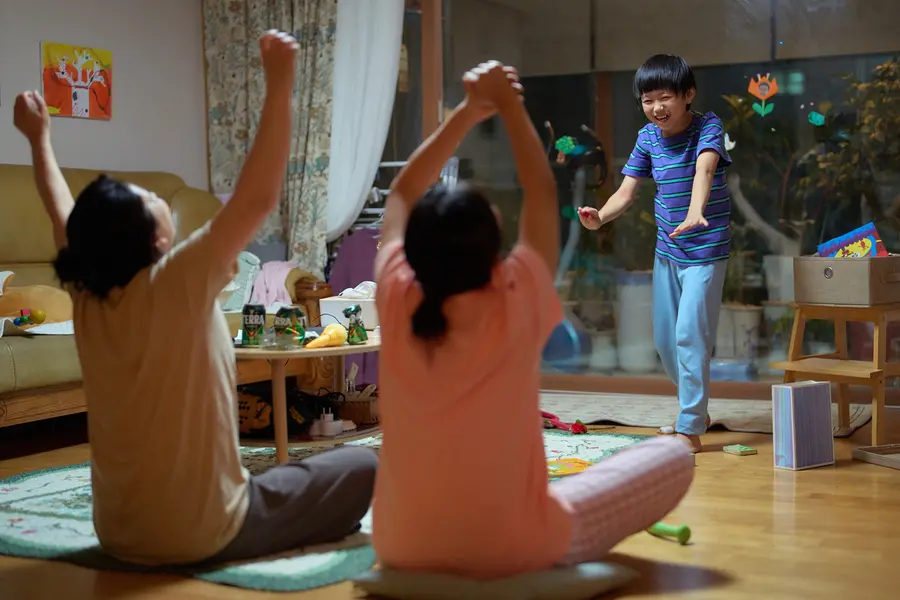
In the film, the main character's younger brother, Hae-in (Lee Jae-hee), practices magic for a talent show. He keeps practicing a magic trick that hides something, and he also hides his sister's letter. Are these two elements connected, and is it a metaphor for his desire to erase his sister's pain?
That's right. I don’t think Hae-in, being around 10 years old in the film, would consciously recognize that. However, considering Hae-in's 10 years of life, he must have seen his sister occasionally having breakdowns and his mother struggling to take care of her. At the same time, he would have had a friendship with his sister, who, like any other sister, takes care of herself and plays around. In the midst of that, their father left home, and there are things that cannot be spoken about at home. I think Hae-in had some awareness of what his sister was going through while experiencing these things. I think he must have contemplated what he could do. But that happens on a level he is not consciously aware of. He hides the letter with a vague thought that he needs to protect his sister.
On the other hand, magic has another meaning. Hae-in is somewhat outside the family's attention. While everyone loves him, because something significant happened to his sister, the focus is on her. If his sister takes a long time in the bathroom, he has to go outside to take care of business. In that situation, this child also seeks attention and affection as a human being. I think magic was a way for him to seek where he could receive family attention. Magic is a bit strange, right? It’s supernatural and mysterious, and it’s shown as a show, combining the desire to prove his existence through magic.
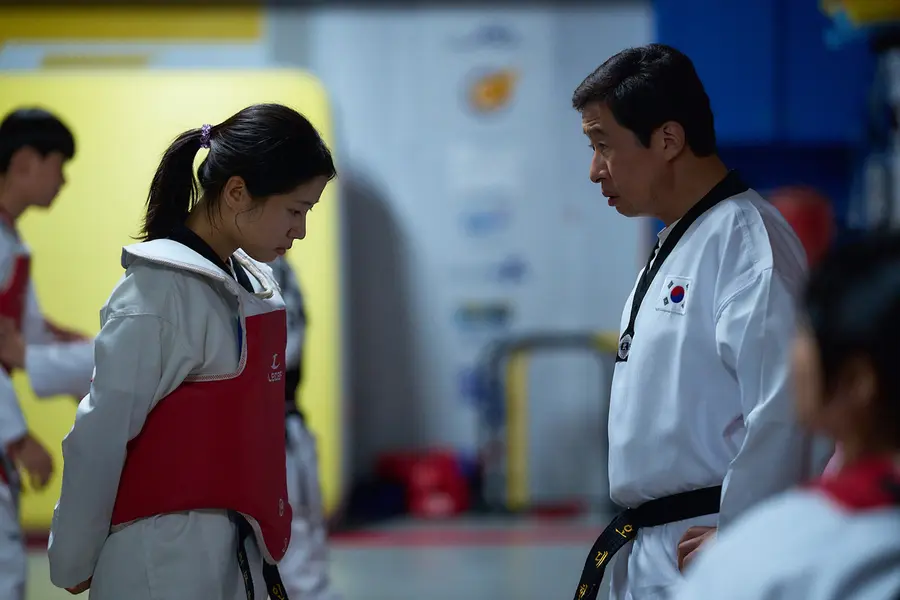
It seems that the character of Master Oh Dae-hyun (Lee Dae-yeon) at the taekwondo studio contrasts with the main character's biological father, showing a model of a good adult. How should we interpret this character?
I think there has always been a good adult beside those who have experienced what the main character has. That was true in my research as well. Unbeknownst to us, our society has a tendency to only reflect the dark aspects, but I feel there are really many good people. I wanted to portray at least that one good adult properly. The main character is not going to become an athlete, but the reason she goes to the studio to train is simply that this adult is good. It’s about learning something from that presence, which is even a male figure, quietly being there. It’s about redefining what a male adult is. I don’t think that’s a fantasy. I believe such adults exist, and I think it’s my role in making this film to highlight those people.
In the film, apples appear repeatedly. How should we interpret this?
There were some episodes related to apples in the script stage. There was something like a warrior, but as revisions were made to delete that, it was removed. However, I think I didn’t want to completely eliminate it. Because I thought apples could serve as a key to understanding the character of the main character.
For example, situations that trigger trauma for the main character will continue to arise in her life, and one might imagine that apples could be connected to something. The film doesn’t specify exactly what that is. However, people think that when they experience sexual crimes, triggers will only occur in sexual situations. Of course, that is true, but it can also be triggered by seeing something related to the context of what they experienced. That’s something that many trauma studies talk about. In that context, I thought that whatever the main character went through, there could be apples involved. But apples are actually common and unavoidable. The main character has faced that common thing to get to this point.
At the same time, I thought the main character might really dislike apples. There could be various reasons for genuinely disliking them, and people might vaguely ask, "Could it be because of this?" So I thought it would be good if these two aspects could work together.
I think this work also brings in sensory elements from media outside of film. Some scenes, like the children filming TikTok videos, evoke the sensation of TikTok, and webtoons are shown prominently on screen. While many films are attempting this these days, it wasn’t seen in your previous works. Is there a reason for this attempt in this film?
I think it’s because my sensitivity to the changing media has increased. I also watch a lot of YouTube and shorts. There’s hardly anyone who doesn’t have a smartphone in their hands while walking around. Nowadays, even elementary school students have them, so it’s a medium that is easier and more convenient than film. So, it felt threatening to me. It has come into life so seamlessly that I’ve thought a lot about how to keep up with it in recent years. At the same time, since this film centers on teenagers, it’s even more necessary to incorporate youth culture.
However, since there is a bit of an age gap, I was worried that I might imitate it awkwardly. At that time, what I could do was to bring in the properties of the media as they are. I also listened to the advice of actors who haven’t gone through that period and actively utilized it. In fact, the dancing video was shot by the actor herself. (The actor playing the friend Yura, Kang Chae-yoon, filmed it) The montage of the main character and Chan-woo on a date was inspired by watching many youth romance vlogs.
On the other hand, after making my second film, I had some reflections on the way I had been making films until now. Until then, I think I had no choice but to do it that way. I was still unfamiliar with the medium of film and in the process of learning, so it was tough to do the basics well. At that time, creating a consistent tone and manner was much more important. But as I continued to make films this way, I wanted to create some cracks. I didn’t want the story to flow in a familiar way but rather to surprise and allow something rough, strange, and unfamiliar to infiltrate. I also enjoy seeing that in films. I thought it would be nice if my film was not definitive and had moments of sudden transitions or new attempts. So, I tried to think of ways to show something new in the most unusual way possible.
![[First Reactions] 'The World of Love' Cineplay Reporter Rating](https://cdn.www.cineplay.co.kr/w160/q75/article-images/2025-10-15/289d1b5f-12c2-44a0-88ff-19b51ecb4cb1.jpg)
![[Interview] 'The Owner of the World' Seo Soo-bin:](https://cdn.www.cineplay.co.kr/w160/q75/article-images/2025-10-24/ba385c06-e75d-45dd-b255-32ee52da3c76.jpg)

댓글 (0)
댓글 작성
댓글을 작성하려면 로그인이 필요합니다.
로그인하기