



![Film 'Odyssey' [Courtesy of Universal Pictures. Resale and DB prohibited]](https://cdn.www.cineplay.co.kr/w900/q75/article-images/2026-04-03/d3960abc-7a70-4df9-b8aa-a80db2d0051b.jpg)
Christopher Nolan’s 〈Odyssey〉, which opened Aug. 5, drew 290,000 moviegoers on its first day in South Korea and suggests the strong U.S. box-office trend may continue into South Korea. Directed by Christopher Nolan and starring Matt Damon, Tom Holland, Anne Hathaway, Robert Pattinson, Zendaya Coleman and Charlize Theron, the film brings the Greek epic 「The Odyssey」 to the screen. It follows King Odysseus (Matt Damon) on the strange journey he endures while trying to return to his home, Ithaca, after the allied Greek forces’ victory in the war with Troy. With North American audiences and early domestic viewers already praising 〈Odyssey〉, Cineplay reporters share how they saw it.
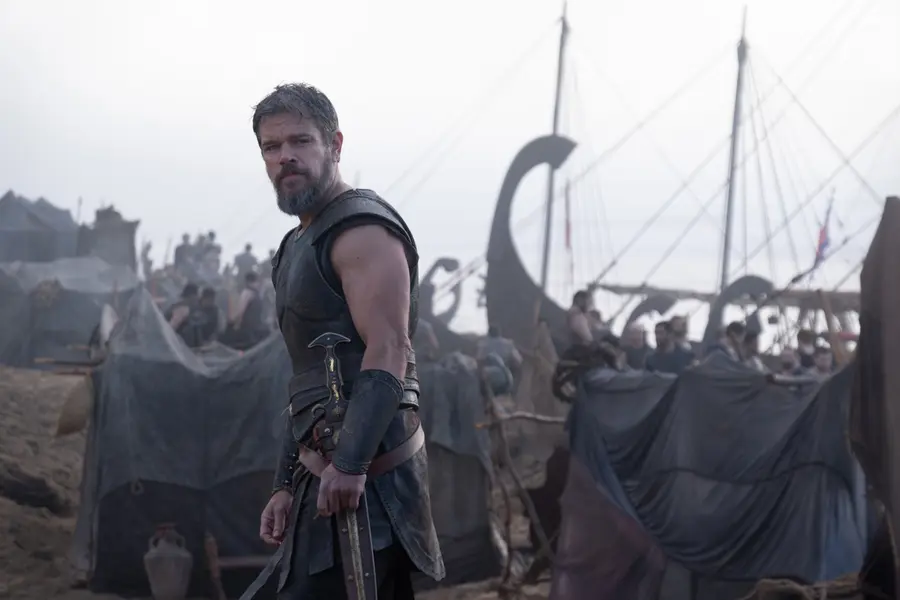
Christopher Nolan asks, "How will you live?"
It may be obvious by now, but the unifying theme across Christopher Nolan’s filmography is homecoming. Characters in 〈Inception〉 (2010), 〈Interstellar〉 (2014) and 〈Dunkirk〉 (2017) all set out on journeys to return home. Even Nolan’s breakthrough, 〈Memento〉 (2001), runs time backward and, following the amnesiac protagonist, ultimately loops back to its opening scene. Is he trying to close that loop? This time he enters the timeless homecoming of Homer’s 「The Odyssey」 to show why this vast story of return has been loved for more than three millennia. Nolan’s chosen method is familiar: he renders mythic heroes with the same secular, interior struggles as ordinary people torn between emotion and duty. Athena (Zendaya Coleman), the goddess of wisdom and strategy; Calypso (Charlize Theron), the sea goddess who tries to hold Odysseus forever; Circe (Samantha Morton), who turns visitors into beasts; the soldier Sinon (Elliot Page), who persuaded Troy to bring in the Trojan Horse; and the one-eyed giant Polyphemus are all presented with such straightforward, folk-tale warmth that you need not know the original to follow along. Why 〈Odyssey〉? Because the deepest pain of returning comes from war. That’s why Antinous (Robert Pattinson) emerges as the film’s primary villain. Is it too much to read the film’s vision of civilization’s destruction alongside the current U.S.-Iran war? Christopher Nolan has made a genuinely antiwar film. Or, more broadly, Christopher Nolan’s question: "How will you live?"
PS. In a Hollywood film that even delivers the line “I am a Greek from Ithaca!” plainly in English, the casting controversy that spread after the trailer — Lupita Nyong'o as Helen and Elliot Page as Sinon — had little meaning.
Ju Seong-chul

An accessible Nolan film, a period drama for today's generation
The film is similar to 〈Oppenheimer〉 (2023) in theme yet takes a markedly different approach. While both share concerns, Nolan takes a very different route here. Although 〈Odyssey〉 uses a nonlinear structure (Odysseus recounting his experiences to Calypso as a story within a story) and parallel narratives (the Odysseus–Telemachus threads), it is noticeably more accessible than Nolan’s earlier films.
Nolan strips away the opacity often associated with his nonlinear storytelling and delivers a film that can reach even the so-called 'anti-Nolan' crowd. The editing is brisk; the film hops across adventure, war, creature and horror genres; and its story-within-a-story sequences deliver so many entertaining set pieces that even if you watched them as clips they would still be fun. In casual terms, it’s simply an entertaining story. The nested tales in 〈Odyssey〉 each carry their own closure, so any section can grip you. It’s effectively a period film tailored to contemporary audiences—especially younger viewers—or at least one willing to meet them halfway. Given the three-hour running time, period setting and classic source material, it should hardly have seemed likely to win over younger viewers, yet that is precisely why it is performing well in North America.
What stands out is Nolan’s familiar viewpoint under a fresh skin. 〈Odyssey〉 is a war film in which war itself is not the focal point. Under Nolan’s adaptation, Calypso and Athena feel more human than divine. What ultimately weighs on Odysseus is not the gods’ wrath but his own guilt. Nolan blurs the line between gods and humans, centers the story on an individual rather than an epic hero, and turns 〈Odyssey〉 into a humane, not merely mythic, tale. In borrowing one of the oldest stories, Nolan ends up posing a question that feels quintessentially his own.
Kim Ji-yeon
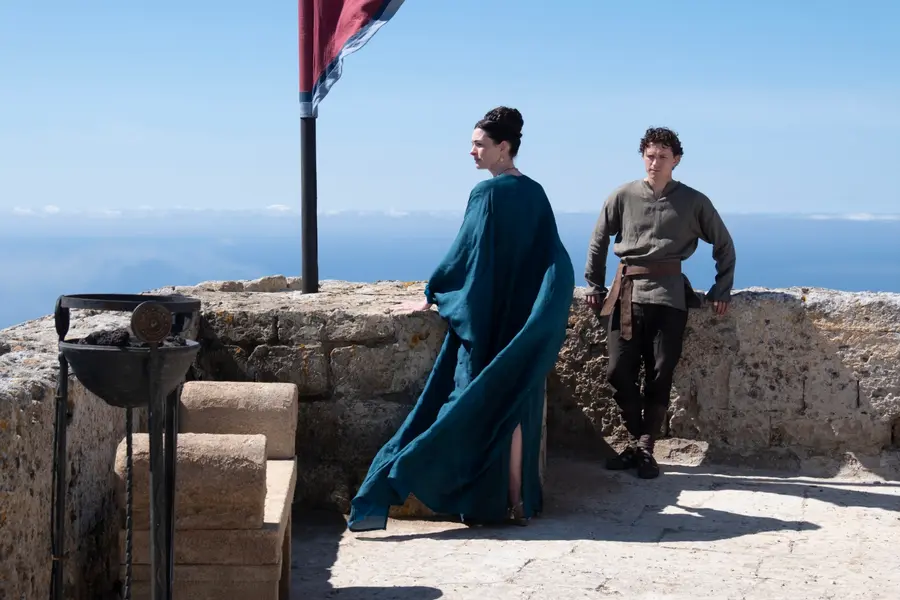
Nolan returns as a storyteller
A brief personal note: I haven't liked Nolan’s films since 〈Interstellar〉. Up to that point he was a director who hit my taste, but from that film onward, while technically accomplished, his movies stopped prompting the kind of spontaneous awe they once did. It wasn’t just a matter of taste; Nolan’s analog direction and obsessive experimentation with time reached a level that felt less cinematic and more like an engineering contraption. So when I found myself uttering genuine awe at 〈Odyssey〉, you can guess what kind of movie it is. Most of all, it felt like Nolan the storyteller — not the engineer — had returned.
〈Odyssey〉 hinges on two axes: Ithaca without its king, and Odysseus’s return. Nolan intentionally mixes Odysseus’s timelines as he weaves the two parts together. Through the minstrel’s voice, Odysseus shifts from the war hero who must return to a man who hastened the fragmentation of the coming era. The moment he senses the enormity of what he has done and falls into despair overlaps with Nolan’s own 〈Oppenheimer〉 in the figure of Robert Oppenheimer. Perhaps that is Nolan’s idea of the burden an intellectual must bear. The film not only reflects a world shaken by the fate of one man but also calibrates what to show and what to conceal with camera tricks, pushing analog filmmaking to its limits. 〈Odyssey〉 lays bare the impossible myth and the psychological torment of a single person in front of the camera. With both sharp insight and visual spectacle, the film is a model example of why cinema keeps being summoned back to the humanities. Honestly, before seeing it I had been ready to criticize the IMAX photography for creating a class divide among audiences. Yet I fell under that magic myself, so I have nothing to say.
Seong Chan-eol











댓글 (0)
댓글 작성
댓글을 작성하려면 로그인이 필요합니다.
로그인하기