


※〈Gyeongju Trip〉 Director Kim Mi-jo's interview continues from Part 1.
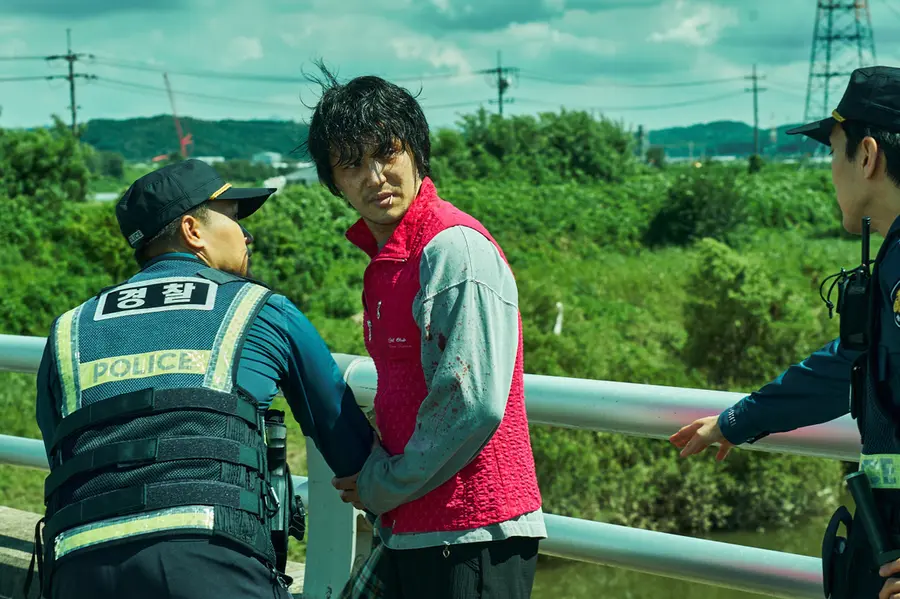
One striking aspect of 〈Gyeongju Trip〉 is how it depicts Baek Sang-hyun, the killer (Byun Yo-han). Why did you choose not to give any backstory to the perpetrator Baek Sang-hyun and instead portray him solely as a heinous criminal?
I think the biggest reason was that I didn’t think the core of this story lay with Baek Sang-hyun. The core is a family story: a daughter who never came back and the family that aches for her. We had a lot of characters, so we were already very busy unpacking their emotions. It wasn’t so much a deliberate refusal to give the criminal a backstory as it was a judgment that this film didn’t need one. I also thought audiences wouldn’t be curious about it. When depicting Baek Sang-hyun, I referenced many real-life cases of random, senseless criminals. Baek Sang-hyun’s first killing, changing into a police uniform and fleeing to the retreat clearing actually happened in a real case. And the detail of him sending a letter to the bereaved family saying, “If I get out, I will take revenge on you,” was also drawn from an actual incident. So I decided the character himself would be sufficient without building a conventional backstory.
The tone of 〈Gyeongju Trip〉—a mixture of comedy and tragedy—is striking. The film shifts between everyday humor and the sorrow of loss, making the emotional pitch feel light at times and heavy at others. What did you do to maintain a consistent tone throughout the film?
I had done black comedy before, but this was the first time I expanded the genre as broadly as in 〈Gyeongju Trip〉, so tonal control was a major concern. Also, what I imagined on the page often changes once I meet the actors and their performances add different textures. So, I’m sorry to say, but I shot many takes with the senior actors in different versions: an exaggerated version, a slightly more realistic, toned-down version, and so on. I felt the variables were huge. We shoot scenes in pieces, but the film is viewed as a whole, and if the emotional arcs all felt disconnected, I didn’t think we could pull the film together. I apologize again to the senior actors for the extra takes. (laughs) In postproduction, our music director worked extremely hard because we were worried audiences would think, “Is this movie a jumble?” The film’s emotions are quite abstract. At one point we even communicated in proportions like “70% tragedy, 30% comedy.” We tried many musical versions. I want to take this opportunity to apologize to our composer as well. (laughs)
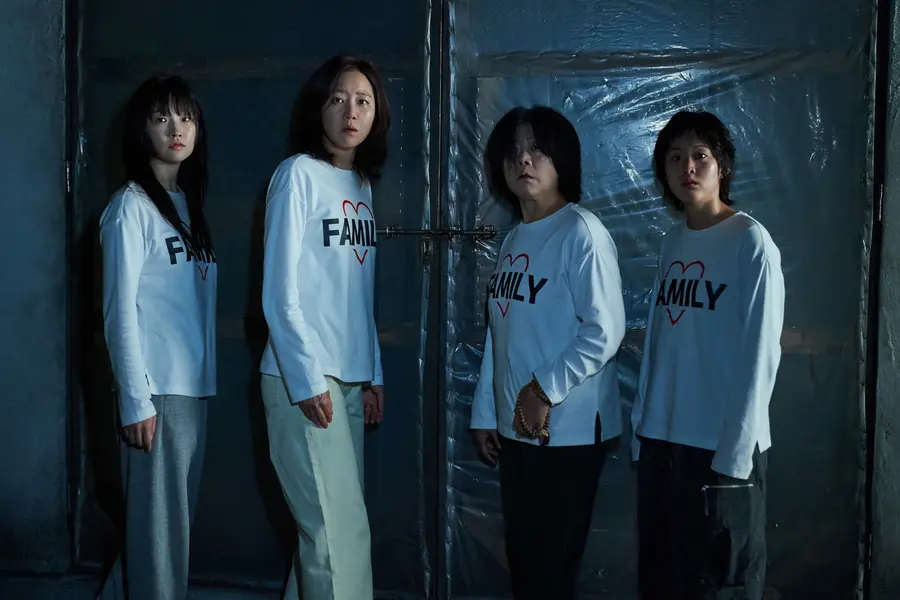
I’m also curious how you cast Lee Jung-eun and Gong Hyo-jin. You said casting took about a year, and in the end you got your first-choice actors.
For the role of Ok-sil, the only actress I had in mind was veteran Lee Jung-eun. I had seen a kind of madness hidden beneath warmth in her performance in the musical "Laundry," and I’d written her name into my notes while drafting the script. It took a year to secure the cast, but every actor I wanted ultimately came on board. I’ve been a huge fan of Gong Hyo-jin since I was young—so much so that I watched the drama 〈Jealousy Incarnate〉 more than 30 times. I sent the script to her prepared to be rejected, purely out of fandom, but she resonated with the material and accepted the role of the eldest daughter, Jang-ju. It felt like a dream.
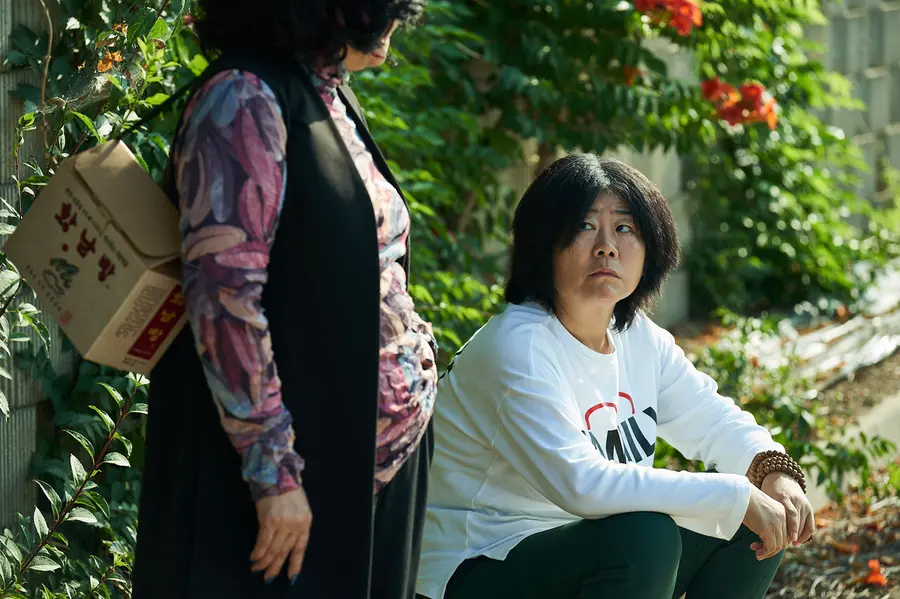
The fact that Ok-sil’s job is a sewing-machine operator and that the film title in the latter half is staged like machine stitching is striking. Can you talk about that choice?
It was important that Ok-sil be a sewing-machine operator because I view this family as people pushed to the margins of mainstream society. Sewing-machine operators are precisely the kind of workers gradually edged out by industrial development. I was deeply moved by the documentary 〈Sewing Women〉 (2022). Also, a sewing-machine operator is someone who hand-stitches names onto handkerchiefs. So I depicted the final 〈Gyeongju Trip〉 title as if it were the mark left by Ok-sil’s machine. The name stamped on the machine in the scene where Ok-sil operates it is my father’s name. (laughs) I snuck that in as an Easter egg only known to my acquaintances. Casting veteran Jeong Ae-hwa—who I love—again after 〈Seagull〉 and inserting her into 〈Gyeongju Trip〉 is also an Easter egg. It’s my way of saying, ‘This is a Kim Mijo piece.’ Like how Park Jin-young adds a ‘JYP’ signature to his songs. I can’t promise Jeong Ae-hwa will appear in my next film, though. (laughs)
※From the paragraph below, there are spoilers for the ending of 〈Gyeongju Trip〉.
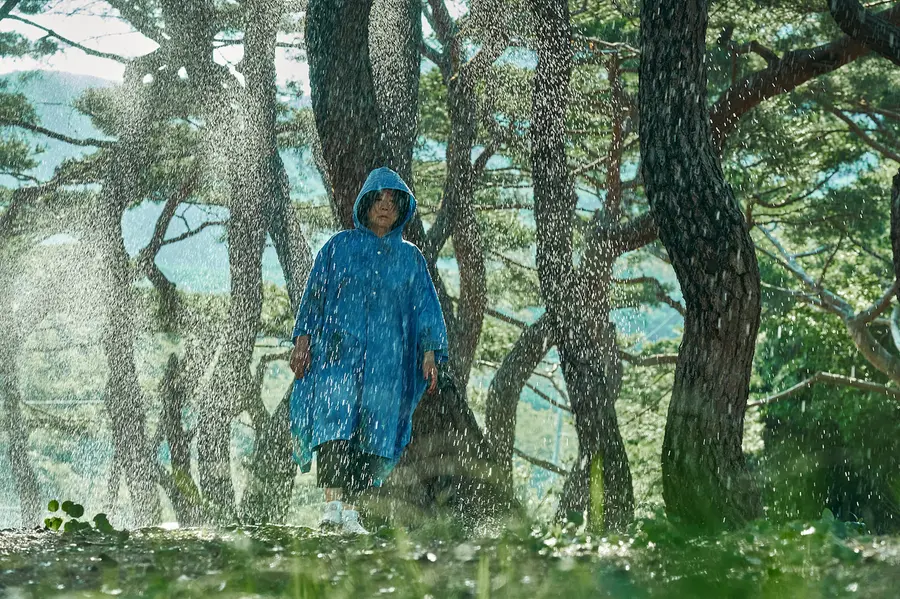
The ending was surprising. The film rejects the fantasy of forgiveness and ends revenge on a final, irreversible note. Ok-sil killing Baek Sang-hyun was not the only possible ending—why did you choose this one?
I’ve always wondered about how often people say, “We should forgive.” But I constantly think, does forgiveness really fix everything? Ok-sil lost both her husband and her daughter. Telling someone who has suffered that much to forgive as consolation felt insufficient to me. Above all, I was curious what someone who refuses to forgive and pushes it to the end would look like. I thought that might be the only way to extinguish the fireball in Ok-sil’s chest. In the film’s latter half, it rains as she descends after killing Baek Sang-hyun; I wanted that rain to at least slightly douse Ok-sil’s blaze. I think Ok-sil is someone who cannot move on unless she finishes this. She keeps saying, “If we just kill that bastard, our family can start anew.” She believes that fiercely and keeps twirling her prayer beads. When she confronts Baek Sang-hyun, she brings a scrap of paper that reads, “Why did you kill?” That detail was also drawn from a bereaved family member who wrote such a note while waiting to meet the perpetrator. Ok-sil’s line at the ending is crucial: “I was afraid I would forgive you.” She is someone who strongly believes that not forgiving is the way to repay Gyeongju and her husband.
The climax packs a lot of impact. The scene in which Ok-sil kills Baek Sang-hyun is harrowing and chilling. Can you share directing details behind that scene?
I thought most about the image of a hanging. When considering how Ok-sil would want to execute Baek Sang-hyun, a gun felt unrealistic and a knife would require direct contact she might not be able to endure. To show that revenge is never easy, I depicted the process of hoisting him onto her back and the act of suspending him as extremely painful and arduous. To suggest what kind of tomorrow might await Ok-sil, I staged that sequence at sunrise. In the final edit I removed a shot of Ok-sil burning a bag and then meeting a large serpent and locking eyes with it as she descends—intended to give the impression that Gyeongju looks down on the mother as a serpent. The cliff-hanging scene at Toham Mountain involved two years of CG work. Only the part where Ok-sil crawls on the cliff was shot live; everything else was created by compositing fields and the city.
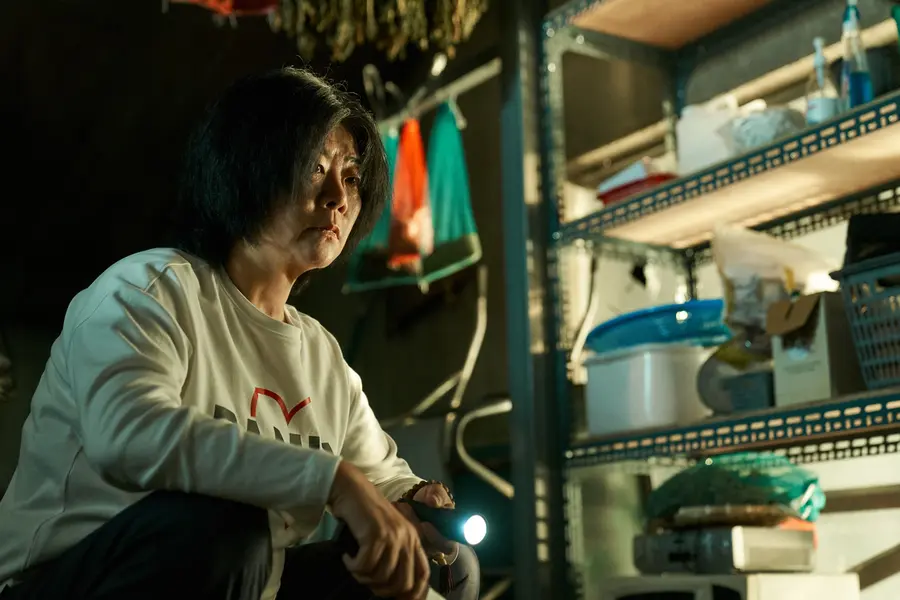
You end Ok-sil’s trial scene with a fade-out. What does the ending mean, and what legal verdict might Ok-sil have received?
I couldn’t draw a firm conclusion, so I chose a fade-out. Personally, and somewhat ironically, I hope the same leniency the law granted to the person who harmed her daughter might also be extended to Ok-sil so she could be released, but depicting that within the film was a separate matter. I couldn’t choose between harsh punishment and leniency, so I left it ambiguous. Deliberately, the judge who hands down Baek Sang-hyun’s sentence and the judge who speaks when Ok-sil’s sentence is announced are meant to be the same person. But I purposely don’t show the judge and instead compose shots around the family. What I really wanted to talk about wasn’t whether legal outcomes were right or wrong, but how families wounded by such tragic events might somehow cope with their wounds and continue living.
The revenge starts with the daughters but by the end Ok-sil carries out the revenge alone. What does it mean that Ok-sil ultimately takes revenge on the murderer by herself?
One of Ok-sil’s defining traits is her identity as a mother. When many people read the early drafts, the most common critique was, “Would a mother really take her children down the road to becoming criminals?” For me, the point was always that a person who firmly believes in something and pursues it to the end—someone convinced that only such an act will bring resolution—will do it. From the first draft, the ending in which Ok-sil acts alone never changed. For that reason, the daughters naturally reach a point where they reveal their feelings, leaving Ok-sil alone. You can see it visually: at first Jang-ju holds the wheel, but later Ok-sil is the one driving. That was intentional.
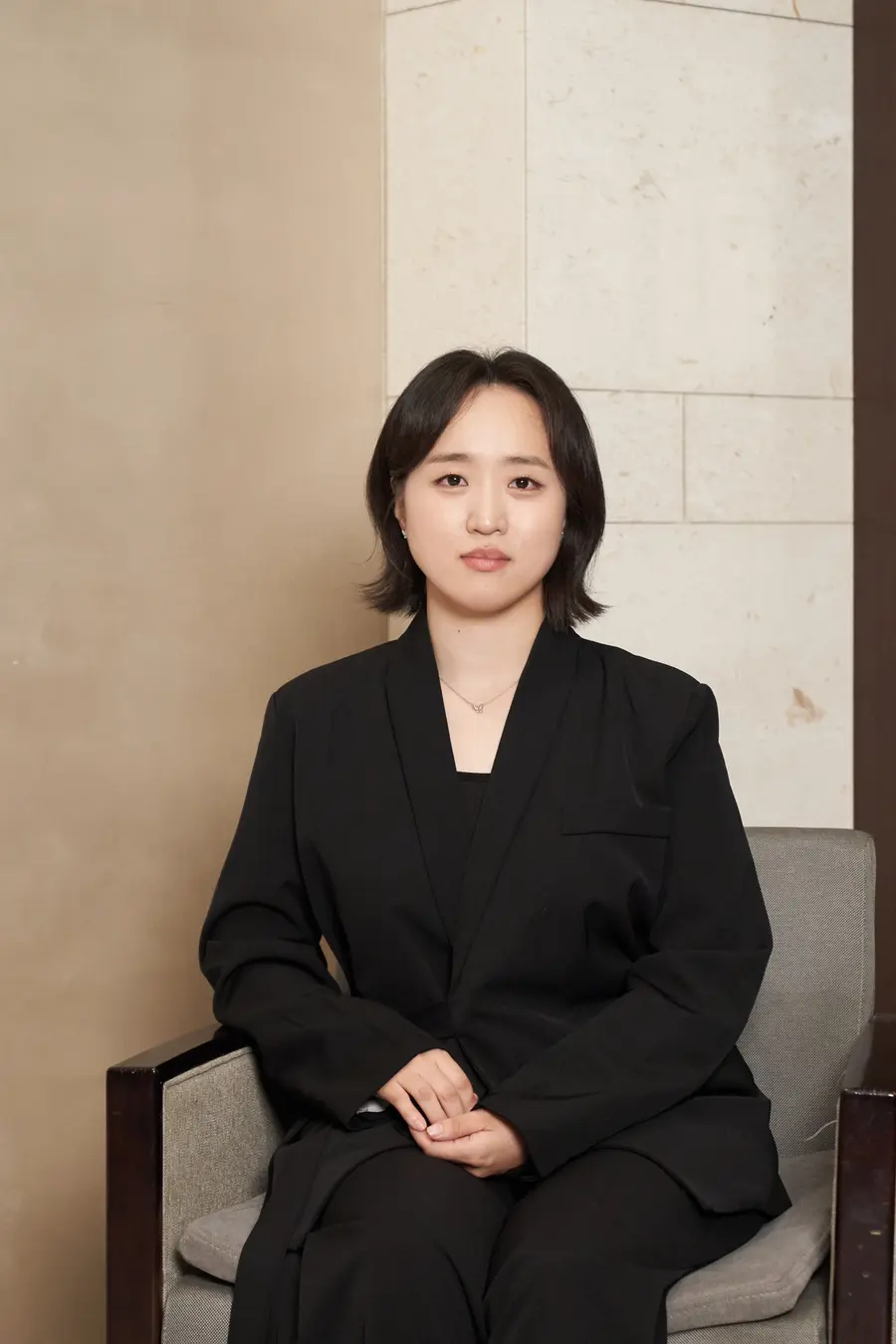
This is your first commercial film after debuting with the feature 〈Seagull〉. 〈Gyeongju Trip〉 feels very different from 〈Seagull〉. As creator Kim Mi-jo, what experiences or changes did completing 〈Gyeongju Trip〉 bring you?
Until now, I didn’t make films with the idea of showing them to someone else. That was true of my shorts and of 〈Seagull〉; I wasn’t crafting stories to please others but focusing on subjects I wanted to obsess over and see made. With 〈Gyeongju Trip〉, for the first time I considered making a story others might also be curious about. I usually start stories from within myself, so scripts often feel like extensions of me. I tend to amplify elements inside me into characters. For my short films I was drawn to certain themes; with 〈Seagull〉 I wanted to watch a character raise their voice against a system. With 〈Gyeongju Trip〉, I really wanted to tell a family story—a different kind of family tale that travels a very tragic path, collapses in places, but through that collapse discovers each other. As time passes, my interests change, and finishing this gave me a sense of closure, so I feel ready to move on to the next topic.
This was your first time running a commercial set. What was the hardest part during filming?
Time constraints. I wanted to shoot each shot meticulously, but limited time, budget, rain and weather variables were very hard. After four shooting blocks we had a break, and while watching the rushes the light bulb went on: films are not made of isolated shots but of scenes, so thinking about the big picture mattered more than obsessing over each shot. That changed my mindset and gave me some practical know-how. Also, it rained a lot. We were supposed to shoot in two months but it took three and a half. Still, I think we managed to capture what we wanted.
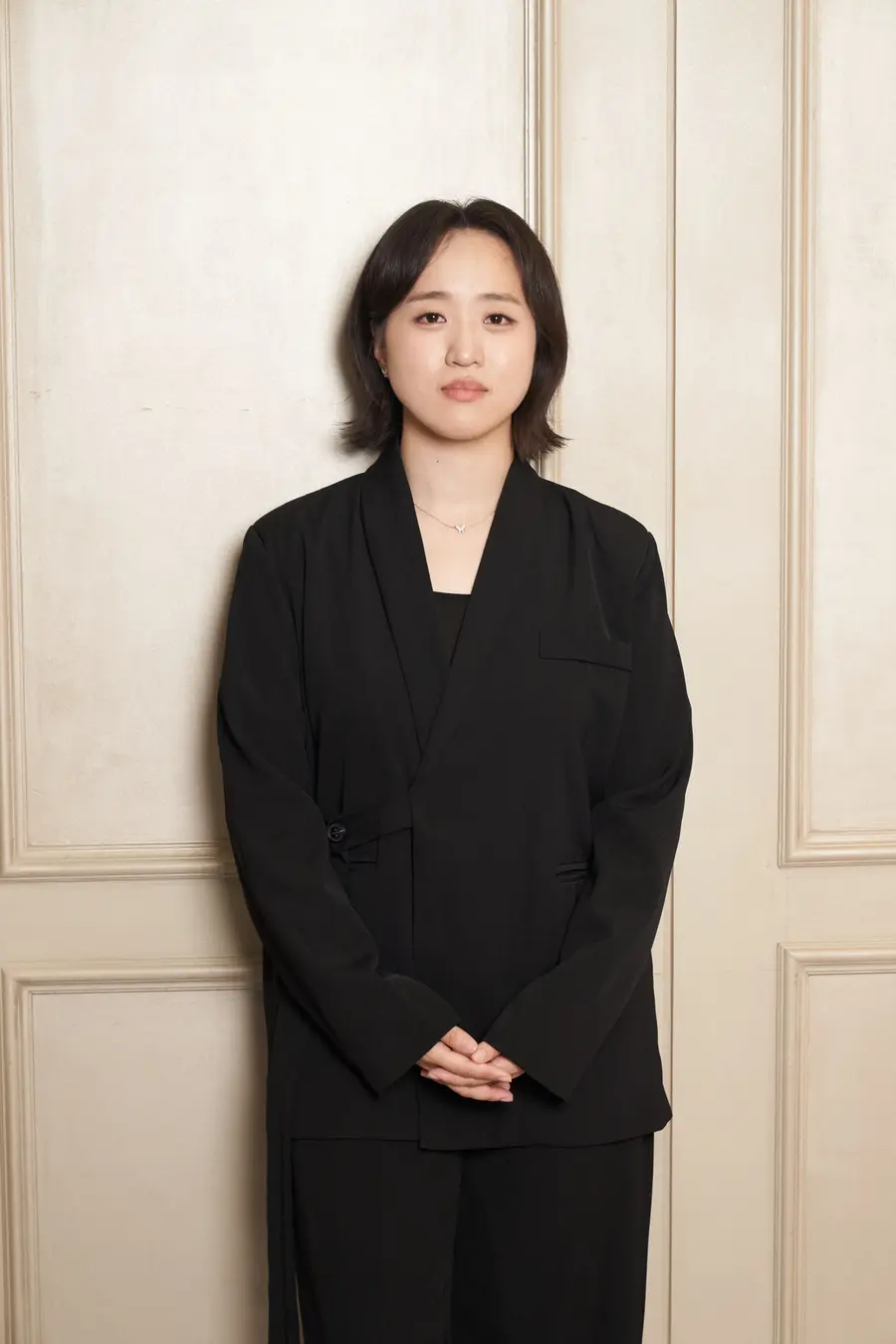
You said you started making films in 2014 and that you visited Gyeongju back then. What was the decisive moment that made you want to become a filmmaker?
I love this question. (laughs) I’ve always loved film. I was a true Korean-film kid who watched nothing but Korean movies. My parents both worked, and as a child left alone at home I’d rent videos from the store and watch them obsessively. I even wrote reviews alone when I was very young. I collected posters and magazines and, bit by bit, something grew. When I was a high school senior I saw 〈The King and the Clown〉 (2005) for the first time and was absolutely blown away. That film made me determined: I wanted to be a director. In my senior year I watched 〈The King and the Clown〉 five times. I like to think I helped it reach ten million admissions. (laughs) After that I started studying Korean history—oddly, back then only students aiming for Seoul National University studied it, but I studied it thinking I wanted to make historical films. My university entrance results were dismal except for Korean history. And I retook the college entrance exam four times. (laughs) I began making films comparatively late; that was in 2014. I traveled to Gyeongju that year, and the title ‘Gyeongju Trip’ was already decided then. I thought, someday when I make a feature, I’ll make this film.
Why did 〈The King and the Clown〉 make such an impression on you?
I’d need, honestly, about two hours to explain. (laughs) That aching sentiment tore at the heart of a 19-year-old girl. I found the final scene overwhelming. Each time I watched it, the inner life of every character became clearer. Eventually I even started imagining what the ministers beside King Yeonsan would feel. (laughs) Director Lee Joon-ik probably doesn’t know this—I’m sure he’s unaware I exist.
Growing up watching films like that likely shaped how you make films. 〈Gyeongju Trip〉 also gives each character a backstory.
That may be true. 〈The King and the Clown〉 set my blood boiling, and later 〈Mad Max: Fury Road〉 (2015) gave me similar feelings. Recently, 〈Odyssey〉 (2026) also provided huge inspiration. I think my passion for blockbusters is increasingly leaning toward Hollywood. (laughs)
![[On the Ground at BIFF] “It Wasn’t Your Birth Mother’s Fault”: ‘Home Sick’ Director Sørensen’s First Confession Reveals Truth Behind 56 Falsified Adoptions](https://cdn.www.cineplay.co.kr/w300/q75/article-images/2026-10-10/6dca361c-d923-44a5-9b83-86299ab17f64.jpg)
![[Interview] Gong Hyo-jin on the laugh-and-cry power of 'Gyeongju Trip' (1)](https://cdn.www.cineplay.co.kr/w160/q75/article-images/2026-08-21/a6201ecb-56d9-4bd7-a2f1-fe4d93a1bfdd.jpg)


![[Kim Ji-yeon’s Jewel Box] From raw terror to weighty warmth, Kim Young-sung of 〈Gyeongju Trip〉, 〈Salmokji〉 and 〈Big Sleep〉](https://cdn.www.cineplay.co.kr/w160/q75/article-images/2026-08-25/104ad788-e253-46bc-8899-bc79d863c6c9.jpg)
댓글 (0)
댓글 작성
댓글을 작성하려면 로그인이 필요합니다.
로그인하기