


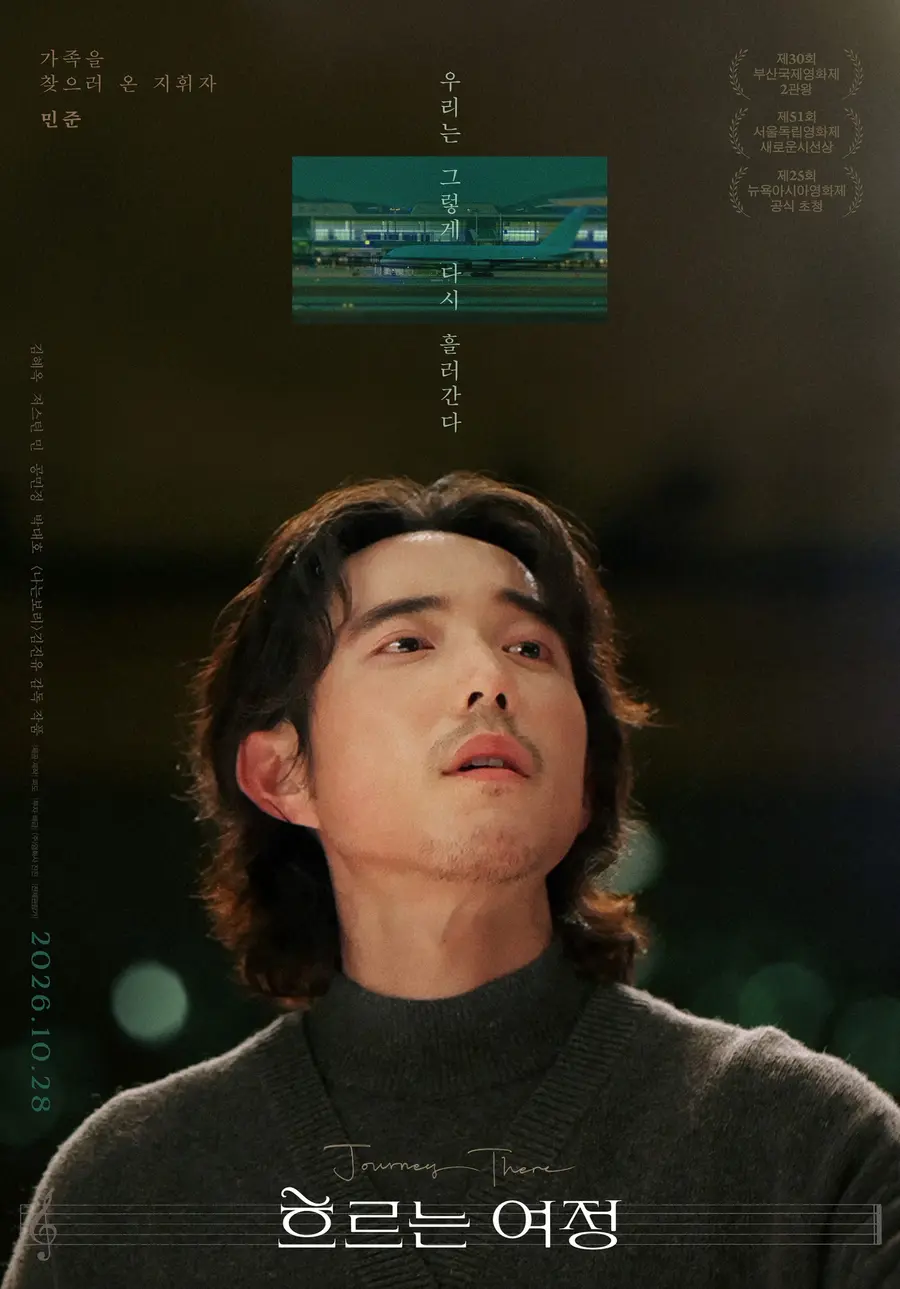
A deeply human story has found a deeply human actor. Min-jun (Justin H. Min) uses informal speech with Chun-hee (Kim Hye-ok) the moment they meet. Unaware of the hierarchy, etiquette and subtle distance between formal and informal Korean, the outsider’s familiar way of speaking becomes less an affront than an opening that breaks down the barriers between them. Their distance closes almost at once, and before long Min-jun is calling Chun-hee “Mom.” Chun-hee, Min-jun and Seong-chan (Park Dae-ho), a boy gifted at the piano, gradually become a family bound not by blood but by music and sincerity.
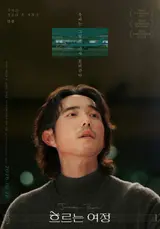
〈Journey There〉, a film that believes in the power of connection beyond words, follows Chun-hee as she prepares for a journey of her own after losing her husband. Unexpected encounters at her new apartment bring a fresh melody into her once-quiet life.
From Yang, the android in 〈After Yang〉 whose warmth was more human than that of the humans around him, to Ben in 〈Shortcomings〉, whose exposed hypocrisy and pettiness inspired a rueful sense of recognition, the people Justin H. Min has portrayed are human precisely because they are flawed. Now Min meets Korean audiences with the warm, deeply human story of 〈Journey There〉.
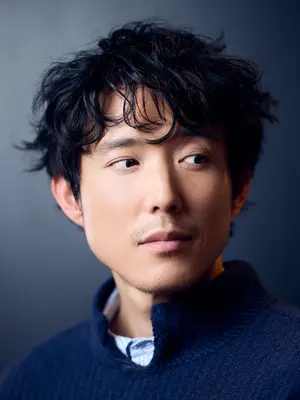
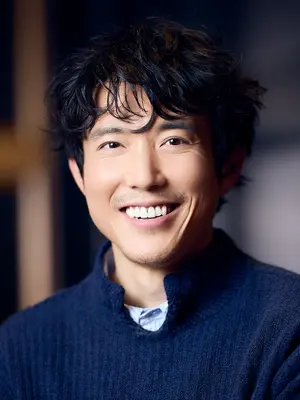
Appearing in his first Korean feature film, Min has described 〈Journey There〉 as a love letter to Korea. Min-jun’s journey—from feeling he does not fully belong to forming genuine connections with others—mirrors Min’s own journey as a person. Like Min-jun, who drinks makgeolli, that most Korean of alcoholic beverages, through a straw from a wineglass, that most Western of drinking vessels, the Korean American actor carries both cultures within him. Ahead of the film’s release on the 28th, Cineplay met Min somewhere in Seoul’s Jongno District on the 20th to discuss his journey.
You met many Korean moviegoers at audience Q&A sessions for 〈Journey There〉 over the weekend. Was there a question or reaction that stayed with you? What was it like meeting audiences in person?
It was just yesterday. An audience member who had seen the film told me they had recently lost someone they loved. It was heartbreaking to hear, but at the same time, I felt the film had brought them some comfort. Hearing a story like that reminds me why we do this work and why we need to share these stories with the world. Meeting audiences is also one of my favorite parts of making movies: sitting alongside strangers in a theater and sharing a collective experience. These days, streaming services mean people go to theaters less often, and I think that’s a tremendous loss. There’s something incredibly powerful about gathering in one place with strangers to watch and feel something together. I was so happy to share that experience with Korean audiences last week.
On Instagram, you wrote that 〈Journey There〉 felt like your love letter to Korea. Why did you describe it that way?
Partly because it’s the first film of my career that I’ve shot in Korea. But Min-jun’s relationship with Korea also very closely mirrors the relationship I’ve developed with Korea. He begins with the feeling that he doesn’t quite belong anywhere, then gradually falls in love with the culture and people here, even the language. Min-jun’s journey resembles the path my own life has taken in so many ways that it naturally became my love letter to this country.
Why did you choose 〈Journey There〉 as your first Korean feature?
I’d been looking for a project I could do in Korea for several years. I read quite a few scripts, but unfortunately, I hadn’t found one I connected with deeply. Then I received the script for 〈Journey There〉, and I was immediately, profoundly moved when I read it. Min-jun’s story touched me, as did the way it mirrored my own life’s journey. Another reason was its themes of life and death. Those are things I think about more and more as I get older. For those reasons, I wanted to be part of this film.
You said Min-jun’s story mirrored your own. Where, specifically, did you feel that connection?
When I was young, I came to Korea with my family, and I remember walking down the street and being shocked to see people who looked just like me for the first time. It was a completely different experience. Even so, I didn’t feel like I fully belonged here. Back then, whenever my brother and I spoke English, everyone stared at us. It was such a different time. These days, nobody in Korea thinks anything of it if you speak English. Everyone speaks English. But back then, just hearing my brother and me speaking fluent English would make people react like, “Oh my gosh, those Korean kids speak English fluently.” I remember wondering, “Do I belong here? Who am I?” In that sense, when Min-jun first came to Korea, he probably didn’t know where his place was or where he belonged, either. But especially over the past few years, as I’ve come to Korea more and more often, it’s begun to feel like a second home. I feel truly comfortable here, and I know so much more about the culture, history and language now. And yes, I feel a sense of belonging in a way I never did before. I’d also add that because I wasn’t born and raised in Korea, I know I can never be Korean in quite the same way as someone who was. In some respects, I’ll always be different. But as I’ve gotten older, I’ve learned to embrace those differences fully and be grateful for them. Now, rather than seeing that difference as a flaw or something lacking, I see it as something to celebrate and affirm. Growing up in America means American culture is deeply ingrained in me, but there are still unmistakably Korean parts of me, too.
〈Journey There〉 deals with life, death and loss, yet it feels warm rather than heavy. As an actor, what appealed to you about a story like this?
The stories I love most bring drama and lightness, humor and sadness together. I think all of those things are part of being human. Even when you’re struggling with something, life isn’t sad all the time. And even when you’re enjoying great success, you’re not happy all the time, either. Life is always a mixture of the two. I think that’s one of the beautiful things this film does really well. Each character struggles in their own way, but they still find so much joy and comfort in one another and in the relationships they build as they go through life.
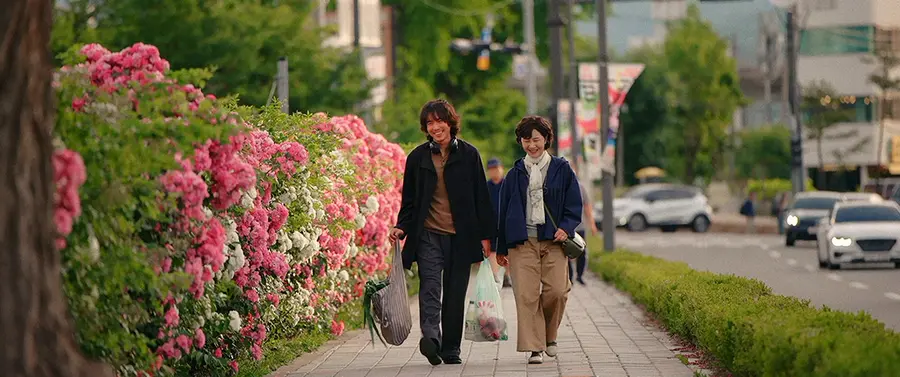
As you said, 〈Journey There〉 is a quiet, weighty story, but there’s humor throughout that lets us laugh. Min-jun drinks makgeolli through a straw from a wineglass and scratches his back with a back scratcher, among other funny details. How did those choices come about?
I’m really glad you noticed those things. Because the film deals with heavy subjects, I wanted to bring in as much lightness and warmth as possible so the audience could breathe. Whenever I saw room for humor or a joke, I tried to work it into the film. Min-jun drinking makgeolli was already in the script, but pouring it into a wineglass and drinking it through a straw was something I suggested to the director myself. I wanted to convey the texture of a character who hadn’t fully put down roots in Korea. To me, that incongruous combination—drinking one of Korea’s most traditional alcoholic beverages from a Western wineglass through a straw—symbolized both the mixing of two cultures and Min-jun’s identity. He’s Korean by blood, but he isn’t from here, so there are quite a few things about him that are different. The back-scratcher scene was in the original script, and Kim Hye-ok and I had a lot of fun playing with it on set. (Laughs)
We’re also curious about director Kim Jin-yu, who writes stories like this. What was he like to work with from an actor’s perspective?
I don’t know if you’ve met director Kim Jin-yu, but he’s one of the most sensitive, emotional souls I know. Whenever someone asks me what my favorite food is, I always say my mother’s kimchi stew. It’s not because it’s the best recipe in the world, but because when I eat it, I can feel my mother’s love throughout my whole body. That’s exactly how I felt working with the director. I could feel his heart and love in every corner of this project. He opened himself up completely for the film. He even cried every day all last week. (Laughs) I truly love his tender, warm sensibility.
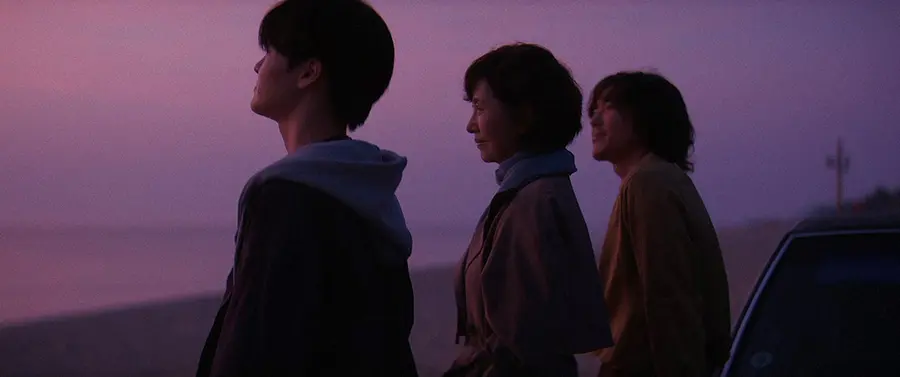
The film captures the beautiful scenery of Gangwon Province, including Myeongju-dong and Jumunjin in Gangneung, and Hongnyeonam Hermitage at Naksansa Temple in Yangyang. You filmed mainly in Gangneung and Yangyang. Are there any moments you particularly remember?
I have so many wonderful memories of Gangneung. It was so peaceful. I love Seoul, but Seoul can get so hectic sometimes. (At this point, Min said “hectic” in Korean.) Gangneung is much quieter. It’s more like the way I most like to live. The apartment where I stayed in Gangneung was 30 seconds from the beach, so I walked along the beach every day before filming began. My little room was really simple, with just a bed and a desk, and it reminded me that you don’t need a lot in life. You only need very small, simple things to be happy. I also remember getting to know the people in the neighborhood. I got to know all the older residents of the apartment building where we filmed, and they always greeted us. It was a wonderful time.
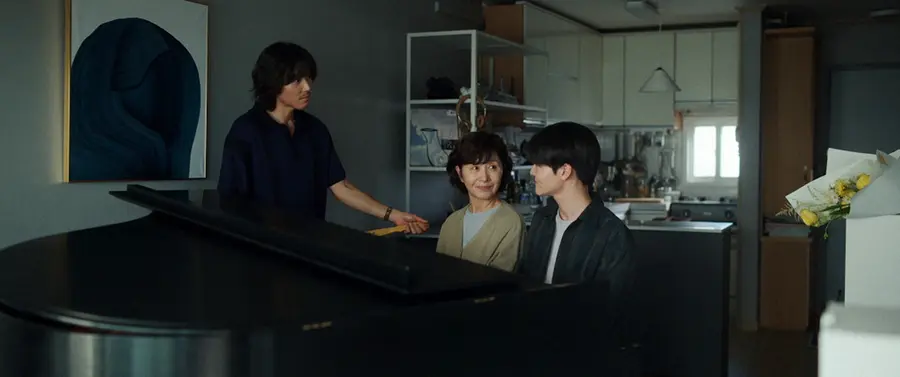
The film has three leads: pianist Park Dae-ho, who had never acted before; Kim Hye-ok, one of Korea’s veteran actors; and you, a Korean American actor. It’s an unusual combination. Was there anything special about acting together?
Chemistry isn’t something you can manufacture. Either it’s there or it isn’t. I think the director did an excellent job casting. You’re absolutely right: the three of us couldn’t be more different, but somehow everything clicked, and we felt chemistry and a bond with one another, both in real life and as our characters. So it all reflects life. I can’t explain exactly why we worked so well together. There was just this magical chemistry, and I’m very grateful for it.
The film suggests that sincerity can come through not only in language but also in communication without words—through music, a glance, a gesture or sign language. In your own life, have you ever felt certain that you connected with someone beyond a language barrier?
The entire shoot was an exercise in communicating without words! (Laughs) I love director Kim Jin-yu so much, but he doesn’t speak English at all. (Laughs) When I tried to express something during filming, he didn’t quite understand what I was saying, and when he tried to tell me something, I couldn’t always understand exactly what he meant. But just like in the film, something between us simply began to make sense. We were both there to do our best, and we cared deeply about and loved this film and its characters, so something came through that transcended language. The more I think about it, the more beautiful I find it that this film so closely reflects what we experienced in real life.
댓글 (0)
댓글 작성
댓글을 작성하려면 로그인이 필요합니다.
로그인하기