


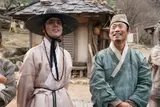
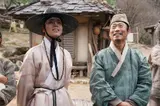
Director Jang Hang-jun’s film “The King and the Man Who Lives” (Wangsa-nam) has escaped plagiarism allegations, with claims that it copied the script of the drama “Eumheungdo.” After the court dismissed an application seeking to block its screening, the hit, which drew 16.88 million viewers, can proceed with OTT (online video streaming service) releases and planned overseas exports as scheduled.
![A still from director Jang Hang-jun’s film ‘The King and the Man Who Lives’ [Provided by Showbox. No resale or DB prohibited]](https://cdn.www.cineplay.co.kr/w900/q75/article-images/2026-04-06/a646958b-3ebb-4f7f-a62a-5e3287421b74.jpg)
The 21st Civil Division of the Seoul Western District Court (presiding judge Shin Myeong-hee) on the 23rd dismissed a request for a temporary injunction to bar screenings filed by the late scriptwriter’s family for the drama “Eumheungdo” against the film’s production companies, Onda Works and BNA Entertainment, and distributor Showbox.
The panel did not find similarities between the script submitted by the family and the film Wangsa-nam. The panel ruled that, while the family’s script consistently centers on “a Confucian-style story of loyalty and righteousness,” with Eumheungdo portrayed in its steadfast dedication toward King Danjong, “the key in Wangsa-nam is that characters interact, change, and grow together,” adding that “the themes, narrative structure, and character setups are completely different.”
The court also concluded that although the two works may share some similarities because they are based on real people and historical facts, the overall plot and unique characteristics make it difficult to view the film as plagiarism. The court further cited the lack of evidence showing that director Jang Hang-jun could have had access to the family’s script, as another ground for dismissal.
Shin Il-soo, an attorney representing the production company, said, “This is the natural decision in which the panel clearly confirmed the film’s independent creative process and the fundamental differences between the two works,” adding, “I hope it becomes an opportunity that prevents creative activities grounded in historical facts from being chilled.”

![[Interview] A Love Letter to Life, Humanity and Korea: ‘Journey There’ Star Justin H. Min, Part 2](https://cdn.www.cineplay.co.kr/w300/q75/article-images/2026-10-22/f97b0baf-32b0-4b5c-983b-df3166e84990.jpg)




댓글 (0)
댓글 작성
댓글을 작성하려면 로그인이 필요합니다.
로그인하기