


Leading South Korean filmmakers, including directors Jung Ji-young and Lee Myung-se, have taken a firm stand over the controversy surrounding 'Assassins', a film at the center of allegations of historical distortion. They sharply criticized efforts to reduce works of art to tools of 'political infighting' and strongly called for the autonomy of the cultural and artistic communities to be guaranteed.
About 20 filmmakers in Busan to attend the 31st 'Busan International Film Festival' (BIFF) held an emergency news conference the morning of Oct. 8 near Haeundae Beach. The gathering drew prominent figures from the film industry, including directors Jung Ji-young and Lee Myung-se, Han Jae-deok, CEO of Sanai Pictures, Kim Dong-hyun, executive director of the Seoul Independent Film Festival, and Kim Hong-joon, former president of the Korean Film Archive. They underscored the seriousness of the situation, saying, "Politicians must not recklessly substitute their judgment for the audience's considered judgment."
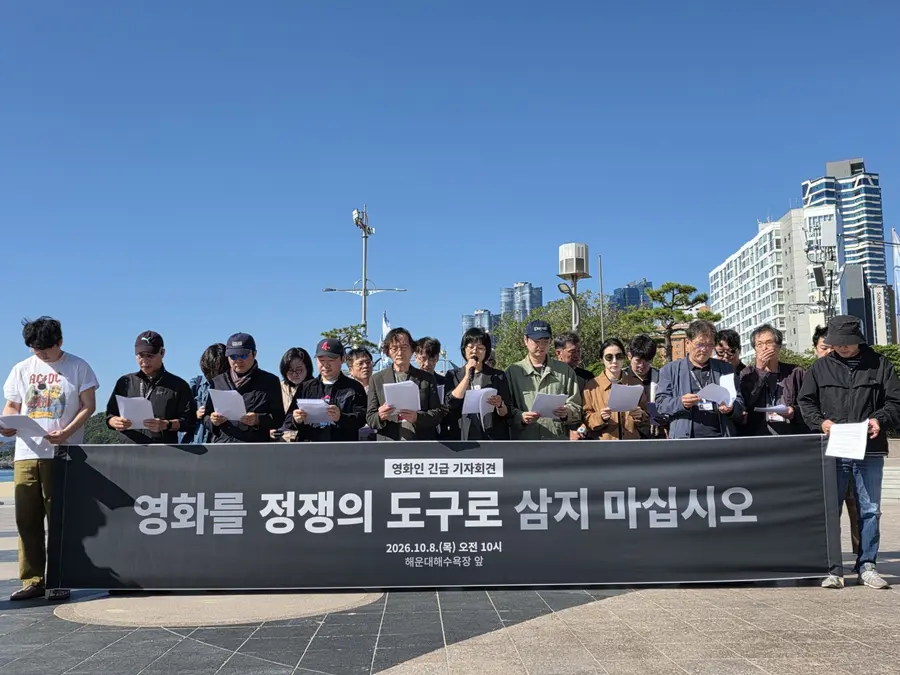
Public sanctions suppress creative freedom and threaten to chill the arts
In a joint statement, the participants said criticism of 'Assassins' had gone too far. They expressed deep concern over the current situation, in which political parties, public agencies and investment institutions have intervened beyond a simple debate over the work's merits, while theaters and film festivals face pressure over whether to screen it. They specifically called for an immediate end to a witch hunt that hastily judges the film's intentions before people have fully watched it or clearly verified the facts, then relentlessly shifts responsibility onto the director, actors and production company.
Jung Sang-min, vice president of the Korean Film Producers Association, explained the backdrop to the news conference, saying, "We have reached the point of imposing sanctions by mobilizing public resources, beyond healthy debate over a work. Filmmakers came together out of an urgent concern that if this precedent becomes entrenched, 'creative activity' will inevitably be seriously curtailed in the future." Director Jung Ji-young also took aim at indiscriminate political attacks, stressing, "A film cannot fully represent history, but projecting the countless questions and mysteries left by history onto the screen is an artist's noble duty."
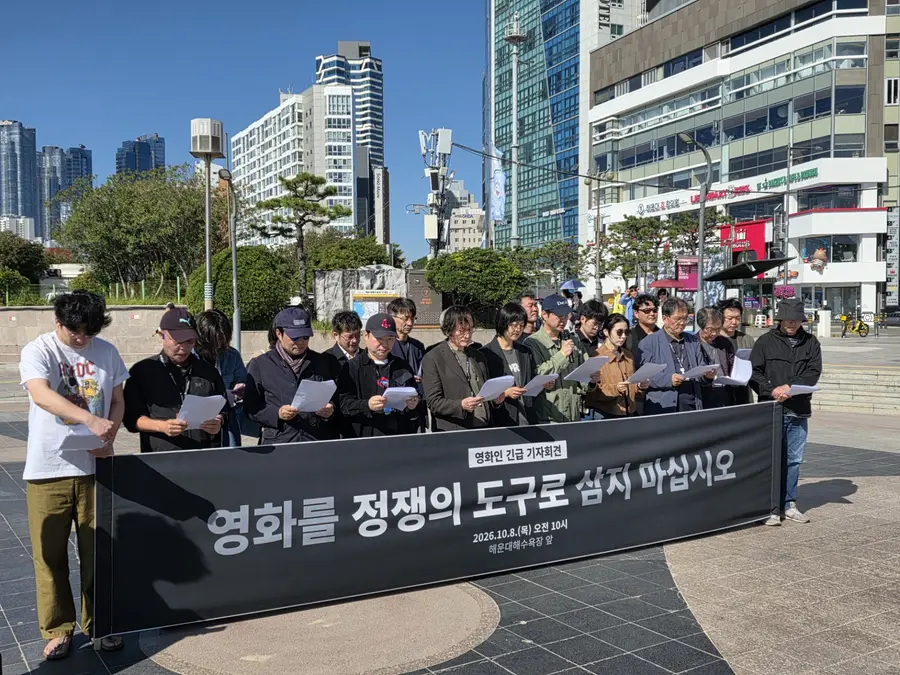
Controversy over pressure reaching overseas festivals raises concerns about political interference crossing the line
The controversy has spread beyond South Korea to the international stage. On Oct. 6, the People Power Party sent an official letter to Jeremy Chua, executive director of the Singapore International Film Festival, openly pressuring the festival to withdraw 'Assassins' as its opening film. The Singapore International Film Festival responded firmly that it had followed a strict 'independent selection' process and would screen the film as scheduled.
The filmmakers at the news conference strongly condemned efforts to drag South Korea's political conflict into the screening decisions that fall within an overseas film festival's independent authority. They drew a clear line, saying, "The selection and screening of a work belong entirely to the film festival's independent judgment, and it is entirely up to the audience how to receive it." They also cited the current situation, in which the personal information of film industry figures has been indiscriminately exposed and the matter has escalated to invasions of their homes and threats to their personal safety, declaring, "These are clearly criminal acts that go beyond reasonable criticism or the expression of an opinion."
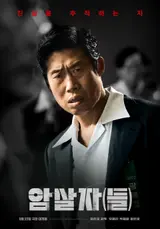
![Poster for the film 'Assassins' [Provided by Hive Media Corp. Resale and database use prohibited]](https://cdn.www.cineplay.co.kr/w900/q75/article-images/2026-10-02/5c5215f0-603d-4144-8d00-be6f219a736a.jpg)
Screening cancellation strips audiences of their rights, underscoring need for democratic debate
The filmmakers made clear that the statement was not intended to unconditionally defend the truthfulness or quality of any particular film. Regardless of whether people support or oppose the work, they were warning against attempts by politicians to control the essential meaning of a cultural or artistic work and the audience's independent judgment. In fact, this year's 'Busan International Film Festival' saw the unprecedented cancellation of all audience engagement events, including a scheduled stage greeting, related to 'Assassins.'
Kim Hong-joon, former president of the Korean Film Archive, noted that films screening at festivals had previously become the center of controversy because of their political context. But he urged a rational resolution, suggesting, "If filmmakers engage in intense and thorough discussions after the festival closes and reach a social consensus and position, this could instead become a constructive and democratic precedent."
[Attachment] One copy of the full joint statement by filmmakers
Joint Statement by Filmmakers
Do not turn films into tools of political infighting
Do not let politicians substitute their judgment for the audience's
Recently, the debate surrounding the film 〈Assassins〉 has rapidly expanded beyond evaluations of the work to questions over its screening at political and public institutions, investment institutions, theaters and schools, and overseas film festivals.
Criticism and debate over a film must be open to everyone. A work dealing with a historical event may naturally prompt even more intense debate.
But we are concerned that this debate is now expanding beyond an evaluation of the film into a tool of political infighting.
Before sufficiently viewing the work or verifying the facts, some are first defining the film's production intent and political character, then continually expanding the list of those held responsible to include the director, actors, production company, investors, public institutions, theaters and festivals. This approach needs to be reconsidered.
In particular, we want to ask:
Who gets to watch a film firsthand and make a judgment?
If politicians criticize filmmakers for trying to lecture audiences, yet seek to define a work's meaning and intent without watching it and decide what people should or should not see, who is actually lecturing the audience?
We also believe that clear principles are needed in the use of public authority, including parliamentary audits and demands for documents.
At the parliamentary audit held yesterday, debate continued over the director and production team's attendance, the investment and support process, and the film's content and historical interpretation.
Parliamentary audits are a system for holding the government and public institutions accountable based on specific facts and evidence. They must not begin by raising unverified allegations and then use them to continually expand demands for documents, witness requests, and the scope of investigations and responsibility, putting pressure on private investment and screening decisions and on the judgment of cultural institutions.
Public authority must not be used as a tool of political pressure.
Regarding this matter, it is necessary to establish what facts and evidence formed the basis for the parliamentary audit and demands for documents, and through what process their targets and scope were expanded. Filmmakers will continue examining that process and its basis through publicly available materials and lawful procedures.
If a question was raised through public authority, it must also be possible to explain what facts and evidence formed the basis for raising it.
Care must also be taken not to extend a domestic political debate to the independent selection and screening decisions of an overseas film festival.
The Singapore International Film Festival said in an official statement on Oct. 7 that, despite outside controversy and demands, it would screen 〈Assassins〉, selected through an independent programming process, as its opening film as scheduled. It also said the role of a film festival is to allow audiences to experience a variety of stories and perspectives.
This is precisely the principle we want to affirm.
Which works a festival selects and screens is a matter for the festival's independent judgment. Whether to watch a work, whether to avoid it and how to receive it are decisions for the audience.
Already, during this debate, the personal information of individuals involved in the film has been exposed, their homes and daily lives have been violated, and the situation has escalated to threats and intimidation. These acts are clearly different from criticism of a film or the expression of a political opinion.
We are not asking anyone to support a particular film.
Nor are we asking anyone not to oppose it.
Whether in support or opposition, our message is that politicians must not substitute their judgment for the work's meaning or the audience's judgment.
Do not turn films into tools of political infighting.
Do not use public authority as a means of political pressure.
Leave audiences the opportunity to watch and judge for themselves.
Let politics take a step back,
and return the power of judgment to the audience.
Oct. 8, 2026
South Korean Filmmakers


![[Weekend Box Office] 'Assassins' regains No. 1, surpassing 1.82 million viewers despite controversy](https://cdn.www.cineplay.co.kr/w160/q75/article-images/2026-10-02/5c5215f0-603d-4144-8d00-be6f219a736a.jpg)
![[On the Ground at BIFF] “Art Is Art”: Zhang Yimou Breaks Silence on Historical Controversy Over “Assassins”; Top Asian Film to Be Named on 15th](https://cdn.www.cineplay.co.kr/w160/q75/article-images/2026-10-07/f584a4c5-b837-42c6-8521-5de6f88d4fc3.jpg)
댓글 (0)
댓글 작성
댓글을 작성하려면 로그인이 필요합니다.
로그인하기