



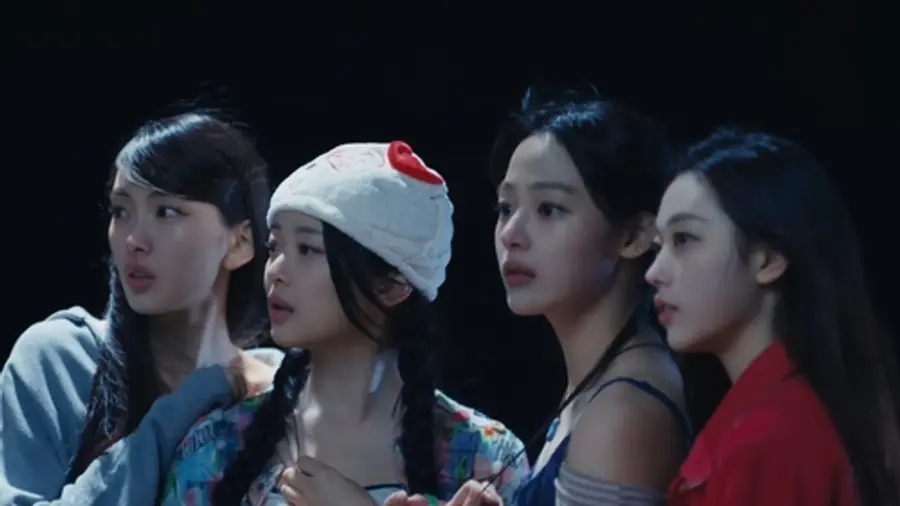
The contents of NewJeans’ exclusive contract have been made public, setting off a widespread controversy.
The New York Times reported on November 6 (Korea time) on the terms of the contract signed when the group NewJeans entered into an exclusive agreement in 2022. The newspaper said the contract omitted provisions in the standard contract guaranteeing underage entertainers’ rights to health, education and sleep. It also reported clauses that could infringe on the members’ rights, including how penalty payments are calculated and a provision concerning image rights after the contract ends. It also confirmed the existence of a clause requiring the members to cover expenses such as skin care and cosmetic surgery.
In response, NewJeans’ agency ADOR said that “addenda are being signed in full” and that claims of violations of underage entertainers’ rights were untrue. Citing a High Court ruling, it also stressed that “the contract was signed after sufficient discussion between both sides.” In a statement rebutting the report, ADOR said that “then-CEO Min Hee-jin, a vice president appointed by Min, each member and their parents, and legal representatives for some members jointly negotiated the wording and signed the final version.” It added that “we asked the newspaper to make clear that Min Hee-jin was the party responsible for the contract, but that request was not accepted.”
Below is ADOR’s full statement.
We are clarifying the facts regarding The New York Times’ November 5 report on NewJeans’ exclusive contract.
[Omission of artist-protection provisions in the government’s standard contract] Labels under HYBE sign the government’s standard addendum for minors with all of their trainees. The addendum includes protections for personal rights, sleep, education and rest, and remains in effect until the artist reaches adulthood. A person responsible for protecting minors is also designated in accordance with relevant laws. In addition, NewJeans’ exclusive contract includes provisions protecting basic human rights and covers the protections guaranteed by the government’s standard addendum for minors.
[Whether the artists’ views were reflected during contract negotiations] The contract was signed in April 2022, after a draft was shared on January 7 of that year. Over the course of three months, the parties held extensive discussions, including question-and-answer sessions, email exchanges and revisions following a review by the artists’ lawyer. A court also recognized that the contract was signed after sufficient discussion between both sides (Seoul High Court case 2025Ra2421). The change requested at the time by the mother of a member currently in a dispute with ADOR was to add a clause requiring the member to “immediately notify the company if there is an attempt to tamper.” Although that request was not reflected in the final version, in response to the company’s detailed explanation, the mother expressed her thanks, writing, “Thank you for your thoughtful response. I’d like to let you know that I have no further comments on your answers.” HYBE’s legal team provides a basic exclusive-contract template for labels to use as a reference. The labels then communicate with the artists, who are the other parties to the contracts, to determine key terms such as the payment settlement method. Regarding the actual division of expenses, one mother asked whether the artists’ share of costs could be reduced. At the time, HYBE’s legal team prepared multiple options for addressing this request and presented them to ADOR, but ADOR’s then-vice president rejected them, and the contract was signed under the current terms.
[CCTV installation] CCTV cameras are installed only in shared spaces, such as practice rooms. They are operated in compliance with relevant laws. The cameras are intended to protect trainees and artists by preventing crimes including trespassing and theft.
[Right to education] HYBE and its labels have a firm principle of fully respecting and following the wishes of artists and trainees and their parents regarding education. There have been cases in which artists who expressed a desire to attend college received full support.
[Penalty clause] NewJeans’ contract states that penalty payments are calculated based on the average monthly revenue during periods in which actual revenue was generated, regardless of the length of the artist’s activities. Although the wording differs from the standard contract, the economic effect is the same, and the provision was not changed to the artists’ disadvantage. The standard contract also contains a provision excluding periods in which no revenue was generated from the penalty calculation. For artists who have been active for less than two years since debut, it provides that only the period in which actual revenue was generated—in other words, the period after debut—is included in the calculation. NewJeans’ contract provides that only periods in which revenue was generated are counted, regardless of the length of the artist’s activities. However, because the group generated substantial revenue immediately after debut and continues to generate significant revenue through streaming, among other sources, the only period in which no revenue was generated was before debut. The contract’s actual effect is therefore exactly the same as that of the standard contract. Accordingly, the penalty in Danielle’s lawsuit was calculated using a formula exactly the same as the one in the standard contract. The Seoul High Court also reviewed this provision in detail during the dispute over NewJeans’ exclusive contract and explicitly ruled that it raised no issues. For reference, this clause applies only in the highly exceptional case “where the company has faithfully fulfilled its obligations, but the artist unilaterally terminates the contract during its term or violates material terms for the purpose of terminating it.”
[Rights to the members’ voices and faces] NewJeans’ exclusive contract contains a provision protecting personal rights, and AI content may be used only with the individual artist’s consent. The members’ mothers were also told this and said they had no objections before signing the contract. Furthermore, if a former agency arbitrarily uses the intellectual property of an artist who has signed with another agency after the exclusive contract ends to actively pursue additional business, it could violate other South Korean laws, including the Unfair Competition Prevention Act. The company is fully aware of these legal risks and has neither reason nor intention to use an artist’s intellectual property without authorization in violation of the law.
[Prohibitions on defamation and inappropriate romantic relationships] Defamation is also specified as a criminal offense under South Korean law. The clause means that artists must not commit crimes that constitute defamation. Contracts with overseas brands may impose even broader obligations to maintain good conduct than those in Korea. Preventing inappropriate romantic relationships that could cause public controversy is also necessary to protect artists. The artists’ parents agreed to this clause when the contracts were signed.
We explained to The New York Times, with supporting materials, that NewJeans’ contract was negotiated and signed by then-CEO Min Hee-jin, a vice president appointed by Min, each member and their parents, and legal representatives for some members. We also asked the newspaper to make clear that Min Hee-jin was the party responsible for the contract, but it did not accept our request. We are providing this explanation because contract documents and court filings held only by the parties have been leaked to foreign media and are being used as a tool to attack K-pop.



댓글 (0)
댓글 작성
댓글을 작성하려면 로그인이 필요합니다.
로그인하기