


※ This interview with Cho Yeo-jeong of 〈Possible Love〉 continues from Part 1 and Part 2.
In the car on the way to the vacation home, Sang-woo tells Ye-ji, “You're Method acting,” and she replies, “I'm trying to love those people.” In that moment, Ye-ji almost seems to have a look on her face that says, “I've been caught.”
That's right. That wasn't how I was approaching it, but when he sums it up so neatly with such a pointed phrase, of course it hits a nerve. In-sung and I talked about that while filming. They're a married couple who started out as schoolmates and friends, so they're used to exchanging cynical, rational remarks in their everyday conversations, almost as if they're debating. But even if that's the kind of husband he is, when he takes such a sharp jab at her genuine feelings, it catches her off guard, and that shows on her face.
Then when Ye-ji says, “I'm trying to love those people,” is she being sincere, or is she lying?
It must be a mixture of both. That's what Ye-ji believes. Loving someone, and believing that trying to love someone is love. Aren't those things always intertwined? Isn't that what love is like?
To some people, Ye-ji's innocent approach might seem all the more sinister. To Ho-seok and Mi-ok, it could be unintentionally rude. While acting, did you ever anticipate that this innocence of yours could make someone uncomfortable?
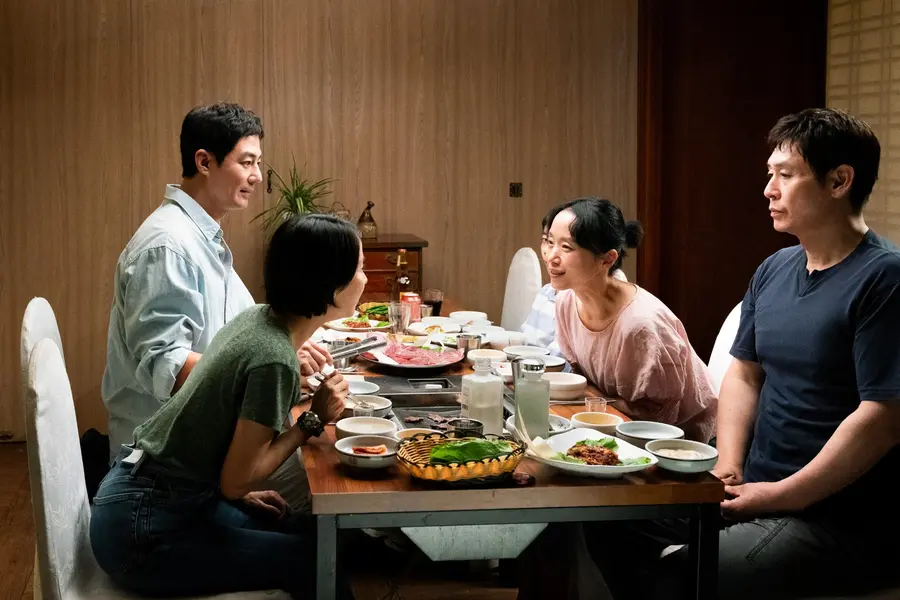
It was already there in the script. Even without any ulterior motive, things are uncomfortable and awkward enough, and the atmosphere is suffocating. You can barely breathe starting with the barbecue restaurant scene. What do you do with that atmosphere? Ye-ji does everything she can to ease that discomfort. So she even says and does things she's never said or done in her life. She says, “Yeah, you bitch,” something she'd never normally say. If you watch that scene, Sang-woo looks at me as if to say, “What's gotten into her?” Ye-ji is trying harder than anyone else there. That's how difficult it is. I knew it was difficult, and because it was difficult, I found myself doing everything I could. When I first saw “Yeah, you bitch” in the script, I thought, “How am I supposed to do this? How could I say something like that in this scene?” But once we all got together and tried it, it was so awkward and uncomfortable that I found myself doing whatever I could.
Then could you, Cho Yeo-jeong the person, make a documentary the way Ye-ji does?
I couldn't. I really couldn't. It's not something just anyone can do. So before filming, I asked the director, “Is this right? This is so hard. What do I do?” And he told me, “That's how every director feels.” He said it wasn't just Ye-ji, that all directors feel that way, even when they're making narrative films. Even when it isn't real. Even making fiction is difficult. And yes, that's right. So I didn't ask any more questions. If that's how he'd written Ye-ji, I had to trust him. If I wavered, the film and the character could end up going in a different direction.
At the Busan International Film Festival's Open Talk, you chose the first interview with Mi-ok as your favorite scene and said that even though she was an actor, she didn't feel like one. Could you elaborate on why, and tell us what it was like working with Jeon Do-yeon?
Some viewers see this film as a story about two women. That's one way to look at it. There are many relationships in the film, but it can be seen as the story of two women and the paths each of them didn't take. Some have even called it “a romance between two women,” and others see it as a friendship between two women. I felt that Ye-ji should be like a shadow in this film. The camera itself is already intrusive and uncomfortable enough, so I thought I should be like a shadow in the film as a documentary director. That's why, from the beginning, I decided to focus only on Mi-ok's eyes. I was thinking, “Just look at Mi-ok. Just watch Mi-ok, genuinely listen to her story and respond.” I think that's why I loved scenes like the one in the cafe so much. She was so completely Mi-ok. “How can she be so completely Mi-ok and not Do-yeon?” When she talked about the car wash from her childhood, it was just so, so real. Every moment was like that. It was the same when I worked with Sul Kyung-gu.
You seem to have a very strong sense of yourself as an actor. What do you always keep in mind when taking on and playing a new character?
There is something I do. When I take on a character, I tend to focus a lot on the director and my scene partners. Rather than thinking, “Since I'm playing this role, I should do it this way,” I tend to study and explore things behind the scenes: “Why does the director want to make this? How do they want to express it? What kind of person is this director, that they want to tell this story?” Every actor is different, but I watch the director closely and lean very heavily on my scene partners, too. I think that's how the character starts to take shape.
You finished filming with that mindset, attended the festivals, and now the film has been released to audiences. What kind of experience has making a film with Lee Chang-dong left you with?
More than anything, it was wonderful to see for myself just how many people around the world love and wait for Lee Chang-dong's films. I thought, “So many people love his work. They've waited so long for his next film.” That made me feel so proud and fulfilled. And it was such an honor to be able to meet audiences through a film by that very director, Lee Chang-dong. Truly.
Expectations for 〈Possible Love〉 at the Academy Awards are higher than ever. You've already experienced an Academy campaign with 〈Parasite〉, and you're also an Academy member. What are your hopes for this race?
I'm embarrassed. (Laughs) Back then, I couldn't participate in the race because I was filming a TV drama, so in a way, this feels like my first time doing it. I only went to the Golden Globes and the Oscars at the end, and I couldn't take part in the race leading up to them. So I followed it through news articles in Seoul. But it's such an honor to be given another opportunity like this. After all, we're representing Korea. We're going to the Oscars as the country's representative film, so I think I need to work really hard and take genuine pride in that. I have to give it my all.




댓글 (0)
댓글 작성
댓글을 작성하려면 로그인이 필요합니다.
로그인하기