


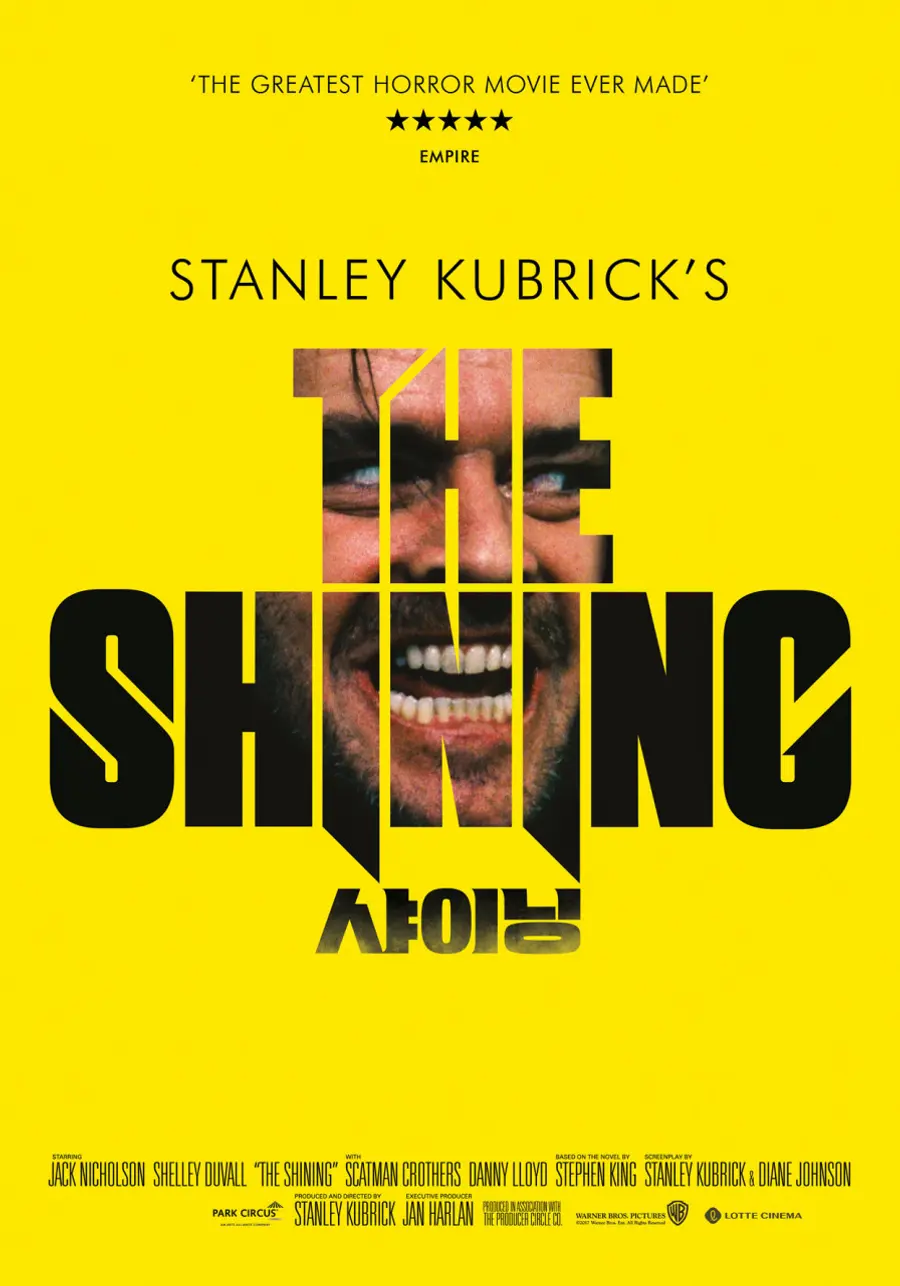
The masterpiece of the great Stanley Kubrick, 〈The Shining〉, has returned this winter. 〈The Shining〉 depicts the horror that ensues as Jack, a man consumed by desire and madness in a remote hotel during winter, gradually descends into madness and threatens his family. The horror of 〈The Shining〉 is crafted by Kubrick's meticulous direction and the film's music, which consistently evokes discomfort. The music of 〈The Shining〉 was not created in the traditional way of a music director composing an original score. Kubrick selected a majority of existing classical pieces, and Wendy Carlos arranged some of the music. Among them, the music of Polish composer Krzysztof Penderecki directly conveys the unknown terror intended by Kubrick to the audience. His music, which focuses on the destructive power of sound itself rather than melody, allows the audience to feel the terror itself as a mass of sound rather than getting lost in emotional empathy through melody. Instead of presenting a specific character's theme, it depicts the space of the Overlook Hotel as a living entity, elevating the film's political significance. Following Penderecki's pieces in the film, one can confront the contradictions of the white male artist, which is the theme Kubrick intended, as well as the violence of race, patriarchy, and colonialism in America.
Representative Composer of Polish Avant-Garde
Krzysztof Penderecki

Penderecki emerged as a leading composer of Polish avant-garde in the 1960s. He is famous for monumental works dealing with war, suffering, and religion, such as 'Threnody to the Victims of Hiroshima' and 'St Luke's Passion'. He primarily expresses these through sound masses rather than melody, using elements like 'Cluster' (a sound mass created by playing multiple notes simultaneously at half-step intervals), glissando (a technique where the pitch slides up and down), and scratch (a technique that produces a sound close to noise by rubbing the strings), creating music that approaches explosion, screams, and immense resonance. Penderecki's music has been discussed in connection with works addressing the Holocaust and war trauma in Europe and America. Kubrick utilizes this aspect to reveal America's violent history.
The Sonification of Violence

Penderecki's piece 'De Natura Sonoris No. 1' plays when Danny explores the hotel on his tricycle. The music employs a large orchestration of strings, brass, percussion, piano, and harmonium to depict explosive sound clusters and percussive collisions. The irregular percussion and sound clusters of the piece blend with the rapidly changing camera angles and abstract carpet patterns, making the hotel corridor appear like a maze with no exit. Penderecki's music 'De Natura Sonoris No. 1' shapes that maze through sound.

The sequence where Wendy and Jack's confrontation reaches its peak is accompanied by Penderecki's representative piece 'Polymorphia', creating extreme suspense. This piece appears during the scene where Wendy ascends the stairs with a baseball bat, struggling with Jack, and fragments of Bartók's 'Music for Strings, Percussion, and Celesta, Movement 3' and 'Polymorphia' intertwine. Each time the terrified Wendy steps back, the string clusters rise slightly and then settle again. The height of the stairs, the characters' breathing, and the crescendo of the music intertwine as one, creating a psychological sense of horror.


In the very next scene in the pantry, 'Polymorphia' continues. Wendy locks Jack in the pantry before he awakens from his momentary unconsciousness and is engulfed in madness. Once he regains consciousness, Jack tries to persuade Wendy to open the pantry door and seeks sympathy. He then threatens and mocks her, psychologically pressuring her. At this moment, the midsection of 'Polymorphia' with its dense string clusters underlies the scene. Jack's patriarchal verbal violence and the sound of strings combine to scream. Originally, 'Polymorphia' is notorious for being atonal music without a special tonality, creating a rough texture through the friction of multiple notes, and suddenly introducing a C major chord at the end. Kubrick removes this resolution, leaving the fear experienced by women under a patriarchal society as unresolved anxiety. Subsequently, 'Polymorphia' reappears right after the scene where Jack murders Hallorann with an axe, evoking the violence that white people have historically inflicted on black people in America.
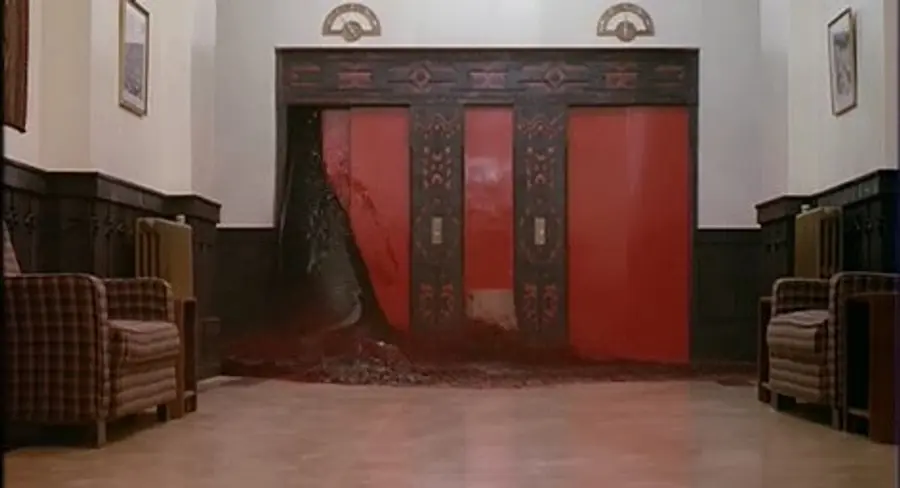
Even after the film ends, Penderecki's music does not fade from memory along with Jack's crazed face. The sounds that wandered through the corridors and maze of the Overlook Hotel continue to resonate. And we, unable to escape that resonance, begin to wonder. Is the ghost of the hotel that swallowed Jack a supernatural being, or is it the history and violence that America has repeatedly enacted? Penderecki's music leaves that question unanswered, remaining as auditory discomfort.
![[Chua-young's Music Box] The Meta Representation of Subculture 'Cosmic Princess Kaguya!' with 'World Is Mine' and 'Reply'](https://cdn.www.cineplay.co.kr/w400/q75/article-images/2026-02-12/09350b70-b012-4e2f-a254-046f646e2d8d.jpg)
![[Choo A-young’s Music Box] After Anger, ‘Oasis: Don’t Look Back in Anger’ Sings Again](https://cdn.www.cineplay.co.kr/w400/q75/article-images/2026-09-10/323f8c2a-129f-4107-b190-114253e0c827.jpg)
![[Chua-young's Music Box] Why Did 'What If We' Resonate with Today's Youth? The Romance Fantasy of the Non-Dating Generation](https://cdn.www.cineplay.co.kr/w400/q75/article-images/2026-01-28/113b25b0-ce84-47ff-807d-5dc4657e02d2.jpg)

![[Chu Ah-young's Music Box] Michael Jackson's 'Thriller' and 'Heal the World' That Tried to Turn Dreams into Reality](https://cdn.www.cineplay.co.kr/w400/q75/article-images/2026-05-21/ffa1b48f-3611-45b6-a14a-e3e0aea5b392.jpg)
![[Chua-Young’s Music Box] Music for the Purification Ritual of Wounded Youth: “Girls Band Cry”](https://cdn.www.cineplay.co.kr/w400/q75/article-images/2026-04-22/10da8998-3cb2-462f-8af6-4063689a916d.jpg)

![[Chua-young's Music Box] May Madness Reign on This Land! '28 Years Later: The Bone Temple' and 'The Number of the Beast'](https://cdn.www.cineplay.co.kr/w400/q75/article-images/2026-03-11/1a6d94b0-98c1-4b3b-8f0f-dd2d9ac48c7d.jpg)

![[Chua-young's Music Box] The Music of 'Pavane' Following the Path of Love](https://cdn.www.cineplay.co.kr/w400/q75/article-images/2026-02-26/cc89ea7d-356d-492c-8168-136478d2e26d.jpg)
![[Chua-young's Music Box] The Coexistence of Sorrow and Hope 'Super Happy Forever' and 'Beyond The Sea'](https://cdn.www.cineplay.co.kr/w400/q75/article-images/2026-01-14/2315abe7-c0c7-4f3f-8774-9a2b0f578550.jpg)
![[Chua-Young’s Music Box] ‘Project Hail Mary’—A Story of Humanity’s Trembling at the Brink of the End, and ‘Sign of the Times’](https://cdn.www.cineplay.co.kr/w400/q75/article-images/2026-04-09/23d4b16b-49c1-47dd-a17a-1e939faddd12.jpg)









댓글 (0)
댓글 작성
댓글을 작성하려면 로그인이 필요합니다.
로그인하기