


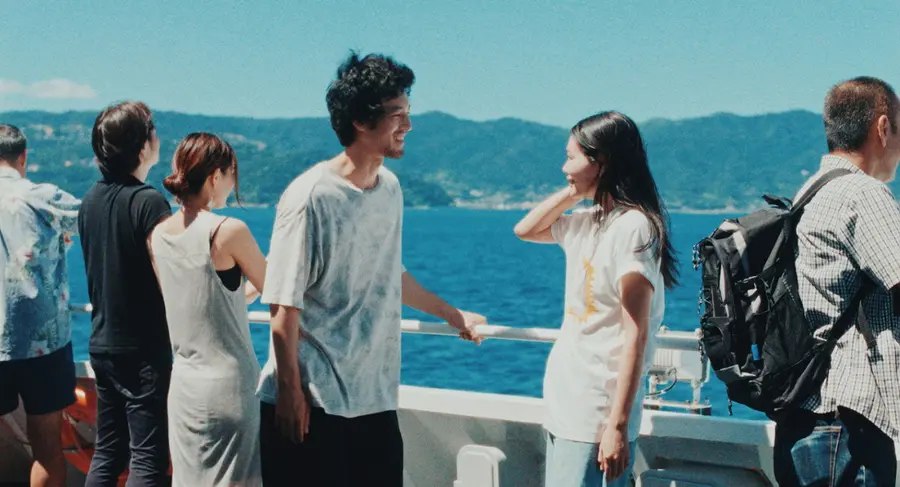
Sano (Sano Hiroki) is alone among people who naturally exchange conversations. He does not listen to their stories, often steering the flow of conversation in another direction or abruptly interrupting it. Maintaining such an indifferent attitude, he suddenly reveals that he recently lost his wife. There is no sadness on his face as he speaks of his wife's death. He speaks flatly, as if listing an event that happened in the past. Then, denying even the words of comfort that come back, he slips away from the scene and stands before people to sing Bobby Darin's jazz pop 'Beyond The Sea'. The bright melody of the music does not fit the situation of disconnection or the character's emotions, creating a moment that feels alien to the film. 〈Super Happy Forever〉 pushes this ironic sensation to the end. The song is another word that enables emotional communication. What kind of heart did Sano, who rarely tried to converse with others, want to reveal with this song?

〈Super Happy Forever〉 is a story about a man who lost his wife, retracing the dazzling summer and love they shared together. Sano returns to the hotel at the coastal resort where he first met and fell in love with Nagi. There, he wanders around the hotel and its surroundings looking for the red hat that Nagi lost five years ago, but cannot find it due to the passage of time. The hotel, once bustling with people, is soon to close. Following the traces of loss that have disappeared, the film leads to the past five years ago when Nagi was alive.
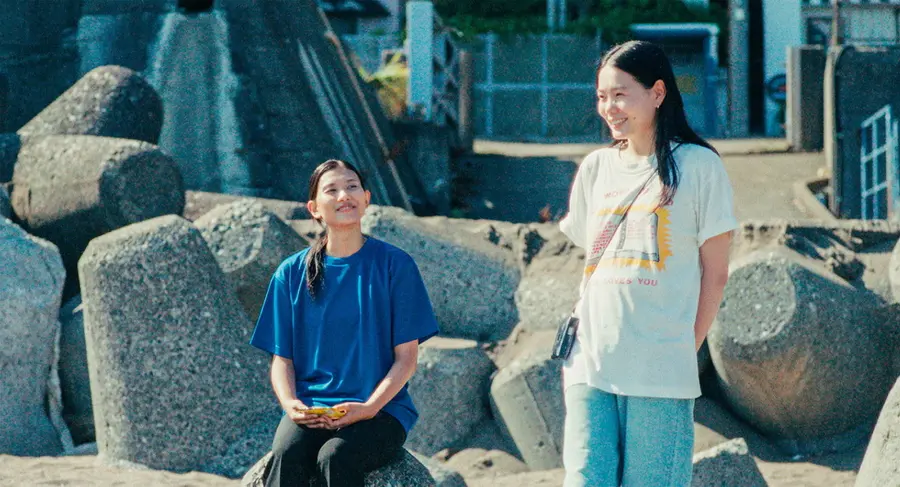
Director Igarashi Kohei connects the past and present without flashbacks, unlike other films. Vietnamese woman An (Hoang Nu Quynh) hums 'Beyond The Sea' while cleaning the hotel room. An's song immediately triggers the Proust effect in Sano, reminding him of the past he shared with Nagi. He listens to her song while wedging a cigarette case, intertwined with memories of Nagi, in the doorframe of the room. At this moment, the camera slowly pans to the side, and the moment from five years ago when Nagi checks in comes back to life. Igarashi intentionally avoids using clear flashbacks to distinguish between the past and present, nullifying the separation of the two. Here, Bobby Darin's music 'Beyond The Sea' serves to connect the past and present along with the prop of the cigarette case.
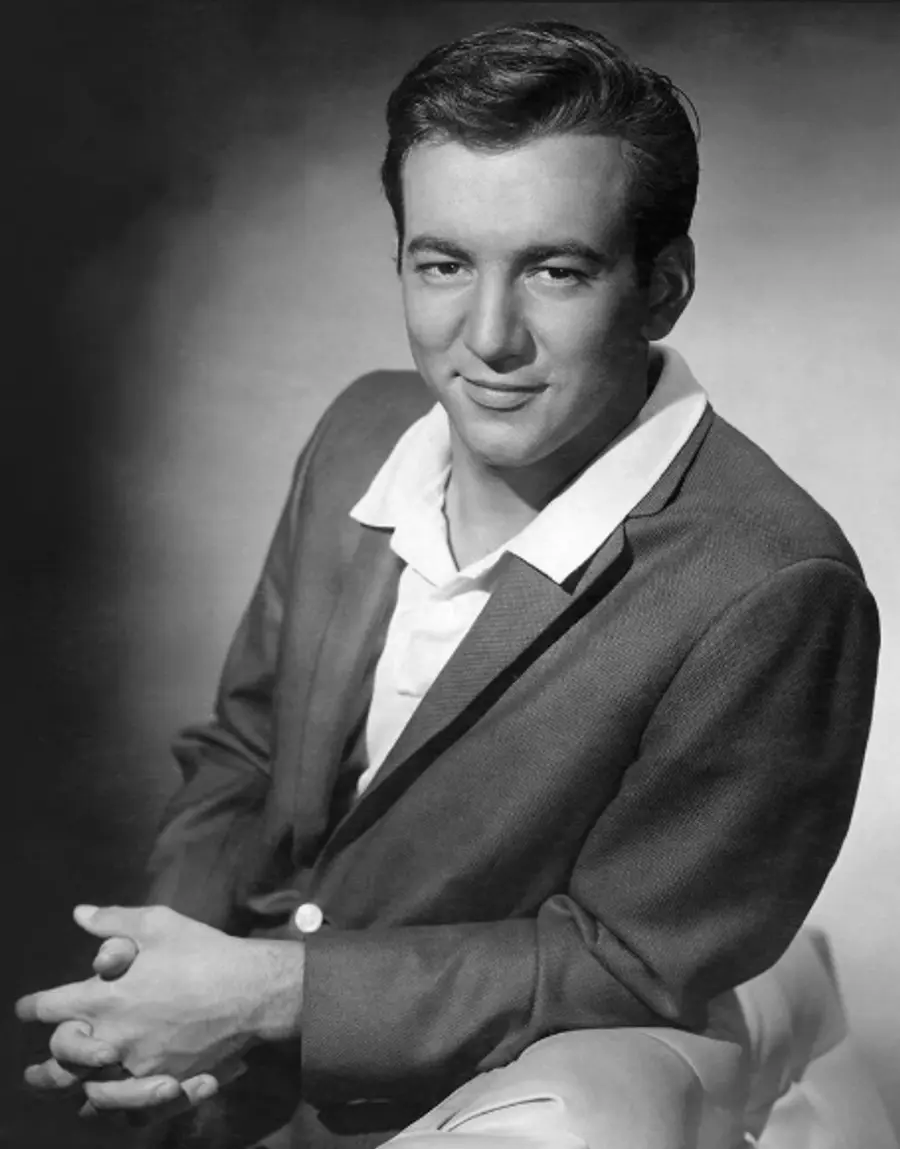
Bobby Darin's 'Beyond The Sea' is a monumental song from 1959 that revives the essence of swing jazz during the rock and roll era. It is a cover of Charles Trenet's chanson 'La Mer' (The Sea) and is the most famous bestseller among over 4,000 recorded versions. Igarashi uses this song, which has been continuously sung, as a core piece of music in the film, adding the historical significance and echoes of the past to the film. Originally, the song praised the beauty of the sea in a contemplative manner, but with the new lyrics by Jack Lawrence, it was reborn as a song expressing longing for a distant lover and a desire to reunite with them. "Somewhere beyond the sea, my love is waiting for me on the golden sand. And she watches the sailing ships. Somewhere beyond the sea, she is waiting for me there. If only I could fly like the birds in the sky, I would sail straight to her arms." The poignant lyrics of the song convey Sano's sorrow at losing his beloved wife, Nagi. Additionally, Igarashi embodies the abstract emotions conveyed through the song's lyrics into the film's imagery.
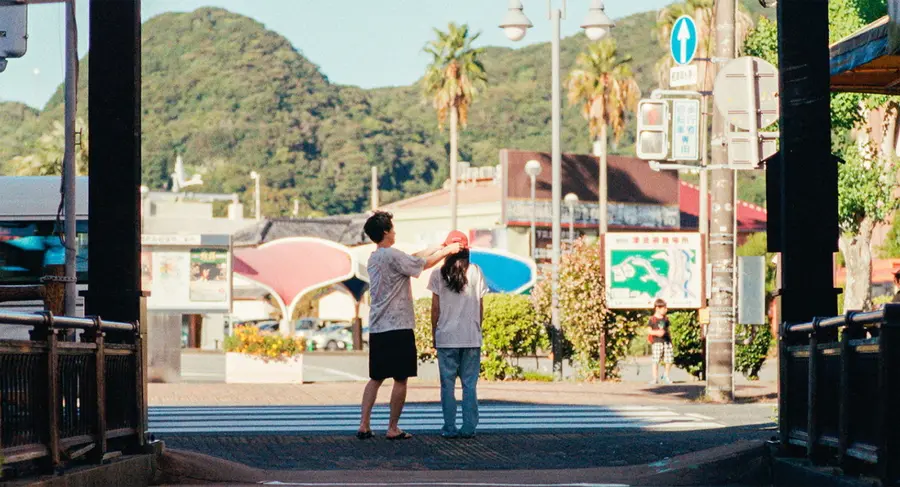
Bobby Darin's 'Beyond The Sea' is arranged for big band, infusing a swing jazz feel into the elegant chanson. The contrast between the sad lyrics, which premise that the sea, time, and fate separate the two lovers, and the swing melody that encourages swing dancing is striking. This contrast creates an irony that sings sadness without making it feel sad, and within this irony, the speaker's sorrow and longing are sublimated into a lively dance. The unique tone of 'Beyond The Sea', where sorrow and hopeful optimism coexist, resembles the world of 〈Super Happy Forever〉, where conflicting elements coexist.
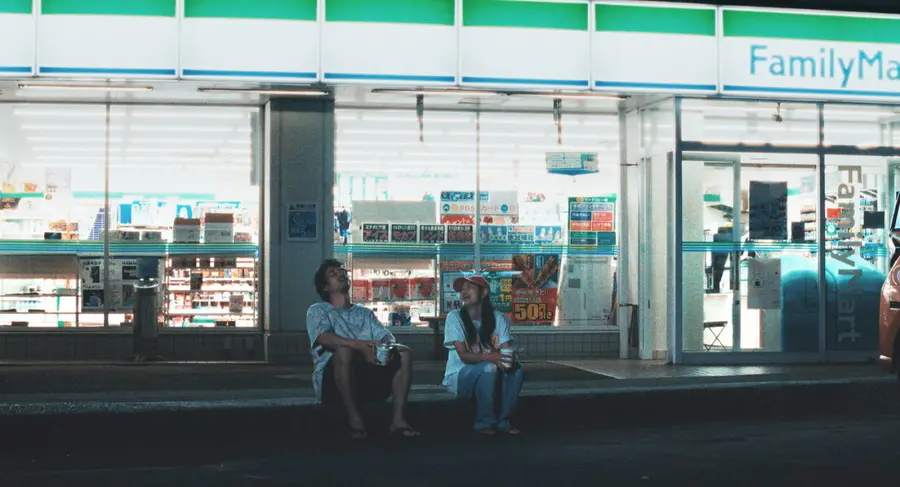
Igarashi Kohei reveals the thematic consciousness of the film by quoting Kamono Chomei's 「Hojoki」 (a traditional Japanese text) in the early part of the film. "The flowing river constantly flows, and it is not the same water as before. The bubbles in the puddle disappear and reappear, and nothing remains the same for long. The people of the world and their dwellings are the same." Kamono Chomei's philosophical insight explores the essence of existence in the midst of constant change rather than fixed eternity. The world of 〈Super Happy Forever〉 resonates with this. The film's structure, which does not distinguish between Sano's present, who has lost his wife Nagi, and the past when Nagi was alive, evokes feelings of both sorrow and love simultaneously. Furthermore, the film's ending, where Nagi's hat is given to An, reveals the cyclical nature of life as the life of the deceased Nagi is transferred to An, who is preparing for a new life. In this way, 〈Super Happy Forever〉 is an ironic art that dismantles the illusion of 'eternal happiness' through the coexistence of conflicting elements. The irony of 'Beyond the Sea' and 〈Super Happy Forever〉 leaves us with the belief that what has disappeared in life coexists with us somewhere beyond the sea.
![[Chua-young's Music Box] The Meta Representation of Subculture 'Cosmic Princess Kaguya!' with 'World Is Mine' and 'Reply'](https://cdn.www.cineplay.co.kr/w400/q75/article-images/2026-02-12/09350b70-b012-4e2f-a254-046f646e2d8d.jpg)
![[Chu Ah-young's Music Box] Michael Jackson's 'Thriller' and 'Heal the World' That Tried to Turn Dreams into Reality](https://cdn.www.cineplay.co.kr/w400/q75/article-images/2026-05-21/ffa1b48f-3611-45b6-a14a-e3e0aea5b392.jpg)
![[Choo A-young’s Music Box] After Anger, ‘Oasis: Don’t Look Back in Anger’ Sings Again](https://cdn.www.cineplay.co.kr/w400/q75/article-images/2026-09-10/323f8c2a-129f-4107-b190-114253e0c827.jpg)
![[Chua-Young’s Music Box] ‘Project Hail Mary’—A Story of Humanity’s Trembling at the Brink of the End, and ‘Sign of the Times’](https://cdn.www.cineplay.co.kr/w400/q75/article-images/2026-04-09/23d4b16b-49c1-47dd-a17a-1e939faddd12.jpg)
![[Chua-young's Music Box] The Screams of 'The Shining', the Auditory Discomfort Created by Krzysztof Penderecki's Music](https://cdn.www.cineplay.co.kr/w400/q75/article-images/2025-12-17/2667f27c-46b5-45d4-bf2d-7bf2b656ff21.jpg)
![[Chua-young's Music Box] Why Did 'What If We' Resonate with Today's Youth? The Romance Fantasy of the Non-Dating Generation](https://cdn.www.cineplay.co.kr/w400/q75/article-images/2026-01-28/113b25b0-ce84-47ff-807d-5dc4657e02d2.jpg)

![[Chua-young's Music Box] The Music of 'Pavane' Following the Path of Love](https://cdn.www.cineplay.co.kr/w400/q75/article-images/2026-02-26/cc89ea7d-356d-492c-8168-136478d2e26d.jpg)
![[Chua-Young’s Music Box] Music for the Purification Ritual of Wounded Youth: “Girls Band Cry”](https://cdn.www.cineplay.co.kr/w400/q75/article-images/2026-04-22/10da8998-3cb2-462f-8af6-4063689a916d.jpg)


![[Chua-young's Music Box] May Madness Reign on This Land! '28 Years Later: The Bone Temple' and 'The Number of the Beast'](https://cdn.www.cineplay.co.kr/w400/q75/article-images/2026-03-11/1a6d94b0-98c1-4b3b-8f0f-dd2d9ac48c7d.jpg)












![[Seongchan Eol's Comic Book] A Mystery Comic Born in the Same Year as 'One Piece'... No, You Should Read This Science Comic 「Q.E.D. Proof Complete」](https://cdn.www.cineplay.co.kr/w160/q75/article-images/2026-01-16/c3b2afc1-03e2-4709-8b1b-7a78b153f5a0.jpg)
![[Chua-young's Music Box] The Meta Representation of Subculture 'Cosmic Princess Kaguya!' with 'World Is Mine' and 'Reply'](https://cdn.www.cineplay.co.kr/w160/q75/article-images/2026-02-12/9f0aef62-9c40-4e9c-807b-b7fdecafd50a.jpg)
![[Chua-young's Music Box] The Music of 'Pavane' Following the Path of Love](https://cdn.www.cineplay.co.kr/w160/q75/article-images/2026-02-26/9cb41876-dfb6-4ccf-98a8-caac1ca57e4a.jpg)
![[Chua-young's Music Box] May Madness Reign on This Land! '28 Years Later: The Bone Temple' and 'The Number of the Beast'](https://cdn.www.cineplay.co.kr/w160/q75/article-images/2026-03-11/92b7a9a0-2aaa-4892-9836-8c2d9dd06d5b.jpg)
댓글 (0)
댓글 작성
댓글을 작성하려면 로그인이 필요합니다.
로그인하기