


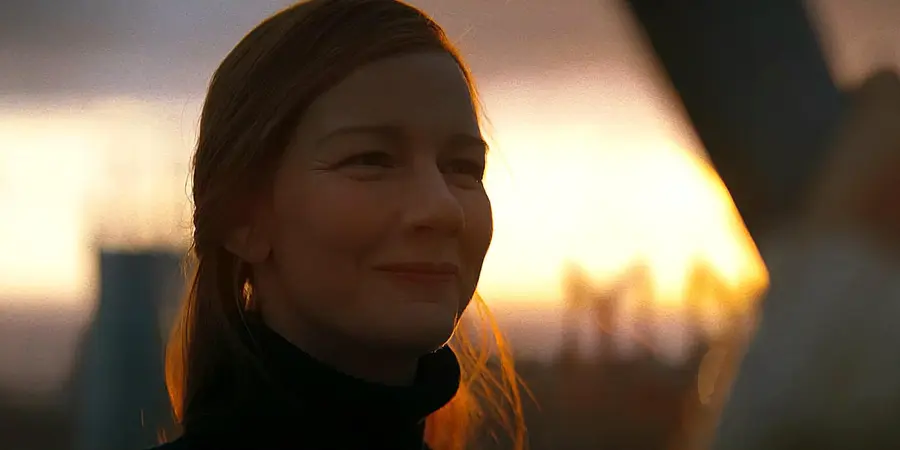
Eve Stratt (Sandra Hüller), the executive in charge of Project ‘Hail Mary,’ which leads the effort to overcome the crisis facing the world, says goodbye by singing at the final party before sending her team out into the vastness of space. Stratt, who rarely showed emotion and always maintained a cool, level-headed demeanor, reveals her sincerity only at the moment of farewell. But the ‘Sign of the Times’ song by Harry Styles that she sings takes on a meaning beyond simply saying goodbye in the film. This scene, which is not found in Andy Weir’s original novel, conveys to the audience Eve Stratt’s concealed, human anguish. At the same time, it compresses the philosophical core of 〈Project Hail Mary〉—the idea that you can only avert the end if you open your hearts to one another.
Coexistence of Despair and Hope
‘Sign of the Times’


Harry Styles’ solo debut single ‘Sign of the Times’ reveals a new side of him through a grand, weighty rock ballad—something that feels utterly different from the bright, upbeat pop sound of his One Direction days. Styles wrote the song after going through a series of events, including terrorist attacks that swept across Europe in the mid-2010s and Brexit in 2016. Having personally witnessed both the collapse of political terror and a massive project called “One Europe,” he recalls the words people need—words like: “We’ve got to get out of here,” like a death sentence already issued, impossible to undo. In interviews, Styles said, “‘Sign of the Times’ came from the belief that this isn’t the first time we’ve had to go through hard times, and it won’t be the last.” Close to the warning that you can’t avoid the end unless you understand one another, the song also contains his own ambivalence. That ambivalence pushes him one step beyond a doomsday mindset—toward a stance that rises above negativity and chooses positivity. He talks about his anxiety and resignation as he moves through a crumbling era, while at the same time offering the comfort he still wants to leave people with—without giving up. ‘Sign of the Times’ is the final outcry of a pioneer who keeps trying—against all odds—to hold on to hope for the future amid the despair of an age that can’t understand one another.
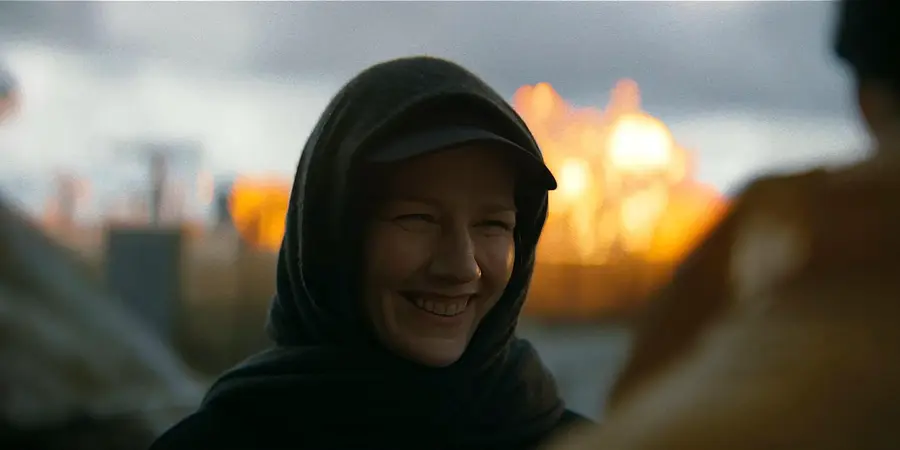

In the film, ‘Sign of the Times’—sung again by Sandra Hüller’s character—briefly breaks through Stratt’s cold exterior and becomes a passage that draws compassion upward toward others, driving her emotions to their peak. At the same time, this scene carries the message the movie ultimately wants to deliver. Stratt is a character formed in a children’s choir in East Germany. She faces the enormous changes of an era when the Berlin Wall falls and Germany is reunified. Stratt is a lone individual whose fate is upended by the current of the times—someone who likely once dreamed of a peaceful world afterward, only for that dream to be thwarted. The conflicts that follow—when people are divided by borders, race, religion, and ideology—kept recurring, and having witnessed them countless times, she shares a viewpoint akin to the narrator of ‘Sign of the Times.’ Stratt already knows that unless a fundamental solution grounded in understanding and communication is achieved, conflicts that overturn the era all over again will happen once more—yet she still refuses to let go of hope.

If you focus on the song Captain Yao sings in the film, you can learn more about Stratt’s true intentions. Just before Stratt sings, Captain Yao sings Scorpions’ ‘Wind of Change.’ Captain Yao, the narrator of ‘Wind of Change,’ and Stratt, the narrator of ‘Sign of the Times,’ are all looking at the same situation—but they hold opposing viewpoints. ‘Wind of Change,’ which became a signature song of German reunification alongside the end of the Cold War, sings about peace, but it’s also an optimistic song that affirms the very change of the times. Captain Yao embodies that same optimism too—believing that humanity’s advanced scientific technology can overcome a disaster spanning the entire universe. Yet the movie shows Yao being found in the vastness of space as a cold, lifeless body, and it does not allow the kind of impulsive optimism that claims human science alone can bring about positive change when the end is near. Stratt’s ‘Sign of the Times’ speaks of hope in despair—not by endorsing Yao’s optimistic affirmation, but by rising up through negation and choosing the light that comes after. What may have looked like Stratt’s simple farewell song is, in fact, her lonely determination not to let go of hope even before the end. In 〈Project Hail Mary〉, ‘Sign of the Times’ does not explain the enormous catastrophe in this universe-spanning disaster—where one person’s survival and another person’s sacrifice form two sides of the same coin. Instead, it tells us the trembling of humanity that can’t move an inch at the very center of it all.
![[Chua-young's Music Box] The Meta Representation of Subculture 'Cosmic Princess Kaguya!' with 'World Is Mine' and 'Reply'](https://cdn.www.cineplay.co.kr/w400/q75/article-images/2026-02-12/09350b70-b012-4e2f-a254-046f646e2d8d.jpg)
![[Choo A-young’s Music Box] After Anger, ‘Oasis: Don’t Look Back in Anger’ Sings Again](https://cdn.www.cineplay.co.kr/w400/q75/article-images/2026-09-10/323f8c2a-129f-4107-b190-114253e0c827.jpg)
![[Chua-young's Music Box] Why Did 'What If We' Resonate with Today's Youth? The Romance Fantasy of the Non-Dating Generation](https://cdn.www.cineplay.co.kr/w400/q75/article-images/2026-01-28/113b25b0-ce84-47ff-807d-5dc4657e02d2.jpg)
![[Chua-young's Music Box] The Screams of 'The Shining', the Auditory Discomfort Created by Krzysztof Penderecki's Music](https://cdn.www.cineplay.co.kr/w400/q75/article-images/2025-12-17/2667f27c-46b5-45d4-bf2d-7bf2b656ff21.jpg)
![[Chua-Young’s Music Box] Music for the Purification Ritual of Wounded Youth: “Girls Band Cry”](https://cdn.www.cineplay.co.kr/w400/q75/article-images/2026-04-22/10da8998-3cb2-462f-8af6-4063689a916d.jpg)
![[Chu Ah-young's Music Box] Michael Jackson's 'Thriller' and 'Heal the World' That Tried to Turn Dreams into Reality](https://cdn.www.cineplay.co.kr/w400/q75/article-images/2026-05-21/ffa1b48f-3611-45b6-a14a-e3e0aea5b392.jpg)
![[Chua-young's Music Box] May Madness Reign on This Land! '28 Years Later: The Bone Temple' and 'The Number of the Beast'](https://cdn.www.cineplay.co.kr/w400/q75/article-images/2026-03-11/1a6d94b0-98c1-4b3b-8f0f-dd2d9ac48c7d.jpg)


![[Chua-young's Music Box] The Music of 'Pavane' Following the Path of Love](https://cdn.www.cineplay.co.kr/w400/q75/article-images/2026-02-26/cc89ea7d-356d-492c-8168-136478d2e26d.jpg)
![[Chua-young's Music Box] The Coexistence of Sorrow and Hope 'Super Happy Forever' and 'Beyond The Sea'](https://cdn.www.cineplay.co.kr/w400/q75/article-images/2026-01-14/2315abe7-c0c7-4f3f-8774-9a2b0f578550.jpg)



![[First Reactions] 'Project Hail Mary' Cineplay Reporter Star Rating](https://cdn.www.cineplay.co.kr/w160/q75/article-images/2026-03-10/032ac75a-504b-4459-b206-530bdfdc43ba.jpg)




![[Weekend Box Office Clash] 'The Man Who Survives With the King' Hits 15 Million, Reservation-Rate Swing Reverses 'Miracle'](https://cdn.www.cineplay.co.kr/w160/q75/article-images/2026-03-26/26ebdfeb-0053-41cb-a719-2ef3a47a0379.jpg)
![[Publishing Industry Issue] Big-Screen Release Boosts… “Project Hail Mary” Becomes #1 Bestseller](https://cdn.www.cineplay.co.kr/w160/q75/article-images/2026-03-27/96aed3fd-3cf7-4b26-88c2-cb1564af4a2e.jpg)
댓글 (0)
댓글 작성
댓글을 작성하려면 로그인이 필요합니다.
로그인하기