


※ This interview with 〈Possible Love〉 actor Zo In-sung continues from Part 1 and Part 2.
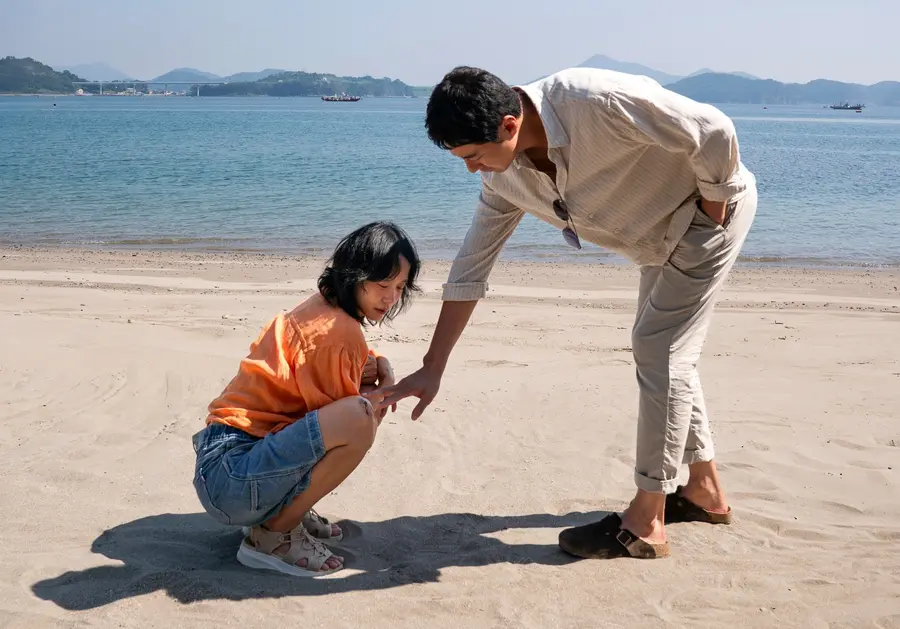
Every little gesture in this film carries tremendous meaning. There's so much to infer from scenes like the one where Sang-woo brushes dirt off Mi-ok's knee. It was fascinating to look for hidden meanings throughout the film. Were there any details you found particularly interesting as you performed?
Here's one example. Brushing off her knee is a key detail, but look at the shadow before that. A shadow falls across her face, which had been brightly lit. It's the shadow of capital coming in. A dark shadow. Then it falls halfway across her, and as the shadow moves off her knee, he brushes it off and withdraws. Capital has that darkness and sweetness in succession, together. That's what he's talking about. So acting with shadows was interesting. Sang-woo's face beyond that shadow is also the image of Mi-ok's fantasy, and Mi-ok doesn't realize that dark shadow is seeping into her. That's one way you could read it. It's fascinating. That's mise-en-scene. It leaves room for interpretation. That's one way I saw it.
You reunited with Jeon Do-yeon on a project after a long time. What was it like acting together?
What more is there to say? It was our first time working together in 23 years, since 〈Shoot for the Stars〉. They say you're bound to lose the mindset you started with. You can only remember it. Working with Do-yeon again after 23 years reminded me of mine. I remember watching her act for the first time on 〈Shoot for the Stars〉 and thinking, 'Is this really happening? How does she deliver her lines so naturally?' That still holds true today. Hearing Mi-ok's first line, I suddenly found that younger version of myself who had watched her act and felt that way. That felt wonderful. And the equalizing thing is that, like the moon in our film, everyone is equal before the director, experienced or not. That's what built our teamwork. I went back to being the young Zo In-sung and had so much fun acting with Kyung-gu and Do-yeon, and then there was (Cho) Yeo-jeong, bringing vitality to the film. So whatever else, I think our ensemble really came through. I don't think we completed our characters on our own; they were completed by our scene partners. Each individual is wonderful in their own right, but I think individual effort and the ensemble together complete a character.
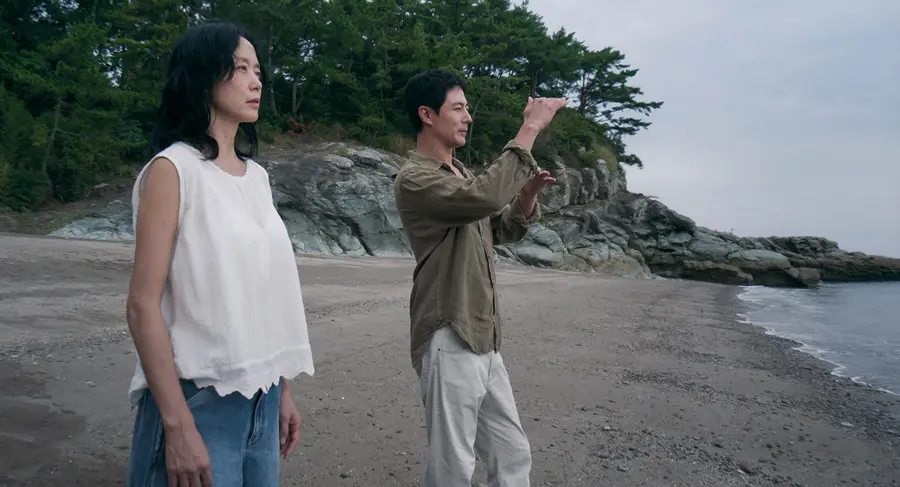
There's also a passage in the script comparing Sang-woo to “Steve Jobs.” What did you think that name meant when applied to Sang-woo?
Steve Jobs is symbolic. He's a symbol of capital, someone who seems capable of doing anything for you and seems to know everything. He's Mi-ok's image of a powerful person, her fantasy. She thinks he can save her.
How was Lee Chang-dong's set different from other sets? We've heard he didn't give the actors much specific direction. Was there anything he said that stayed with you?
You've probably heard this a lot. I'm sure Do-yeon and Yeo-jeong said the same thing. He doesn't make us uncomfortable with abstract ideas. He just lets us live on set. When he tells us not to act, it's because acting is ultimately something you show. You don't have to do that; it's fine if your lines come out awkwardly; he just wants you to feel it inside. 'As you live with these characters in this space you inhabit, hold on to the feeling you got from the writing, even if it's only in your heart. Then you don't have to express it.' I think his saying that made Sang-woo a more mysterious character. Otherwise, he would have been very clear-cut and dull, and not interesting.
Ultimately, 〈Possible Love〉 is a film that inevitably invites different interpretations depending on who's watching. You must have encountered interpretations that differed from what the director and actors intended.
Yes, the more interpretations, the better, and this is a film that can't help but generate a range of them. I think that's especially true of his work. He doesn't say, “This is what it means.” Even though he directed it a certain way, he'll say, “I can see how it might feel different, too.” For instance, Cheol takes the whistle. Some people think the caretaker, Min-sik, gave Cheol the whistle. Since that's a possible interpretation, he says, “You could see it that way.”
During your previous interview for 〈Humint〉, you said you were thinking about “acting without expressing.” I felt that idea came through well in Sang-woo in this film. Did working in Lee Chang-dong's world help resolve some of those questions?
To avoid expressing things, you need good directing and a good script. Only then can you do it. Otherwise, you have no choice but to express them. Ultimately, not expressing means trusting the screenplay. The screenplay has already laid all the groundwork, step by step. The director is a novelist, after all. As you'll know if you've seen the film, it can feel like a novel. Because it's filled with all those things, the emotional current is already moving even if you don't express it. You can't call that an individual working method. I realized that when those three elements come together, a character can develop and expand into multiple interpretations without your having to express things.
Images of you and Sul Kyung-gu shedding tears right after the Venice Film Festival screening of 〈Possible Love〉 drew a lot of attention. Sul said, “I was grateful Zo In-sung cried with me so I wasn't the only fool.” What did those tears in Venice mean?
At the end, the film holds on the moon for several minutes. Then the credits roll and the music comes in, and I got choked up. I've been to other film festivals, but I'd firmly resolved not to look like someone carried away by his own film. But when I saw Kyung-gu crying, his tears were beautiful. He was working with the director again after a long time, and so was Do-yeon, and I could feel their deep loyalty and camaraderie. My own interpretation came into it, too. That's why those tears looked beautiful to me. I'm sure he was crying partly because he loved the film, but it was also Lee Chang-dong, a director he loves, returning with his first film in eight years, and their reunion. He didn't say that, but that's how I interpreted his tears. It hit me in that instant, and I couldn't hold back my own.
Over the past few years, you've continued to take leading roles in films by directors at the forefront of commercial cinema. You also led 〈Hope〉, Na Hong-jin's long-awaited return this summer. Directors seem to have a lot they want to say through you these days. How does it feel to work on such meaningful projects one after another?
I don't know. Your attitude matters in an acting career, and so does your acting, but another factor is luck. I think all I can say is that I was lucky. Does life go according to plan? It really doesn't. Knowing that, I try to relax and always think, 'Let's see where life takes me, and make the best choices within that.' I'm grateful to all three directors I worked with this year. I don't know what they see in me that makes them trust me with these roles, but even when the work wasn't easy, I enjoyed it and learned a lot. That's the truth.
This year, you went to the Cannes Film Festival with 〈Hope〉 and the Venice Film Festival with 〈Possible Love〉. That must feel particularly meaningful as an actor.
I'd never been to festivals like those in my life. My dining experiences had amounted to people in the neighborhood buying me a meal at the end of the year and saying, “Good work this year, In-sung.” Then I was eating in Cannes, and Netflix treated me to delicious food in Venice. That's an experience in itself. For an actor, it's an opportunity. After spending all my time in Korea, I get to take my films to overseas festivals and see, 'So this is how these people work and communicate,' and, while going through the Academy Awards race, 'So this is what the culture is like here.' We might fight over a glass of soju and then make up over one, but there they have these brunch parties. (Laughs) You go to an after-party and have to make small talk, but what do you talk about with someone you've just met? My mother never taught me that. A culture of having parties at lunchtime couldn't exist in Bangi-dong. (Everyone laughs) You learn that culture. Because that's their life. You get to see various directors in person and communicate a little, meet famous actors in person and tell them, “I enjoyed your film.” And how did the journalists there see this film? With different cultures, there are bound to be differences in perspective, right? You make that kind of small talk, too. I feel like I'm learning the culture as a whole. I think the director gave us that as a gift. And because we had the director, this great mountain behind us, we could hold our heads higher there without feeling intimidated.
The word “superstar” has followed you for a long time. Where do you think you are now on your journey as an actor?
I'm not sure how far I've come. If my metacognition were good enough to know that, I'd really be a god. Being able to view yourself objectively is truly in the realm of the divine. Still, it's true that I started out as a star. My projects did well, and people loved my characters, so I became a star. But I think it's true that my focus has consistently been on acting. That's why I considered whom I worked with important. For instance, my choices were writer Noh Hee-kyung (〈That Winter, the Wind Blows〉) and director Han Jae-rim for 〈The King〉. They were somewhat adventurous choices. I keep thinking, if a project does well and an actor has something to offer, isn't that what makes a star? Then how will I be used, and how will I develop? Will I grow on my own, or get help from someone? Who should I work with at this point to fulfill my creative desires and sense of accomplishment? I'm at that crossroads of choice every moment. And there's one thing I want to make absolutely clear: There has never been a moment when I didn't give it my all. I think that's who I am today.
댓글 (0)
댓글 작성
댓글을 작성하려면 로그인이 필요합니다.
로그인하기