


Christopher Nolan’s masterpiece “Odyssey” is sending shockwaves through movie theaters worldwide. By bucking the complacent current of the modern film industry that relies on computer graphics (CG)—and even directly constructing a full-size Trojan Horse on a 10m scale—the result maximizes Nolan’s distinctive analog philosophy. This story analyzes the harrowing location shoot that “Matt Damon”—the film’s star—says was “the harshest set of my acting career,” as well as the astonishing side of this 20-year project, fueled by “IMAX” (IMAX) film reaching 640km.
![Film ‘Odyssey’ [Provided by Universal Pictures. No redistribution or database use]](https://cdn.www.cineplay.co.kr/w900/q75/article-images/2026-08-10/17bcfaee-4409-4e2d-a479-789845063c1d.jpg)
The essence of a story set in motion by a 20-year longing—and one companion dog
According to distributor Universal Pictures, “Odyssey” is an ambitious project Nolan has nurtured for more than 20 years. In the early 2000s, right after directing “Insomnia” (2002), he began planting the seeds of an ancient saga by getting involved in the production of “Troy” (2004). The drive to bring Homer’s “Odyssey” to the screen finally became reality after the mega hit of Nolan’s previous work, “Oppenheimer” (2023).
![Director Christopher Nolan [Yonhap News photo]](https://cdn.www.cineplay.co.kr/w900/q75/article-images/2026-08-10/1b973377-06d4-4a7e-9ba0-659c61979af8.jpg)
The unexpected muse that birthed the “ultimate dog movie”
Interestingly, at the foundation of this vast epic sits Nolan’s “companion dog”. Together with his producer and wife, “Emma Thomas”, he raised a dog—and became deeply captivated by the blind waiting of “Argos”, a loyal companion who waited for his owner for 20 years within the story. The presence of Argos adds a surge of emotion to the protagonist Odysseus’s brutal homecoming—and became a decisive factor behind Nolan’s own decision to label the work “the ultimate dog movie.”
![Filming site for the film ‘Odyssey’ [Provided by Universal Pictures. No redistribution or database use]](https://cdn.www.cineplay.co.kr/w900/q75/article-images/2026-08-10/e6b0c5e9-e6a6-4800-b8cc-30108fe66960.jpg)
History’s first 100% IMAX shoot—and the weight of film that goes beyond Seoul and Busan
Nolan’s obsession with “IMAX” (IMAX), a drive that began with “The Dark Knight” (2008), reaches an unprecedented level with this film. In a first for film history, he managed the feat of shooting the entire movie with “IMAX film”. Noise problems from the heavy cameras were controlled with a soundproof case called the “blimp system”, and the drawback of making an actor’s gaze feel awkward was perfectly offset with specialized corrective mirrors. For this aesthetic stubbornness, the total length of film consumed comes to about 640km. It’s an overwhelming amount that easily surpasses the distance from Seoul to Busan.
![A scene from inside the film ‘Odyssey’ [Provided by Universal Pictures. No redistribution or database use]](https://cdn.www.cineplay.co.kr/w900/q75/article-images/2026-08-10/061c4871-3189-4782-a2ae-83f0ca8b1ff4.jpg)
A 10m Trojan Horse and an 18m one-eyed monster—analog realism that overwhelms CGI
In an age dominated by digital technology, Nolan’s “physical model” rule forms the backbone of “Odyssey”. The “Trojan Horse”, a symbol of the fall of Troy, was built as a massive real object standing 10.7m tall and weighing 3t. The performers, led by “Matt Damon”, completed nail-biting infiltration scenes by hiding inside the actual horse rather than acting in a fictional set.
The mythological creature “Cyclops” was also built as a colossal mechanical doll on an 18m scale. The combination of “Bill Irwin”’s precise motion performance, who previously played TARS in “Interstellar” (2014), breathes uncanny life into it. The battle scenes against the giant race showcase the essence of analog action: stunt actors with different heights were deployed, and the film crafts classic perspective.
![A scene from the film ‘Odyssey’ [Provided by Universal Pictures. No redistribution or database use]](https://cdn.www.cineplay.co.kr/w900/q75/article-images/2026-08-10/38f20752-2900-40ce-9d16-9581a4ab6a85.jpg)
Across 6 countries on location and in a 91-day grind, the crew fires off a box-office legend of 1.3 trillion won
The film’s spectacle comes from “real locations” spanning the globe. For a sea scene, they built a ship using ancient methods and set it afloat in the water. On a 10,000㎡ site in Morocco, they constructed a massive Trojan fortress made up of more than 60 structures. On the Italian island of Favignana—serving as the backdrop for Ithaca—an extreme schedule followed each day, involving constant trips up and down sheer cliffs at an elevation of 313m.
The crew’s journey cutting across six countries over 91 days—Morocco, Italy, Iceland and Greece—runs parallel to Odysseus’s ordeal. That painstaking craftsmanship translated directly into box-office results. After opening in North America, the film surpassed $939 million in global revenue (about 1.3 trillion won). In South Korea as well, it drew 1 million viewers in just four days at local theaters, sparking an overwhelming “box-office surge”.


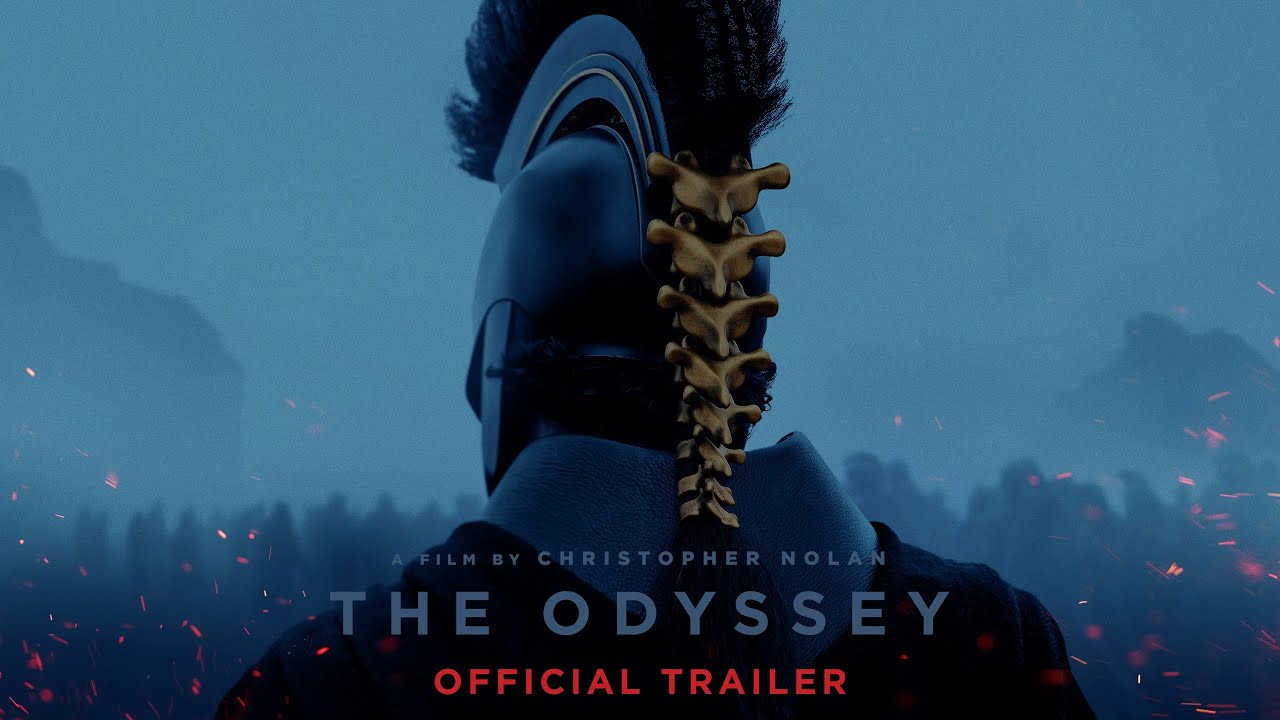

![[Photo &] Christopher Nolan’s New Film, “Odyssey,” Shot Entirely in IMAX for the First Time Ever—Releases on Aug. 5](https://cdn.www.cineplay.co.kr/w160/q75/article-images/2026-07-24/873d94e4-89dc-4fb8-803c-f6e144aaccfa.jpg)


![[Photo &] Christopher Nolan Makes His First Trip to Korea With New Film “Odyssey”… “I Fell in Love With Korean Salt Bread and Baseball” — Press Event With Charlize Theron and Matt Damon](https://cdn.www.cineplay.co.kr/w160/q75/article-images/2026-08-03/b4e65c19-e829-4b55-8d58-55cf5618d3e1.jpg)

댓글 (0)
댓글 작성
댓글을 작성하려면 로그인이 필요합니다.
로그인하기