


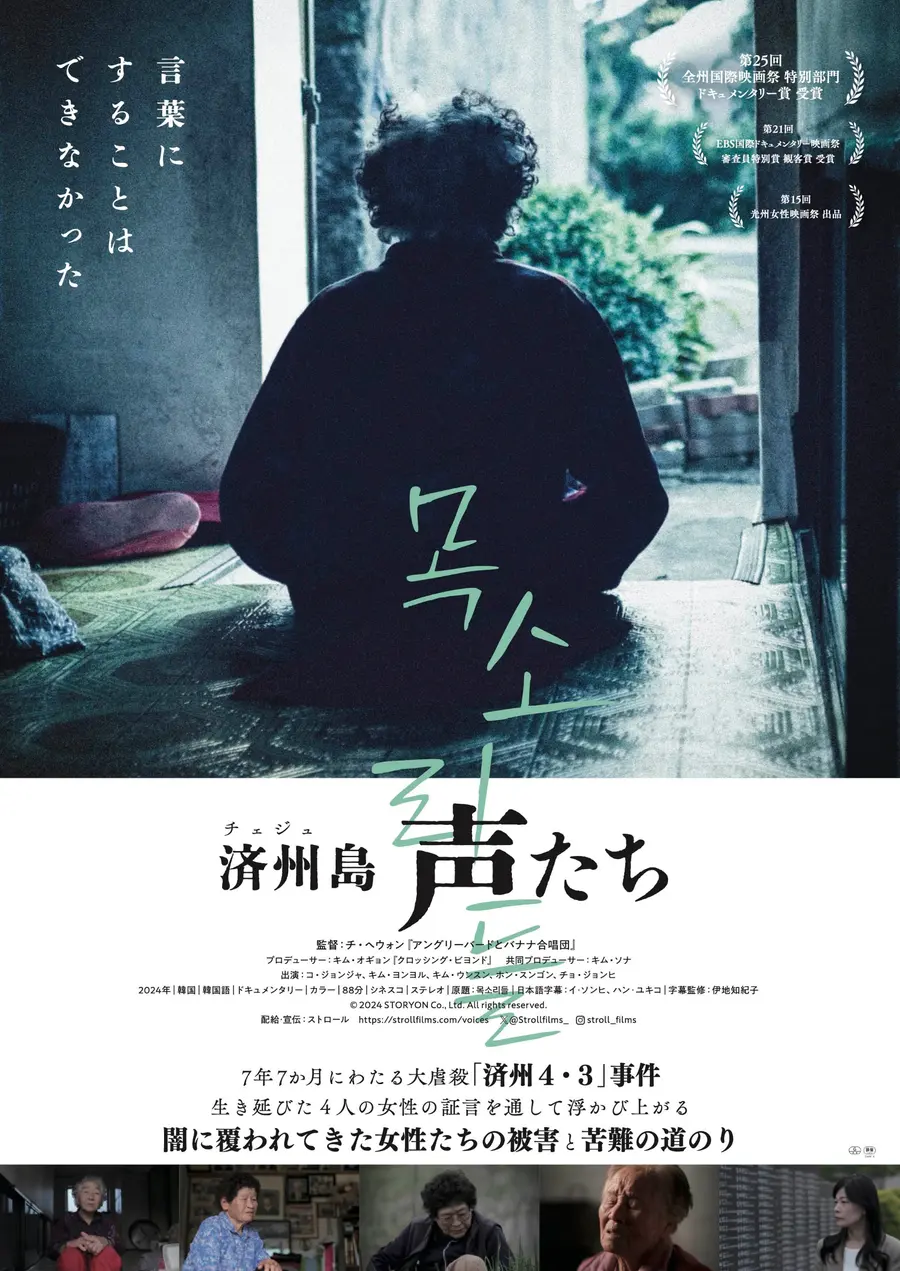
Oral histories of four women who broke their silence reveal a tragedy that crosses borders
The pain of Jeju 4·3, concealed in the shadows of history for more than half a century, is brought to life through women’s perspectives in the documentary ‘Voices.’ The Jeju 4·3 Peace Foundation announced that ‘Voices,’ directed by Jihye Won, will open simultaneously in three major Japanese cities—Osaka, Tokyo and Kyoto—on the 7th.
Completed with production support from the Jeju 4·3 Peace Foundation, ‘Voices’ is a compelling record of the firsthand testimony of four women survivors who endured years of brutality. It sensitively tells the stories of women who rebuilt their lives even after state violence tore apart their communities and families. The film’s artistic merit was recognized with the Documentary Award at the ‘25th JEONJU International Film Festival’ in 2024. It went on to win both the Special Jury Prize and the Audience Award at the 21st EBS International Documentary Film Festival, earning strong support from critics and audiences alike.
To coincide with the Japanese release, the film will also be the focus of academic and cultural exchanges exploring the historical questions it raises. Three ‘special talks’ will be held over two days, on the 14th and 15th, in Osaka and Kyoto under the overarching theme ‘Jeju 4·3 and Women: A Path of Hardship.’
The tour opens at 3 p.m. on the 14th at the Korean Christian Center in Japan (KCC Hall) in Osaka. On the 15th, discussions will follow screenings in a question-and-answer format at Osaka’s Seventh Art Theater at 1:30 p.m. and at Demachiza in Kyoto at 4:35 p.m.
Leading authorities on oral histories of women and 4·3 will speak at the talks. Poet Heo Young-sun, former director of the Jeju 4·3 Research Institute, who led the planning and publication of the five-volume series 4·3 and Women, and Cho Jeong-hee, a member of the series’ writing committee and a team leader at the ‘Jeju 4·3 Peace Foundation,’ who appears in the film, will join the panel. Noriko Izichi, a professor at Osaka Metropolitan University who oversaw the Japanese subtitles and academic commentary for the film, will moderate, fostering historical understanding between the two countries.
The speakers plan to share behind-the-scenes stories from documenting the everyday lives of women in 4·3 and Women, insights into the making of the film, and survivors’ vivid memories and scars that could not all fit into its running time. They will focus in particular on the multiple forms of violence inflicted amid extreme terror, the resulting trauma, and the weight of the social silence survivors carried for half a century after the war.
At the first talk on the 14th, a video about the life of the late Jin A-young will be screened. She lost her jaw in a punitive force’s gunfire and had to live with her face covered by a cotton cloth for the rest of her life. The screening will be accompanied by Heo’s reading of a poem dedicated to her, bringing the historical tragedy to life through art. Heo has written numerous collections of oral histories, including To You Who Ask About Jeju 4·3. Her signature poetry collection, Haenyeo, has also been translated and published in Japan. Joining her, Cho is an expert in practical historical investigations who previously served as a specialist investigator for the Jeju 4·3 Committee and the Truth and Reconciliation Commission, and led the publication of official investigation reports.
The event is hosted by the Liaison Council of Japan-based Organizations Related to Jeju 4·3, with the Association of Bereaved Families of Jeju 4·3 Victims in Japan, the Osaka group Thinking About Jeju 4·3, the Executive Committee for the Memorial Service for Jeju 4·3 Victims in Japan, and the Center for East Asian Media Studies at Hokkaido University’s Graduate School of International Media, Communication, and Tourism Studies serving as co-organizers.
Oh Kwang-hyun, president of the Association of Bereaved Families of Jeju 4·3 Victims in Japan, said, “These screenings and talks will give first-, second- and third-generation Jeju residents in Japan who left their homeland an opportunity to reflect on the pain of history, and will mark a major turning point in spreading the universal human rights values of 4·3 through Japanese civil society.” He emphasized that the event “is especially significant as a landmark effort to bring into the light the suffering and existential pain of women who have long been marginalized.”



댓글 (0)
댓글 작성
댓글을 작성하려면 로그인이 필요합니다.
로그인하기