


※ 〈The Assassins〉 review continues from Part 1. This article contains spoilers for the film.
The Moment He Stops the Taxi
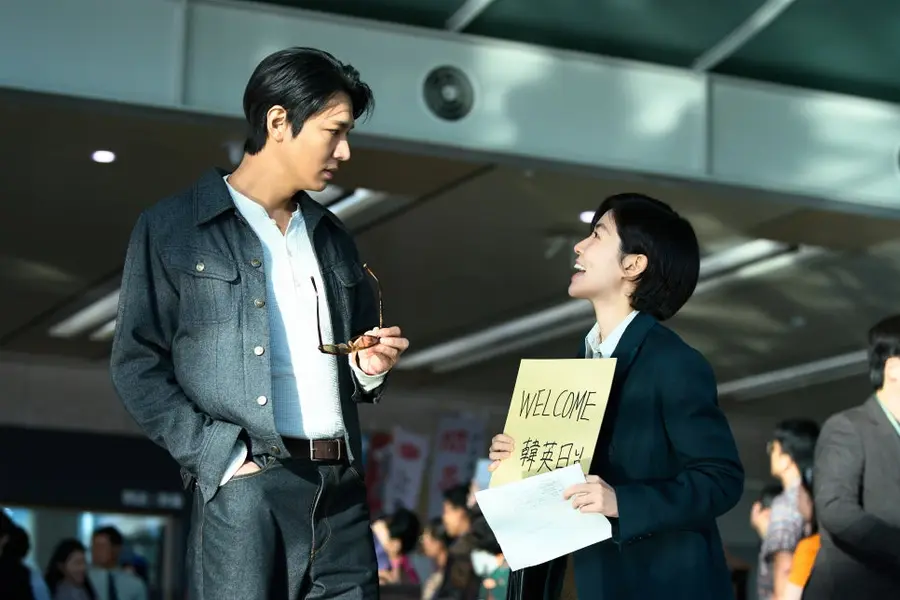
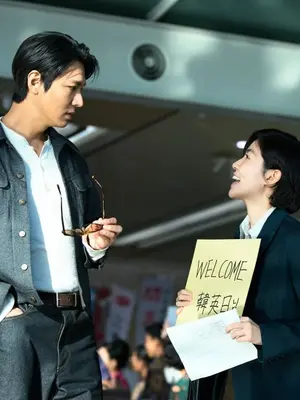
The person who greets Young-il in Tokyo is Lee Kang-ja, a Korean resident of Japan who works for the Far East Group's Japanese branch. Young-il initially finds her bothersome, but soon relies on her interpreting as he continues his reporting. He travels with Lee Kang-ja to Osaka, where she tells him she will say she is “shopping at Isetan” to her eldest brother. There, they follow the trail of Moon Tae-kwang and finally discover that Moon was not alone from the beginning.
Maeda was the man who approached him with ease, offering generous sums of money, kindness, words of recognition and a new ideology. He promised to take care of everything even after they went to Korea, and in Seoul he bought two pairs of high-end shoes in Myeongdong and shared them with Moon. For Moon Tae-kwang, who had been drawn to radical ideas because “the blood runs hot, but reality is cold” while making a living as a day laborer, Maeda must have offered the illusion of a new life and the chance to accomplish something great. A photograph remains of the two men standing side by side, smiling warmly. It was kindness, more than threats, that turned a lonely young man into a terrorist.
Young-il, who holds the truth, is attacked by the Korean Central Intelligence Agency. Lee Kang-ja's final phone call gives him a chance to escape to the airport, but the moment he sees her being loaded into a van, he stops a taxi. He turns his back on the escape route secured by privilege and throws his whole body against the van. Even with his right hand broken, he protects her to the end. Young-il has pursued the truth while enjoying every privilege imaginable, but for the first time, in a place where what he possesses is of no use, he pays the price with his body. He arrives, his hand broken, at the place where he must bear the weight of state violence with his body—the very spot where Jae-hwan was first thrown from the truck.
The Place Where He Loses His Hand
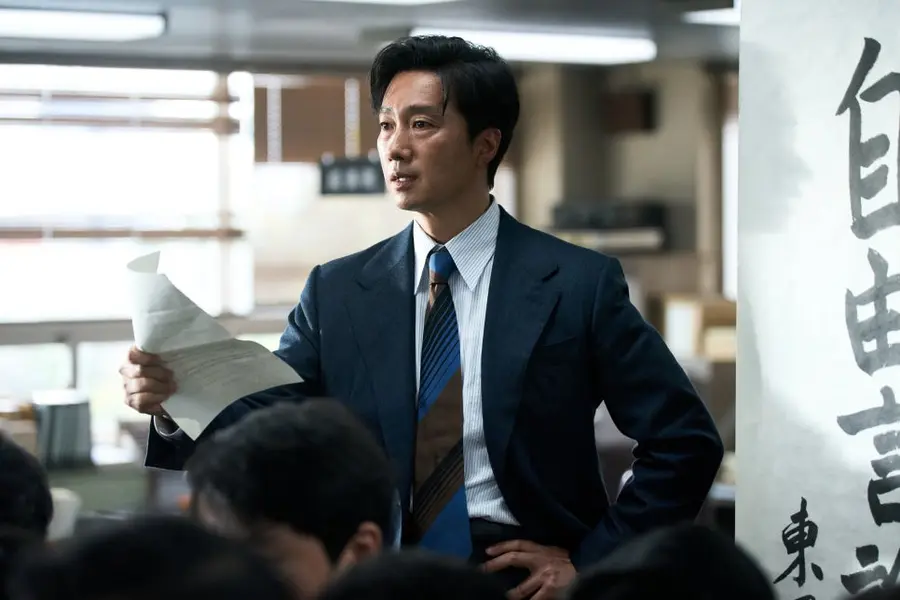
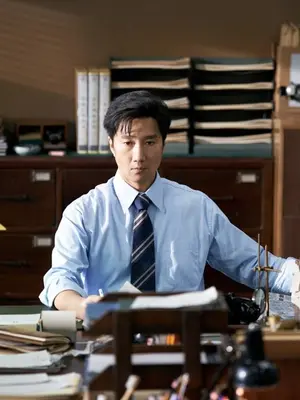
Young-il badly injures his right hand and can no longer type or quickly write across his notebook with a fountain pen. Power may have believed that breaking the hand that records events or destroying the typewriter would bring the record itself to a halt. But after losing the use of his right hand, Young-il builds barricades on the front line of the final struggle, doing everything he can with his body. In the chaos, as shoe heels and clubs fly, he climbs onto a desk and keeps pressing the camera's shutter with his hand in a cast.
“Declaration of Commitment to Freedom of the Press”
The sentence Jae-hwan writes becomes a declaration, and Young-il enacts that sentence with his body. A pen beside a typewriter ruined by sand, and a body stepping forward in place of a broken hand. The moment recording and action meet, a declaration is complete. That is how the hot hearts of those pursuing the truth come together. Jae-hwan, who reads the declaration to the end even as police boots trample him, is loaded onto the truck again and taken away. This time, his eyes are covered with a bloodstained bandage, and Chul-gu is beside him. The man holding a pen and the man who once pressed his uniform are taken away in the same truck. All they can see is a sliver of light leaking through gaps in the netting. The truth cannot be seen in its entirety, and there is no way to know the road ahead. But the net has openings, and light enters through them. Is asking questions not the act of refusing to be trapped in the web of explanations that power has woven so tightly, and of staring to the end at what comes through its gaps?
15 Years Later
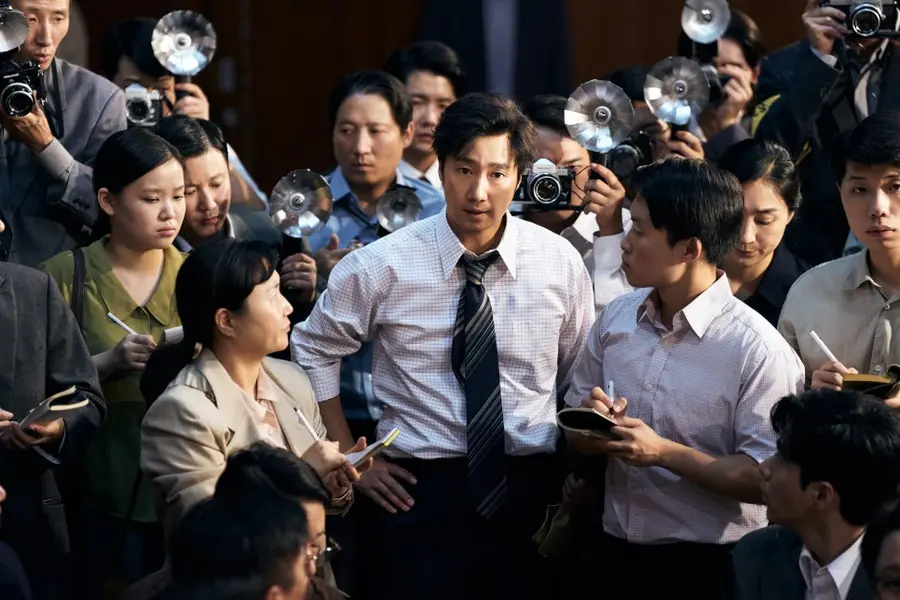
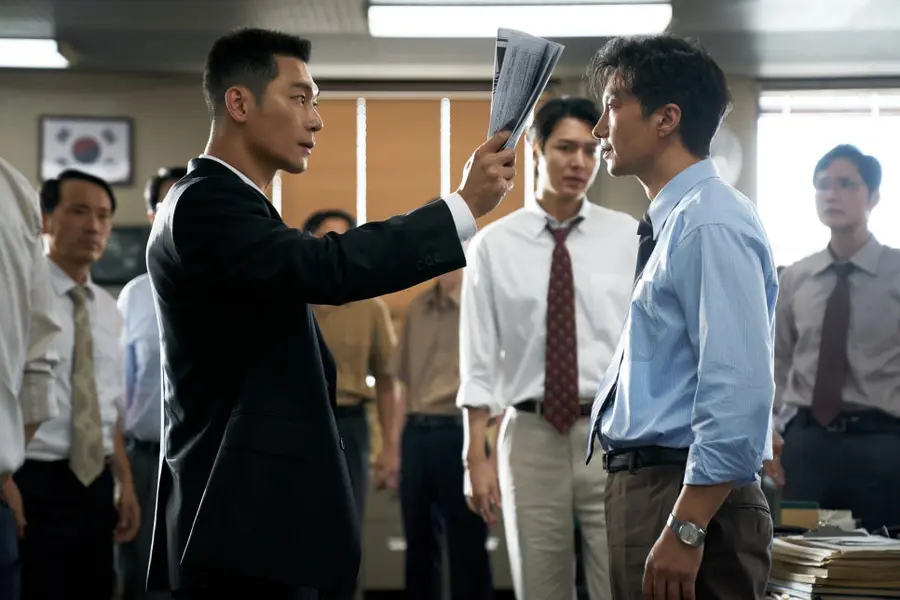
The film jumps ahead to 1989. A hearing is being broadcast live on television, and the head of the forensic team that handled the scene examination in 1974 takes the stand. He speaks about the bullet that pierced the first lady, holding out photographs he took at the scene but was never able to show the public. His hand trembles as he pushes up his glasses, and the head of the 1974 investigative headquarters shouts that he is a communist. If a red pen in the conference room erased a headline 15 years earlier, now a red stigma tries to erase the witness.
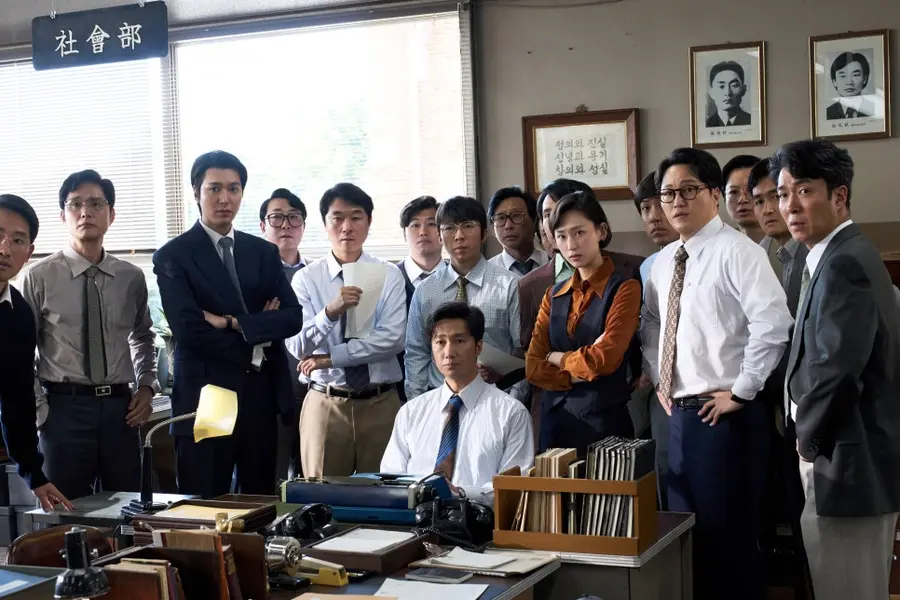
Jae-hwan watches the hearing. Young-il is beside him. The sign hanging from the newsroom ceiling has changed from the Chinese characters “社會部” to the Korean script “social affairs desk,” and their colleagues have grown older, little by little. The changed setting suggests they may have moved to a new newspaper, one that was the first to adopt the Korean alphabet and horizontal writing. The film does not explain. One thing is clear: They still exist as journalists.
At the same time, Chul-gu watches the same hearing from an apartment security office. He never returned to the police force. He had demanded the truth from Moon Tae-kwang to the end in a neatly pressed uniform, and had listened as the head of the forensic team quietly explained his findings, almost in a whisper, inside the red darkroom. Now he watches on a small screen in the security office as the truth of that day is finally spoken. The film does not conceal this asymmetry. The late emergence of the truth does not mean everyone who paid a price for it gets to return to their former place.
What Persistence Proves
〈The Assassins〉 is not a film that always hides what it wants to say behind metaphor. At times, its emotional tone clashes with the gravity of the drama, and its characters articulate their convictions too clearly. But I do not want to regard that merely as a flaw. In some eras, saying the obvious is itself an act.
Pursuing the truth requires a hot heart. But the heat this film shows is different from a passion that flares easily. It means reporting again after being thrown down a muddy slope. Picking up a pen to write when the typewriter stops. Stepping forward with one's whole body even after one's hand is broken. Pressing one's uniform and asking questions even after being dismissed. And holding on to photographs that could not be shown to the world for 15 years.
The heat of those who pursue the truth is proved not by its temperature but by its persistence. The epilogue of 〈The Assassins〉 proves that sentence. There is no guarantee that asking for and demanding the truth will be properly rewarded. They are loaded onto trucks, their hands are broken and they lose their uniforms. Still, they keep asking to the end. Their actions cannot be explained through a calculation of gains and losses. None of the three is a born fighter or a revolutionary seized by a grand ideology. They are simply people who remain faithful to the ethics of their professions to the very end.
In The Rebel, Camus locates the beginning of rebellion not in a grand ideology but in the boundary within a person that says: This is as far as you can go. When someone who has followed orders all his life says “no” at a certain moment, that refusal also becomes an affirmation that something inside him must not be trampled. The resistance of Jae-hwan, Chul-gu and Young-il is the same. They endure and endure, then stop before a line they cannot cross. In the film's rapid pace, it is easy to miss the moments when that small inner fracture begins. The score does not. Electric guitar and bassoon, flute and piano quietly push the characters at the instant their hearts begin to tilt from one side to the other, rather than explaining their emotions for them.
No one whispered to them that they should become great or advance toward the truth to the very end. The person seduced by that whisper was Moon Tae-kwang, the man holding the gun. The money, kindness and grand ideology Maeda offered turn a lonely man hungry for recognition and human connection into a tool in a script written by someone else. His body speaks that truth first. Throughout the latter half of the film, Moon Tae-kwang walks with a loose, empty gait, his eyes unfocused. He does not react even when Chul-gu cries out for him to tell the truth. There is only one moment when he comes alive: when he spots Maeda after all the verdicts have been handed down. His vacant eyes sparkle, and he finally returns like a living person. Eyes that did not respond to voices demanding the truth shine only before the face of the man who approached him under another name and handed him the role of hero in a great cause. It is the film's most chilling scene.
With its unusually frequent close-ups of hands, 〈The Assassins〉 places two kinds of action side by side: hands moved by greatness injected from outside, and hands that begin moving on their own because of a small inner fracture. The declaration is born from the latter hands, through a pen that gathers “hot hearts.” The truth the film pursues to the end is less a fixed conclusion than an attitude a person adopts—a posture of choice. Grand convictions are not given to everyone, but everyone retains the ability to choose what stance to take in a given moment.
Director Heo Jin-ho does not claim to have perfectly reconstructed the truth of the assassination. The film repeatedly makes clear that it is a fact-based fiction, exposing the boundary between the historical record and cinematic imagination. That is precisely why it does something more honest. It returns questions blurred by history to us in the form of questions once again.
At the 1974 investigative headquarters news conference, Jae-hwan finally shouts something he can no longer contain: “If we do not reveal it now...” The film deliberately leaves the rest of the sentence unspoken. It simply repeats the phrase twice. If we do not reveal it now, it becomes fact as it stands. Today's distortion becomes tomorrow's newspaper story, then an official record, and, after enough time passes, history. It took 15 years. Because the question did not disappear in the meantime, the things that could not be said and could not be revealed were able to return on a live broadcast. 〈The Assassins〉 asks us one final question: If we do not reveal it now, when will we?






댓글 (0)
댓글 작성
댓글을 작성하려면 로그인이 필요합니다.
로그인하기